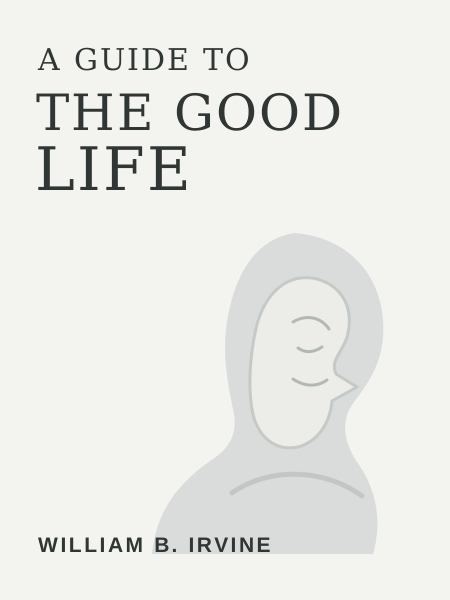
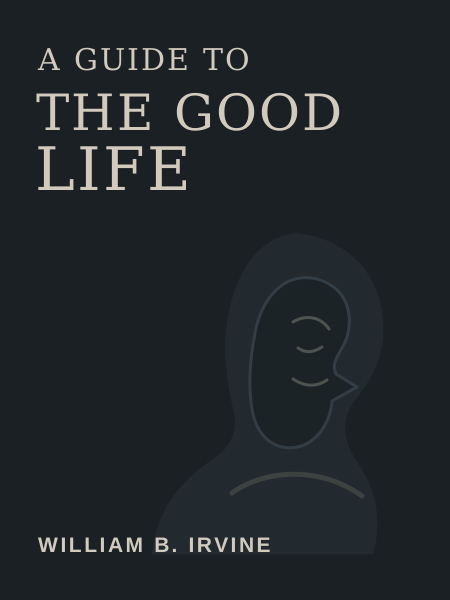
A Guide to the Good Life
William B. Irvine · 2008
Editorial rating
- Evidence
- 7/10
- Actionability
- 9/10
- Originality
- 7/10
The thesis
Modern life breeds chronic dissatisfaction because we lack a philosophy of life - a coherent framework for deciding what's worth pursuing. Stoicism provides that framework by teaching tranquility through controlling what you can, accepting what you can't, and deliberately practicing techniques to break hedonic adaptation.
Who this is for
Professionals feeling perpetually unsatisfied despite external success, anyone caught in the hedonic treadmill of "just one more" (promotion, purchase, vacation), and readers seeking a secular, practical philosophy of life without religious overtones.
My favorite quote
We need, in other words, to learn how to enjoy things without feeling entitled to them and without clinging to them.
Why it matters
This captures the Stoic sweet spot - engagement without attachment. You can enjoy relationships, possessions, and experiences while knowing they're impermanent.
Do this
Today, pick one thing you take for granted (your car, your coffee, your partner). Imagine losing it. Notice how your appreciation changes.
Start here
Practice Negative Visualization daily: spend 60 seconds imagining the loss of something you value (your health, a relationship, your job). This isn't pessimism - it's hedonic adaptation prevention. By mentally rehearsing loss, you appreciate what you have now and prepare emotionally for inevitable change. Do it every morning for a week and watch how gratitude replaces entitlement.
Critical summary
Irvine, a philosophy professor, resurrects Stoicism as a practical life philosophy for modern skeptics who find self-help shallow and religion unappealing. His approach is pragmatic: Stoicism as "psychological technology" for achieving tranquility (absence of negative emotions, presence of joy).
The core framework is the trichotomy of control: (1) things you control completely (your opinions, goals, values), (2) things you don't control at all (weather, others' opinions, the past), and (3) things you partially control (outcomes dependent on both your effort and external factors). Stoic practice means internalizing goals - focusing on what you can control - and accepting everything else.
The book's structure is methodical: Part 1 covers Stoic history, Part 2 details psychological techniques (negative visualization, voluntary discomfort, self-denial), Part 3 applies Stoicism to specific life domains (insults, grief, anger, fame, old age, death), and Part 4 addresses modern objections.
What it gets right
- Extremely practical: every chapter includes exercises you can start today
- Accessible to non-philosophers: jargon-free, conversational tone, modern examples
- Addresses objections head-on (Isn't this pessimistic? Doesn't this kill ambition?)
- Voluntary discomfort exercises are powerful: cold showers, periodic fasting, sleeping on floors - small doses of controlled hardship build resilience
What it misses
- Assumes readers have margin for contemplative practices (assumes leisure, stability, basic needs met)
- "Just change your goals" can feel victim-blaming for people facing structural barriers
- Irvine's personal anecdotes sometimes feel privileged (professor with tenure has time for philosophical reflection)
- Minimizes the difficulty of implementing these techniques under real duress
CRITICAL PROBLEMS
The book occasionally treats Stoicism as a complete life philosophy when it's really a coping strategy for a specific type of person (educated, middle-class, with autonomy over their life). Someone working three jobs to survive doesn't have bandwidth for negative visualization exercises. The advice "focus only on what you control" can enable passivity when systemic change is possible and necessary.
Evidence quality is mixed: the techniques work (backed by modern psychology research on hedonic adaptation, gratitude, and cognitive reframing) but Irvine's claim that Stoicism leads to "tranquility and joy" is harder to measure. We have his personal testimony and historical examples, but no controlled studies.
The "internalize your goals" advice can backfire: if your goal is "to play well" not "to win," you might underperform. External goals often drive peak performance, even if they risk disappointment.
Key concepts
Negative Visualization
Regularly imagine losing what you value to appreciate it now and prepare for loss. Prevents hedonic adaptation. Practice daily.
Voluntary Discomfort
Periodically choose mild hardship (cold showers, skipping meals, uncomfortable clothes) to build resilience and appreciate comfort. Seneca's "practice poverty."
Trichotomy of Control
Categorize every concern as fully controllable (your reactions), partially controllable (outcomes you influence), or uncontrollable (externals). Act accordingly.
Hedonic Adaptation
The psychological tendency to return to baseline happiness after positive changes. Stoicism fights this through negative visualization and gratitude.
Internalizing Goals
Set goals based on effort, not outcomes. "Play my best" not "win the game." Reduces disappointment and anxiety.
Self-Denial
Consciously abstaining from available pleasures to strengthen willpower and avoid becoming enslaved by desires. Key to freedom.
Core insights
-
Tranquility comes from wanting what you have
The hedonic treadmill keeps you perpetually unsatisfied. Stoicism breaks the cycle by training you to appreciate present circumstances rather than always seeking more.
-
Fear of loss steals present joy
If you're terrified of losing what you have, you can't enjoy it. Negative visualization paradoxically increases enjoyment by acknowledging impermanence.
-
Voluntary discomfort is vaccinate against involuntary discomfort
When hardship inevitably strikes (illness, job loss, grief), you're less devastated if you've practiced controlled doses. Resilience is trainable.
-
Insults only hurt if you value the insulter's opinion
Epictetus taught that insults are information about the insulter, not you. If a dog barks at you, do you care? Apply the same logic to human critics.
-
Social fatalism frees you from anger
Assume people are fated to behave as they do (they can't help being themselves). You wouldn't rage at rain for being wet; don't rage at difficult people for being difficult.
Implementation steps
Today
- Practice negative visualization: pick 3 things you take for granted, imagine losing each for 30 seconds
- When someone annoys you today, pause and think: "They're fated to be this way. Can I be annoyed at a dog for barking?"
This week
- Try one voluntary discomfort exercise: cold shower, skip one meal, sleep without a pillow
- Before bed each night, review the day using Seneca's evening meditation: What went wrong? How could I have responded better?
This month
- Start internalizing goals in one area: "give my best presentation" not "get the promotion"
- Practice handling insults using the sting-elimination strategy: pause, consider if it's true, consider the source
Ongoing
- Make negative visualization a morning ritual: 2 minutes imagining loss before starting your day
- Build a Stoic reading habit: one ancient Stoic text per quarter (Meditations, Discourses, Letters)
Suggested 30-day practice plan
An editorial application plan created by Monolithic Vault - an interpretation of the book's ideas, not part of the original book.
- Day 1
Read Part 2 on psychological techniques. Try negative visualization for 60 seconds.
- Day 2
Practice the trichotomy of control: list today's concerns as controllable/partially controllable/uncontrollable
- Day 3
Try voluntary discomfort: take a cold shower or skip dessert
- Day 7
Start evening meditation routine: review the day's events Stoically before bed
- Day 14
Implement one internalized goal in your work or personal life
- Day 21
Test insult immunity: next time criticized, use sting-elimination (consider if true, consider source)
- Day 30
Review progress. Which technique helped most? Commit to one permanent practice.
Free PDF summary
Take this analysis with you: a designed two-page field-notes sheet with the thesis, my favorite quote, the key concepts and core insights, and the full 30-day checklist. Print it or keep it - free, no signup.
Go deeper
If this analysis earned your attention, the full book goes further than any summary can. The original is always the primary source.