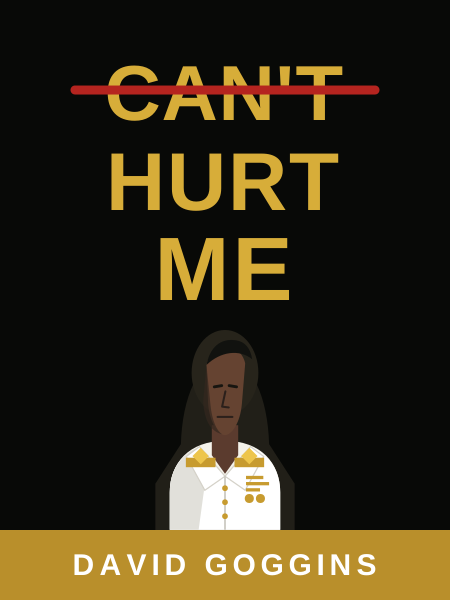
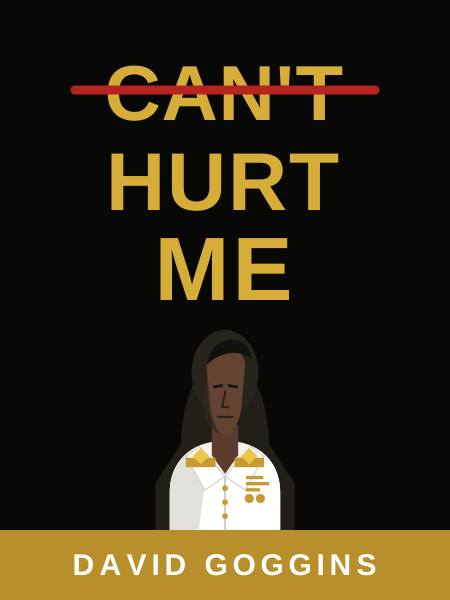
Can't Hurt Me
David Goggins · 2018
Editorial rating
- Evidence
- 3/10
- Actionability
- 8/10
- Originality
- 7/10
The thesis
You are capable of far more than you believe. When your mind says you're done, you're actually only at 40% of your capacity. Mental toughness is built through deliberate exposure to discomfort - callousing the mind the way physical labor callouses hands.
Who this is for
People who know they're capable of more but keep quitting, athletes and professionals hitting plateaus, and anyone who suspects their limits are more mental than physical.
My favorite quote
The only way to move from a life of misery to a life of meaning is to find the courage to face your darkest hours and embrace them, not run from them.
Why it matters
Goggins' entire philosophy centers on running toward discomfort rather than avoiding it. The growth is in the struggle.
Do this
Identify one thing you've been avoiding because it's uncomfortable. Schedule it for this week.
Start here
Build a Cookie Jar: Write down 10+ past victories - times you overcame difficulty, pushed through pain, achieved something hard. When you're suffering in a current challenge, mentally reach into the jar and draw strength from evidence that you've done hard things before. Your past is proof of your capability.
Critical summary
Goggins, a former Navy SEAL and ultramarathon runner, delivers an autobiography-as-self-help manual. His story - from abused child and 300-pound exterminator to elite military operator and endurance athlete - is genuinely extraordinary.
What it gets right
- The accountability mirror concept is immediately usable: brutal honesty about your current state
- The Cookie Jar technique provides practical mental ammunition for hard moments
- Goggins models extreme ownership: no excuses, no victimhood despite legitimate trauma
- The 40% Rule, while not scientific, is useful for recalibrating perceived limits
- Each chapter includes specific challenges to implement - not just concepts
What it misses or overstates
- The 40% Rule has no scientific basis - it's a motivational metaphor, not physiology
- Extreme approaches risk injury, burnout, and unsustainable practices
- His story is survivorship bias incarnate - many who push this hard break, not breakthrough
- Not all problems yield to "just push harder" - some require smarter strategy
- Little acknowledgment of mental health complexities or when to rest
- The "never quit" ethos can become toxic in wrong contexts
Evidence quality: Zero. This is memoir and personal philosophy, not research. Goggins is not a scientist; he's an exceptionally driven individual sharing what worked for him. His accomplishments are verified fact, but his methods are anecdotal. The question isn't "Is this true?" but "Is this useful for me?"
Key concepts
The 40% Rule
When you think you're maxed out, you've only used 40% of your capacity. Your brain quits before your body needs to.
Callousing the Mind
Like physical callouses protect hands, mental callouses are built through repeated exposure to discomfort.
The Accountability Mirror
Brutal, honest self-assessment. Write your weaknesses on Post-its and face them daily.
The Cookie Jar
A mental reservoir of past victories to draw on when current challenges feel overwhelming.
Taking Souls
In competition, pushing so hard that your opponent's spirit breaks - they see you won't quit.
The Governor
The mental mechanism that shuts you down to protect you. Learn to override it.
Core insights
-
Suffering is the crucible
Every hard thing Goggins survived became fuel for the next challenge. Your past struggles are assets, not liabilities.
-
Motivation follows action
Don't wait to feel motivated. Start the hard thing; motivation comes from momentum.
-
Your internal dialogue matters
How you talk to yourself during struggle determines whether you break through or break down.
-
Embrace the "suck"
The misery of training or hardship is the point, not something to minimize. It's where growth happens.
-
The uncommon among uncommon
Excellence isn't enough. In competitive fields, you must outwork people who are already exceptional.
Implementation steps
Today
- Create your Accountability Mirror: Write 3-5 brutal truths about your current situation on Post-its
- Build your initial Cookie Jar: List 5 times you pushed through difficulty
This week
- Do something physically uncomfortable every day (cold shower, extra workout, skip a comfort)
- When you want to quit something, push 10% further before stopping
This month
- Set one "impossible" goal that scares you; create a training plan
- Conduct an "After Action Review" of your last failure: What really happened? What can you control?
Ongoing
- Expand the Cookie Jar continuously - add each new victory
- When hitting walls, ask "What would Goggins do?" (Push through, find another way, or reframe)
Suggested 30-day practice plan
An editorial application plan created by Monolithic Vault - an interpretation of the book's ideas, not part of the original book.
- Day 1
Set up your Accountability Mirror; write your current honest assessment
- Day 2
List 10 past victories for your Cookie Jar (big or small - they all count)
- Day 3
Complete one task you've been avoiding because it's uncomfortable
- Day 7
Test the 40% Rule: When exercise feels done, push 10 more minutes
- Day 14
Review your Post-its - which truths have you addressed? Update with new ones
- Day 21
Schedule your "impossible" goal challenge; commit publicly
- Day 30
Reach into the Cookie Jar during a hard moment; note whether it helps
Free PDF summary
Take this analysis with you: a designed two-page field-notes sheet with the thesis, my favorite quote, the key concepts and core insights, and the full 30-day checklist. Print it or keep it - free, no signup.
Go deeper
If this analysis earned your attention, the full book goes further than any summary can. The original is always the primary source.