Antifragile
Nassim Nicholas Taleb · 2012
Editorial rating
- Evidence
- 6/10
- Actionability
- 6/10
- Originality
- 9/10
The thesis
The opposite of fragile isn't robust - it's "antifragile," something that gains from disorder, stress, and volatility. Most modern systems are fragile because we've optimized for efficiency over resilience. Build systems, careers, and lives that benefit from randomness rather than being destroyed by it.
Who this is for
Entrepreneurs building businesses that could face unexpected shocks, investors managing risk, and anyone designing systems (organizations, careers, health regimens) who wants to benefit from volatility rather than be crushed by it.
My favorite quote
Wind extinguishes a candle and energizes fire. Likewise with randomness, uncertainty, chaos: you want to use them, not hide from them.
Why it matters
We instinctively try to eliminate volatility, but the right response is to position yourself to gain from it.
Do this
Identify one area where you're fragile (dependent on things staying the same) and add optionality.
Start here
Use the Barbell Strategy: combine extreme safety with extreme risk, avoiding the middle. Put 90% of resources in ultra-safe positions (cash, stable income, resilient systems) and 10% in highly speculative bets with unlimited upside. This makes you antifragile - you can't lose more than 10%, but your upside is uncapped. Never be in the fragile middle where moderate risk produces moderate but potentially catastrophic losses.
Critical summary
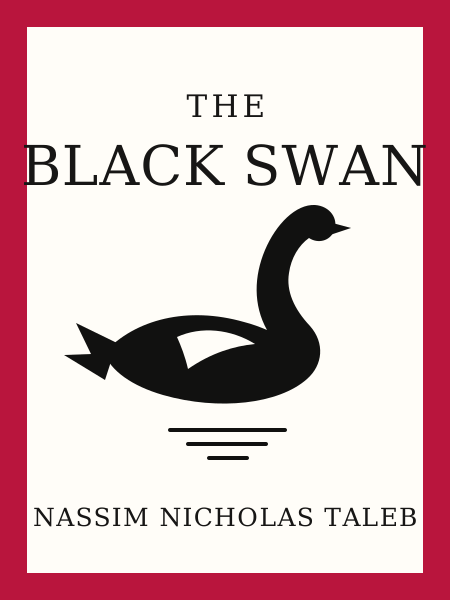
Nassim Nicholas Taleb, former trader turned philosophical essayist, extends his Black Swan ideas into a comprehensive framework. Where The Black Swan diagnosed the problem (rare events dominate), Antifragile offers the solution: build systems that gain from disorder.
The book introduces a tripartite classification: fragile (harmed by volatility), robust (indifferent to volatility), and antifragile (gains from volatility). Human bones, startup ecosystems, and evolutionary systems are antifragile - stress makes them stronger. Most corporations, centralized governments, and optimized supply chains are fragile.
What it gets right
- The antifragile concept genuinely fills a linguistic and conceptual gap
- Barbell strategy is immediately actionable
- Skin in the game as ethical principle - don't transfer downside to others
- Critique of over-optimization and efficiency worship is prescient (see COVID supply chains)
- Via negativa: often better to remove harm than add intervention
What it misses
- The book is sprawling - 500 pages that could be 200
- Taleb's arrogance and personal attacks on academics are tiresome
- Vague on how to actually become antifragile in specific contexts
- Some claims about medicine, nutrition, and psychiatry are unsupported or wrong
- The concept doesn't apply universally - some systems genuinely need stability
Evidence is largely anecdotal and philosophical. Taleb draws on finance, evolutionary biology, and history, but the arguments are more conceptual than empirical. His dismissal of academic research while making sweeping claims creates tension.
Key concepts
Antifragile
Things that gain from disorder and stress. Design your career, portfolio, and systems to have this property.
Barbell Strategy
Extreme safety + extreme risk, nothing in between. Split resources 90/10 between ultra-safe and high-upside bets.
Via Negativa
Improvement through removal, not addition. Before adding solutions, remove what's causing harm.
Skin in the Game
Bearing the consequences of your decisions. Never give advice without suffering the downside.
Optionality
Having options that let you benefit from uncertainty. Collect options, especially cheap ones with unlimited upside.
Fragilista
Someone who makes systems fragile by over-intervening or over-optimizing. Don't be one.
Core insights
-
Fragility is the real risk, not volatility
The question isn't "will there be shocks?" but "are you positioned to gain or lose from them?"
-
The barbell beats the middle
Moderate risk is the worst position - you get moderate returns with potentially catastrophic losses. Go extreme or go safe.
-
Small stressors strengthen; large ones kill
Hormesis - controlled stress builds resilience. Exercise, fasting, and small business failures all build antifragility.
-
Time is the ultimate test
If something has survived for centuries (Lindy Effect), it's likely antifragile. Favor the time-tested over the novel.
-
Optionality trumps prediction
You don't need to predict the future if you're positioned to benefit from any outcome. Collect cheap options.
-
Remove before adding
Via negativa - the first intervention should be removing harm, not adding solutions.
Implementation steps
Today
- Identify your biggest fragility: What depends on conditions staying exactly the same?
- List your optionalities: Where do you have asymmetric upside (limited downside, unlimited upside)?
This week
- Apply barbell to your portfolio: Separate ultra-safe assets from speculative positions
- Identify one "fragilizing" intervention you could stop (over-optimization, over-scheduling)
This month
- Introduce small stressors that build resilience (physical: exercise variation; financial: small experiments)
- Map where you lack skin in the game - where you take risks without bearing consequences
Ongoing
- Build optionality systematically: skills, relationships, small bets
- Apply Lindy: favor time-tested over novel when stakes are high
Suggested 30-day practice plan
An editorial application plan created by Monolithic Vault - an interpretation of the book's ideas, not part of the original book.
- Day 1
Read Part I (Antifragile concept) and Part II (Modernity and Fragility)
- Day 2
List your top 5 fragilities - dependencies on things staying the same
- Day 3
Apply barbell to one domain (finances, time, or career)
- Day 7
Identify 3 small stressors you could introduce for hormetic benefit
- Day 14
Review decisions through skin-in-the-game lens - where do you lack it?
- Day 21
Catalog your options; identify 3 cheap options you could acquire
- Day 30
Audit one system you control for fragility; redesign for antifragility
Free PDF summary
Take this analysis with you: a designed two-page field-notes sheet with the thesis, my favorite quote, the key concepts and core insights, and the full 30-day checklist. Print it or keep it - free, no signup.
Go deeper
If this analysis earned your attention, the full book goes further than any summary can. The original is always the primary source.