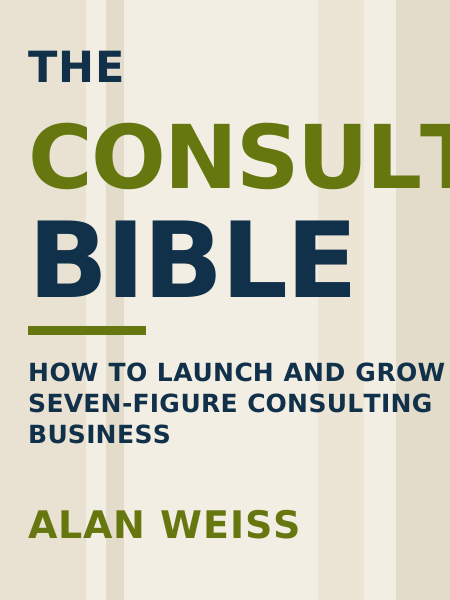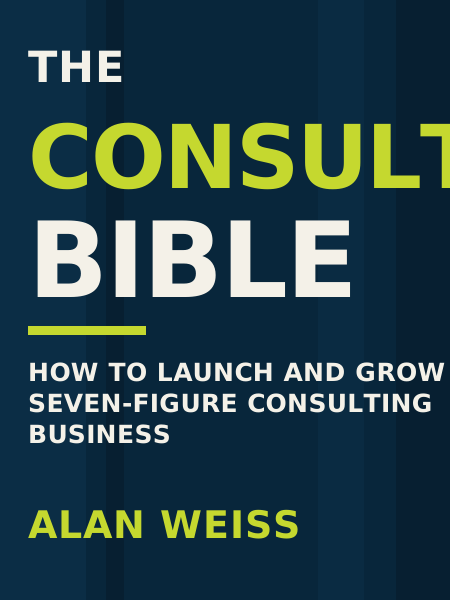

Built to Sell
John Warrillow · 2011
Editorial rating
- Evidence
- 7/10
- Actionability
- 9/10
- Originality
- 7/10
The thesis
Build your business as if you're going to sell it, even if you never plan to. A sellable business is a better business: it doesn't depend on you, it has predictable revenue, and it delivers consistent value. The process of making your company sellable will make it more profitable and more enjoyable to run.
Who this is for
Service business owners who've built a dependency on themselves, founders thinking about exit in 2-5 years, and anyone who realizes their "asset" would be worthless without their personal involvement.
My favorite quote
Don't generalize; specialize. If you focus on doing one thing well and hire specialists in that area, the quality of your work will improve and you will stand out among your competitors.
Why it matters
Most struggling businesses try to be everything to everyone. Specialization creates defensible positioning - and commands premium pricing.
Do this
Write down everything your company offers. Circle the one thing you do better than anyone else. What would it take to become known only for that?
Start here
The TVR Test: Is your offering Teachable (can you train employees to deliver it?), Valuable (do customers need it enough to pay premium prices?), and Repeatable (will customers need it again, creating recurring revenue)? If you can't answer yes to all three, your business isn't sellable - it's a job you've created for yourself.
Critical summary
Warrillow tells the story of Alex Stapleton, a fictional advertising agency owner who can't sell his company because it depends entirely on him. His mentor Ted guides him through transforming a generalist, project-based services firm into a specialized, productized business with recurring revenue - one that ultimately sells for a premium.
The 8-step process is the book's core contribution: specialize, create a standard offering, charge up front, say no to projects outside your specialty, hire salespeople, stop selling your time, build a management team, and find an advisor to sell the company. Each step systematically removes the owner from day-to-day operations while increasing business value.
What it gets right
- The story format makes abstract concepts concrete and memorable
- TVR framework (Teachable, Valuable, Repeatable) is immediately useful
- Practical advice on pricing, team building, and sales process
- Shows the compound effect of systematization on valuation multiples
What it misses
- Heavy focus on service businesses - less applicable to product companies or tech startups
- The transition from generalist to specialist can kill revenue in the short term (Alex's story glosses over this pain)
- Some advice (charge up front, productize everything) doesn't work for all business models
- Limited coverage of emotional difficulty of letting go for founder-operators
Evidence comes from Warrillow's experience selling four companies and advising hundreds more through his Value Builder System. The frameworks are practical and battle-tested, if not academically validated.
Key concepts
TVR Framework
Teachable (you can train others to deliver it), Valuable (customers pay premium), Repeatable (creates recurring revenue).
Specialization Premium
Generalists compete on price; specialists command premiums for expertise.
Standard Service Offering
A productized, repeatable process that delivers consistent outcomes regardless of who performs the work.
The 15% Rule
No single client should represent more than 15% of revenue - concentration is a red flag for acquirers.
Positive Cash Flow Cycle
Charge up front or use progress billing so growth doesn't consume capital.
Options Strategy
Run the business to maximize optionality - whether you sell, pass it on, or keep running it indefinitely.
Core insights
-
Sellability = quality of life
Even if you never sell, the process of making your business sellable will make it more profitable and less dependent on you.
-
Specialization is counterintuitive but essential
It feels risky to narrow your focus, but specialists get premium pricing and referrals that generalists never see.
-
Your business is not your product
The deliverable is secondary. Your real product is the system that creates and delivers value - that's what acquirers buy.
-
Salespeople free you from dependency
If you're the primary rainmaker, you haven't built a sales engine - you've built another job for yourself.
-
Acquirers buy the future, not the past
What matters isn't current revenue but scalable potential. Paint the picture of what's possible with their resources.
Implementation steps
Today
- Apply the TVR test to your current offerings - where do they fail?
- Calculate your client concentration - does any customer exceed 15% of revenue?
This week
- Identify your ONE specialization - the thing you do better than competitors
- Draft a standard service offering with a fixed price (even if you currently quote custom)
This month
- Create a process document for your most repeated service delivery
- Begin quoting the standard offering to new prospects - track acceptance rates
Ongoing
- Work toward no client exceeding 15% of revenue
- Build management team that can run operations without daily founder involvement
Suggested 30-day practice plan
An editorial application plan created by Monolithic Vault - an interpretation of the book's ideas, not part of the original book.
- Day 1
Complete the TVR assessment for all your current offerings
- Day 2
Identify your potential specialization - what could you be known for?
- Day 3
Research what specialists in your space charge (hint: it's more than you)
- Day 7
Draft your first "standard service offering" with fixed scope and price
- Day 14
Pitch the standard offering to 3 prospects; gather feedback
- Day 21
Document the delivery process so an employee could execute it
- Day 30
Calculate your Owner Dependency Score - how many hours must YOU work for the business to function?
Free PDF summary
Take this analysis with you: a designed two-page field-notes sheet with the thesis, my favorite quote, the key concepts and core insights, and the full 30-day checklist. Print it or keep it - free, no signup.
Go deeper
If this analysis earned your attention, the full book goes further than any summary can. The original is always the primary source.