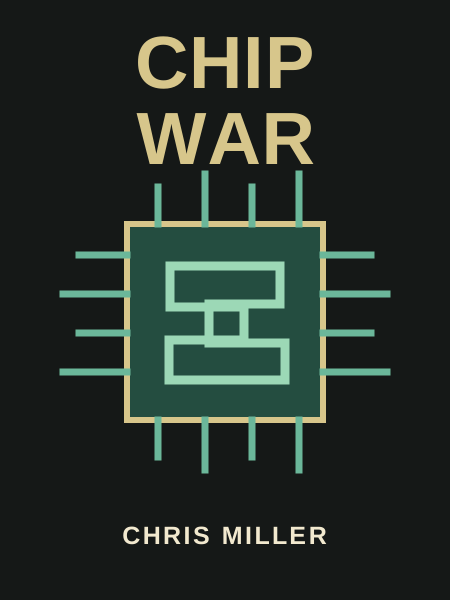
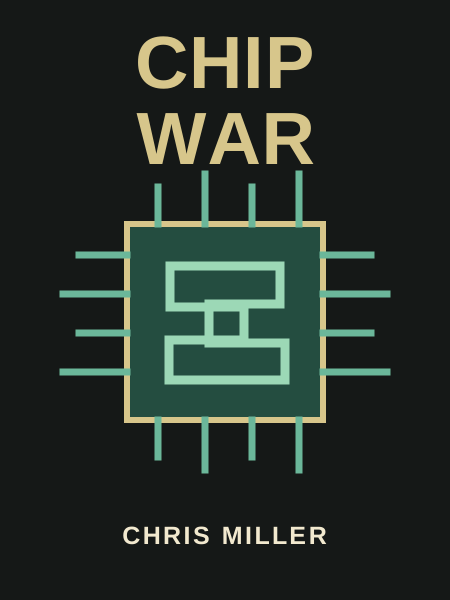
Chip War
Chris Miller · 2022
Editorial rating
- Evidence
- 10/10
- Actionability
- 6/10
- Originality
- 9/10
The thesis
Semiconductors are the new oil - the single most critical resource determining military, economic, and geopolitical power in the 21st century. The U.S.-China rivalry will be won or lost based on who controls advanced chip manufacturing, and the current supply chain is dangerously fragile and concentrated in Taiwan.
Who this is for
Business strategists, policymakers, tech executives, and anyone trying to understand the geopolitical forces shaping the next decade. Essential reading for anyone in semiconductors, supply chain, or strategic planning at companies dependent on chips (which is nearly every company).
My favorite quote
World War II was decided by steel and aluminum, and followed shortly thereafter by the Cold War, which was defined by atomic weapons. The rivalry between the United States and China may well be determined by computing power.
Why it matters
This reframes semiconductor manufacturing from "tech industry concern" to "existential national security issue" - the battlefield of the 21st century.
Do this
Audit your company's chip dependencies today. Where do your critical semiconductors come from? If Taiwan Strait tensions escalate, which products fail first? Stress-test your supply chain.
Start here
37% of the world's new computing power comes from Taiwan, 44% of memory chips from Korea, and 100% of extreme ultraviolet lithography machines from one Dutch company (ASML). This concentration is unprecedented - OPEC's 40% oil market share pales in comparison. A single earthquake, blockade, or invasion could halt global chip production, crippling everything from smartphones to missiles. Understanding this fragility is the first step to navigating the chip war reshaping business and geopolitics.
Critical summary
Miller, an economic historian and professor at Tufts Fletcher School, chronicles how semiconductors evolved from Cold War military technology to the foundation of modern civilization. The book is structured chronologically: Bell Labs' transistor invention (1947), Silicon Valley's rise, Japan's challenge in the 1980s, Taiwan's TSMC dominance, and China's current drive for chip independence.
Central argument: Chips are now more strategically critical than oil. China imports $260 billion in chips annually (more than Saudi Arabia exports in oil). The U.S. has ceded manufacturing leadership to Taiwan and Korea but maintains dominance in design (Nvidia, Qualcomm, Intel) and tooling (ASML's Dutch EUV monopoly). China is pouring billions into closing the gap, but faces a "stranglehold" - every advanced chip depends on American or allied technology somewhere in the supply chain.
The book is part history, part geopolitical thriller, covering: Jack Kilby's integrated circuit, Morris Chang founding TSMC, Japan's DRAM assault on Intel, Morris Chang founding TSMC, Soviet espionage failures, and the 2018-2022 U.S. export controls choking China's chip ambitions.
What it gets right
- Impeccable research: 6 years of work, hundreds of interviews, academic rigor. Winner of Financial Times Business Book of the Year 2022.
- Makes complexity accessible: Explains semiconductor physics, fab economics, and supply chain intricacies without requiring engineering background.
- Geopolitical clarity: Frames chip competition as central to U.S.-China relations, not peripheral tech issue.
- Balanced perspective: Acknowledges U.S. complacency (letting TSMC dominate manufacturing), Chinese vulnerabilities (trapped 5+ years behind leading edge), and Taiwan's precarious position (world's most valuable hostage).
- Timely: Published 2022, captures current moment (though events move fast - some analysis already outdated by late-2024 developments).
What it misses
- Limited forward guidance: Miller published before U.S. CHIPS Act implementation and recent export control escalations. Book is backward-looking history, light on predictive framework.
- Undersells chip shortage complexity: Correctly notes 2021-22 shortage was demand spike (not supply failure), but doesn't fully explore automotive industry's structural procurement problems.
- Eurocentric supply chain view: ASML's EUV monopoly is well-covered, but Southeast Asian back-end packaging (critical supply chain layer) gets minimal attention.
- Assumes reader knows basics: If you don't know what a "logic chip" vs. "memory chip" is, you'll struggle early. Lack of glossary.
Evidence quality: Exceptional. Academic-level research, extensive citations, interviews with key executives (Morris Chang, TSMC; Jensen Huang, Nvidia; etc.). Not peer-reviewed (it's trade publishing) but far exceeds typical business book rigor. Comparable to Ben Thompson's Stratechery analysis depth.
Critical reception: Near-universal praise. NYT: "Nonfiction thriller." Economist: "A fine place to start" understanding chips. Financial Times Business Book of Year. Goodreads: 4.37/5 (31,500+ ratings). Greg Mankiw (Harvard economist): "Highly recommended." Few substantive critiques except "wish it had more forward-looking strategy recommendations."
Key concepts
Chips Are the New Oil
No product is more central to international trade. China spends more importing chips than global aircraft trade. Military, economic, geopolitical power now rest on computing power. Recognize this in your strategic planning.
TSMC's Irreplaceable Role
Taiwan Semiconductor Manufacturing Company produces 90%+ of the world's most advanced chips (sub-5nm). No backup supplier exists. If TSMC stops producing, Apple, Nvidia, AMD all halt. Understand your dependence.
The Stranglehold Strategy
U.S. controls chokepoints - EUV lithography (ASML, Netherlands), chip design tools (Synopsys, Cadence), and advanced materials. China can't make leading-edge chips without these. But stranglehold invites decoupling risk.
Moore's Law Is Slowing, Economics Are Brutal
Cutting-edge fab costs $20 billion+, only cutting-edge for 2-3 years. Economics favor extreme consolidation (TSMC, Samsung). Few companies can afford to play this game. Plan accordingly.
China's Chip Independence Dream
Xi Jinping has made chip self-sufficiency a top priority. Hundreds of billions invested. But China remains 5-10 years behind leading edge and can't catch up without access to U.S./allied tech. Tension is permanent.
Military Applications Define Innovation
Cold War drove semiconductors (missile guidance). AI is the new driver (autonomous weapons, cyber warfare). Military-commercial cycles accelerate advancement. What's your company's AI chip strategy?
Core insights
-
"The chip industry is the most globalized industry ever"
No single country can produce advanced chips alone. Every chip requires U.S. design tools, Dutch lithography, Taiwanese manufacturing, Korean memory, Japanese materials. This interdependence is strength and vulnerability.
-
"Chips from Taiwan provide 37% of world's computing power annually"
Taiwan is the world's most strategically critical piece of real estate. A Chinese invasion or U.S.-China decoupling would trigger a global economic depression.
-
"A facility to fabricate the most advanced logic chips costs twice as much as an aircraft carrier but will only be cutting-edge for a couple of years"
Semiconductor economics are insane. Only companies with massive scale (TSMC, Samsung, Intel) can compete. Consolidation is inevitable.
-
"In the age of AI, data isn't the constraint - processing power is"
Everyone focuses on training data. Miller argues chip shortage is the real bottleneck. Nvidia's GPUs are the new gold. Whoever controls AI chip supply controls AI future.
-
"Soviet chip industry failed despite massive espionage"
USSR stole designs but couldn't master manufacturing precision. Proof that semiconductors require entire ecosystems (universities, capital, talent, culture), not just blueprints. China faces the same challenge.
-
"One U.S. semiconductor executive: 'Our fundamental problem is our number one customer is our number one competitor'"
U.S. chip firms' biggest market is China. Export controls hurt American companies as much as Chinese buyers. There's no clean solution.
-
"Success in semiconductors depends as much on engineering intuition as scientific theory"
Universities (MIT, Stanford) provided foundational knowledge, but mass manufacturing required years of tweaking processes. Tacit knowledge can't be easily stolen.
Implementation steps
Today
- Map your semiconductor dependencies: Which chips does your product/service rely on? Where are they fabricated?
- Search "TSMC capacity allocation" to see if you're competing with Apple/Nvidia for foundry slots
This week
- Conduct supply chain stress test: Model impact of 6-month Taiwan Strait blockade on your business
- Review your sourcing strategy: Are you over-reliant on single-source chips? Identify backup suppliers or design alternatives
- If you're in B2B tech, add "semiconductor risk" to your customer contracts and quarterly risk disclosures
This month
- Read CHIPS Act analysis: Understand U.S./EU subsidies for domestic chip fabs - does your company qualify for incentives?
- Evaluate China exposure: If you sell chips or chip-dependent products to China, what percentage of revenue is at risk from export controls?
- Scenario plan for 2025-2030: What if U.S.-China decouple semiconductors completely? Model revenue impact and mitigation strategies
Ongoing
- Subscribe to semiconductor industry newsletters (SemiAnalysis, Fabricated Knowledge) to track geopolitical developments
- Quarterly executive review: "How has semiconductor geopolitics changed our risk profile this quarter?"
- Build strategic relationships with chip vendors - TSMC allocation is relationship-driven, not just price-driven
Suggested 30-day practice plan
An editorial application plan created by Monolithic Vault - an interpretation of the book's ideas, not part of the original book.
- Day 1
Read Chip War cover-to-cover (or audiobook at 1.5x). Absorb the history and current landscape.
- Day 3
Present key insights to your executive team. Make semiconductor strategy a standing agenda item.
- Day 5
Conduct internal audit: Which products depend on sub-10nm chips? What's the lead time? What's the contingency?
- Day 7
Meet with your chip suppliers (or your hardware team if you're software). Understand their Taiwan/China exposure.
- Day 10
Analyze competitors: Who's winning chip allocation? Who's getting squeezed? What can you learn?
- Day 14
Develop 3 scenarios: (1) Status quo, (2) Taiwan Strait crisis, (3) Full U.S.-China decoupling. Model business impact for each.
- Day 21
Draft risk mitigation plan: Dual-sourcing, chip inventory buffers, design-for-alternative-chips strategies.
- Day 30
Board presentation: "Semiconductor Strategy in an Era of Chip Wars." Secure buy-in and budget for mitigation.
Free PDF summary
Take this analysis with you: a designed two-page field-notes sheet with the thesis, my favorite quote, the key concepts and core insights, and the full 30-day checklist. Print it or keep it - free, no signup.
Go deeper
If this analysis earned your attention, the full book goes further than any summary can. The original is always the primary source.