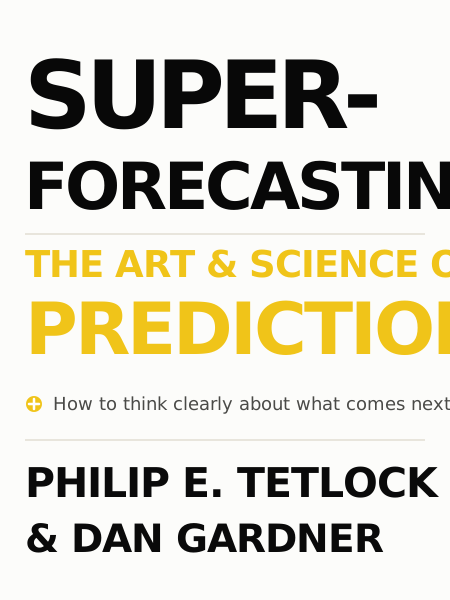
Superforecasting
Philip Tetlock · 2015
Editorial rating
- Evidence
- 9/10
- Actionability
- 7/10
- Originality
- 8/10
The thesis
Most experts are terrible at prediction - barely better than chance. But a small minority, "superforecasters," consistently outperform professionals with classified intelligence. Their secret isn't brilliance - it's intellectual humility, probabilistic thinking, and constant updating. Forecasting is a skill that can be learned.
Who this is for
Strategists and planners who must make decisions under uncertainty, investors evaluating future outcomes, and anyone who wants to improve their judgment and avoid the overconfidence that plagues expert prediction.
My favorite quote
The foxes beat the hedgehogs. Better forecasters tend to be more open-minded, careful, curious, and self-critical.
Why it matters
The hedgehog's one big idea creates confidence but produces terrible predictions. The fox's many small ideas produce humility and accuracy.
Do this
For your next prediction, state a precise probability (not "likely" but "65%") and write down why.
Start here
Think in precise probabilities and update them frequently. Instead of "X will probably happen," say "I estimate a 70% probability of X." Then, as new evidence arrives, adjust. Superforecasters make small, frequent updates rather than waiting for definitive proof. Start with the base rate (how often do events like this typically occur?), then adjust for specifics. This "outside-in" approach beats intuition.
Critical summary
Philip Tetlock, Wharton professor and co-leader of the Good Judgment Project, spent decades studying prediction. His earlier work proved that expert predictions were barely better than dart-throwing chimps. This book offers redemption: some people are genuinely good at forecasting, and we can learn their methods.
The Good Judgment Project, an IARPA-funded forecasting tournament, pitted amateur volunteers against professional intelligence analysts with access to classified information. The amateurs won - by 30%. The best performers, dubbed "superforecasters," shared distinctive traits: probabilistic thinking, active open-mindedness, and relentless self-improvement.
What it gets right
- Rigorous empirical foundation - this is science, not anecdote
- Clear, learnable techniques: base rates, Fermi estimation, belief updating
- Debunks expert confidence while offering hope that skill matters
- Fox vs. hedgehog framework is memorable and useful
- Shows that teams of superforecasters beat prediction markets
What it misses
- The book takes too long to get to practical techniques (first third is setup)
- Some forecasting contexts don't translate (geopolitics vs. business)
- Tension with Taleb's Black Swan critique not fully resolved - superforecasters excel at short-term, narrow questions, not rare events
- Less actionable than it could be - the appendix "Ten Commandments" is thin
Evidence quality is exceptional. The Good Judgment Project is one of the most rigorous studies of forecasting ever conducted, with pre-registered predictions and careful scoring. This is as close to scientific proof as the forecasting literature gets.
Key concepts
Superforecasters
The top 2% of forecasters who consistently beat experts and prediction markets. Study their methods.
Probabilistic Thinking
Assigning precise probabilities (not vague terms like "likely") and updating them. Start using numbers today.
Base Rates (Outside View)
Starting with how often events like this typically occur before adjusting for specifics. Ask "how often does this happen?" first.
Active Open-Mindedness
Actively seeking disconfirming evidence and alternative views. Cultivate intellectual humility.
Belief Updating
Making small, frequent adjustments as evidence arrives, not waiting for proof. Update early and often.
Foxes vs. Hedgehogs
Foxes know many things and aggregate perspectives; hedgehogs know one big thing. Be a fox.
Core insights
-
Forecasting is a skill, not a gift
Superforecasters aren't geniuses - they're disciplined thinkers who constantly improve. You can get better with practice.
-
Precision enables learning
Vague predictions ("could happen") can never be proved wrong. Precise probabilities can be scored and improved.
-
Start outside, then go inside
Begin with base rates (how often does this happen?), then adjust for specifics. This beats starting with your gut.
-
Update early and often
Small frequent adjustments beat waiting for certainty. Superforecasters update their forecasts constantly.
-
Aggregate diverse perspectives
Foxes beat hedgehogs because they synthesize many viewpoints instead of defending one theory.
-
Intellectual humility is a superpower
The best forecasters know what they don't know. Overconfidence is the enemy of accuracy.
Implementation steps
Today
- Pick one upcoming decision and make a precise probability prediction (e.g., "70% chance the project ships on time")
- Write down the reasoning behind your probability
This week
- For a decision you face, find the base rate: How often do similar situations succeed/fail?
- Identify three alternative perspectives on a current challenge
This month
- Start a prediction journal: date, prediction (with probability), reasoning
- Review predictions monthly to calibrate - are your 70% predictions right 70% of the time?
Ongoing
- Join a forecasting platform (Good Judgment Open, Metaculus) to practice with feedback
- Build a habit of updating predictions when new evidence arrives
Suggested 30-day practice plan
An editorial application plan created by Monolithic Vault - an interpretation of the book's ideas, not part of the original book.
- Day 1
Read Part One on what makes forecasters good or bad
- Day 2
Make 3 predictions about work/life with precise probabilities
- Day 3
Find the base rate for one current decision
- Day 7
Review and update your Day 2 predictions - what's changed?
- Day 14
Join Good Judgment Open or Metaculus; make your first scored prediction
- Day 21
Review your prediction journal - where were you overconfident?
- Day 30
Teach one superforecasting technique to a colleague
Free PDF summary
Take this analysis with you: a designed two-page field-notes sheet with the thesis, my favorite quote, the key concepts and core insights, and the full 30-day checklist. Print it or keep it - free, no signup.
Go deeper
If this analysis earned your attention, the full book goes further than any summary can. The original is always the primary source.