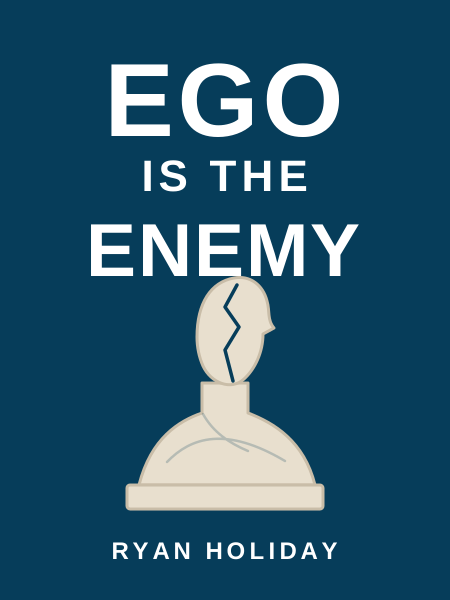
Ego Is the Enemy
Ryan Holiday · 2016
Editorial rating
- Evidence
- 6/10
- Actionability
- 7/10
- Originality
- 5/10
The thesis
Ego - that unhealthy belief in your own importance - sabotages every stage of your career: it prevents learning when you're aspiring, breeds complacency when you're succeeding, and turns failure into catastrophe. Replace ego with earned confidence, humility, and purpose.
Who this is for
Ambitious professionals who confuse confidence with arrogance, startup founders whose early success breeds overconfidence, and anyone recovering from failure who needs to rebuild without ego-driven delusions.
My favorite quote
When we remove ego, we're left with what is real. What replaces ego is humility, yes - but rock-hard humility and confidence. Whereas ego is artificial, this type of confidence can hold weight. Ego is stolen. Confidence is earned.
Why it matters
Distinguishes true self-assurance (earned through work) from false bravado (stolen through self-deception).
Do this
Before your next big meeting, ask "What don't I know?" instead of rehearsing what you'll prove.
Start here
Understand ego vs. confidence: Ego is self-importance without substance. It tells you you're special before you've done the work. True confidence comes from competence, humility, and realistic self-assessment. When ego drives you, every setback feels like a referendum on your worth. When confidence drives you, setbacks are just data.
Critical summary
Holiday divides the book into three parts tracking a career arc: Aspire (starting out), Success (achieving goals), and Failure (recovering from setbacks). Each phase has its ego traps.
What it gets right
- Clear distinction between ego and confidence resonates
- Historical examples span business, military, sports (George Marshall, Katharine Graham, Jackie Robinson)
- Practical advice on staying grounded: seek feedback, remain a student, focus on work over talk
- The three-part structure maps to real career experiences
What it misses or overstates
- Ignores successful egomaniacs (Steve Jobs, Elon Musk) who thrived despite massive egos
- Holiday's own brand-building arguably contradicts the message (books, merchandise, prominent self-promotion)
- Some critics see it as "Stoicism for startups" - virtue ethics repackaged as career strategy
- The advice skews individualistic; doesn't address systemic barriers where humility alone won't suffice
- Can feel preachy ("you must," "you will") without acknowledging complexity
CRITICAL PROBLEMS
The book cherry-picks examples. For every humble success story, there's a narcissistic billionaire who won anyway. Holiday defines success materially (career advancement, wealth) rather than Stoically (virtue, inner peace). Some readers question whether Holiday, who aggressively markets himself, truly lives ego-free. The framework also risks blame-shifting: if you fail, maybe your ego was the problem (not structural inequality, bad luck, or market conditions).
Evidence quality: Anecdotal. Historical case studies illustrate principles but aren't scientific proof. The link between ego reduction and success is plausible (psychology supports humility's benefits) but not rigorously tested here.
Key concepts
Student Mindset
Approach everything as a learner, not a know-it-all. Ask one "dumb" question in your next meeting.
Passion vs. Purpose
Passion is emotional and self-focused ("I want"); purpose is rational and other-focused ("What's needed?"). Audit your goals: which are passion-driven?
Canvas for Others
Help those above you succeed without seeking credit. Volunteer for unglamorous work that clears their path.
Restrain the Temptation to Talk
Talk depletes energy that could go into work. Let results speak; silence builds mystique.
Work, Work, Work
Consistent effort beats flashy promises. Show up daily when others chase shortcuts.
Sympatheia
Stoic concept - you're part of a larger whole, not the center. Zoom out: how small are you in cosmic terms?
Core insights
-
Ego mistakes confidence for arrogance
Real confidence is quiet because it's earned. Arrogance broadcasts insecurity dressed as certainty.
-
Pride blocks learning
If you think you already know, you can't absorb new information. Stay humble enough to admit ignorance.
-
Success breeds ego, ego sabotages success
Winning makes you feel invincible. That delusion causes the mistakes that end you.
-
Failure magnified by ego becomes identity crisis
If your self-worth depends on external validation, failure destroys you. Separate your work from your worth.
-
The best defense is not needing one
When ego demands you're always right, every criticism is a threat. Egoless people listen and improve.
Implementation steps
Today
- Identify one area where you're pretending to know more than you do
- Ask someone for feedback you've been avoiding
- Do one unglamorous task that helps someone else succeed
This week
- Track how often you talk vs. listen - aim for 30/70 ratio
- Replace one instance of self-promotion with actual work
- Study someone who achieved more with less ego (Holiday suggests George Marshall, Katharine Graham)
This month
- Take on a project below your "status" - embrace grunt work
- Read Meditations or Letters from a Stoic for deeper Stoic grounding
- Identify three blind spots through 360-degree feedback
Ongoing
- Journal nightly: "Where did ego drive me today?"
- Treat every accomplishment as incomplete (what's next?)
- View criticism as coaching, not attack
- Measure yourself against your potential, not others
Suggested 30-day practice plan
An editorial application plan created by Monolithic Vault - an interpretation of the book's ideas, not part of the original book.
- Day 1
Define your current career stage (Aspire, Success, Failure)
- Day 2
List three ego-driven beliefs you hold ("I deserve X," "I'm the best at Y")
- Day 3
Challenge one belief - find evidence you're wrong
- Day 7
Week 1 reflection - how did ego show up?
- Day 10
Do unglamorous work: volunteer for a task others avoid
- Day 14
Mid-month audit - track talk vs. action ratio
- Day 17
Read about one humble leader (George Marshall, Angela Merkel)
- Day 21
Apply one insight: where can you be more student, less expert?
- Day 25
Ask for brutal feedback from someone you trust
- Day 30
Final essay - how is confidence different from ego in your life?
Free PDF summary
Take this analysis with you: a designed two-page field-notes sheet with the thesis, my favorite quote, the key concepts and core insights, and the full 30-day checklist. Print it or keep it - free, no signup.
Go deeper
If this analysis earned your attention, the full book goes further than any summary can. The original is always the primary source.