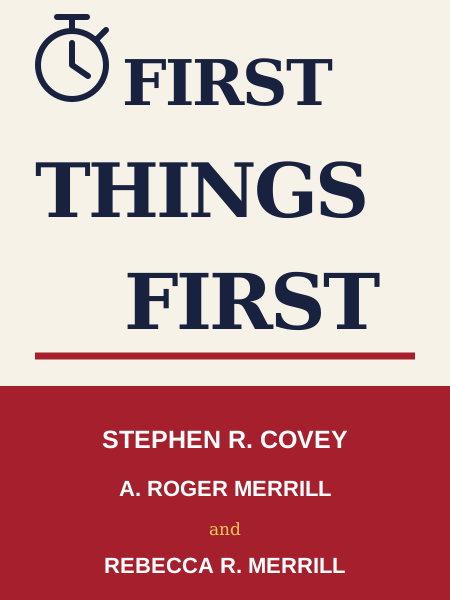
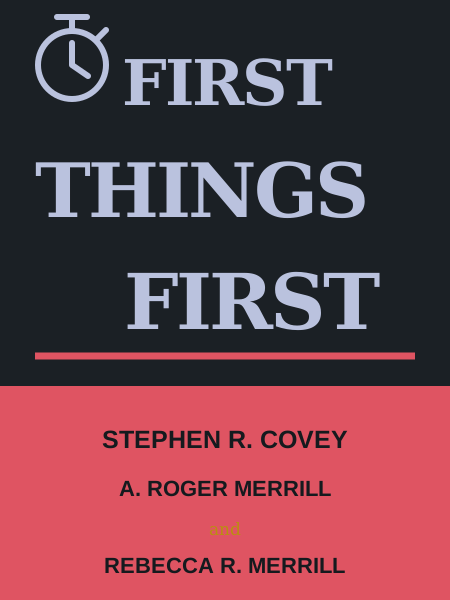
First Things First
Stephen R. Covey, A. Roger Merrill, and Rebecca R. Merrill · 1994
Editorial rating
- Evidence
- 8/10
- Actionability
- 10/10
- Originality
- 9/10
The thesis
Effectiveness is achieved by organizing and executing your life around importance (your Compass), not urgency (your Clock). This requires consistently prioritizing Quadrant II activities - those that are important but not urgent - to ensure your daily actions align with your deepest values and long-term goals.
Who this is for
Professionals, managers, and parents who feel trapped in a cycle of crises and busywork (urgency addiction) and wish to trade short-term efficiency for long-term effectiveness, balance, and principle-centered living.
My favorite quote
The key is not to prioritize what’s on your schedule, but to schedule your priorities.
Why it matters
It concisely inverts traditional time management philosophy, demanding that you block time for important activities (Quadrant II) before filling the rest of your day with urgent requests.
Do this
Identify one high-value, non-urgent activity (e.g., strategic planning, relationship building) and block a dedicated, non-negotiable two-hour slot for it on your calendar this week.
Start here
Use the Time Management Matrix (The Four Quadrants) to analyze your time. Your primary focus must be Quadrant II: Important, Not Urgent. Activities here include planning, relationship building, new opportunity exploration, and self-renewal. By proactively spending time in Q2, you prevent important issues from escalating into the stressful, crisis-driven Q1 (Urgent and Important). Your goal is to minimize Q1, reduce or delegate Q3, and eliminate Q4.
Critical summary
This book serves as a radical departure from the "third generation" of time management (focused on efficiency, goal-setting, and daily to-do lists), positioning itself as life leadership rather than simple time management. Covey et al. argue that merely doing more things faster (the Clock approach) is useless if the ladder of success is leaning against the wrong wall. The book introduces the Compass - our personal values, principles, and mission - as the true guiding force.
The central framework hinges entirely on the Quadrant II Organizing Process, which is structured around four fundamental human needs (to Live, to Love, to Learn, and to Leave a Legacy) and four key capacities (Self-Awareness, Conscience, Independent Will, Creative Imagination). The weekly planning system requires defining key life roles, setting one or two "big rock" (Q2) goals for each role, and scheduling those rocks first, before fitting in the "gravel" (urgent tasks) and "sand" (distractions).
What it gets right
- The metaphor of the Clock vs. the Compass is a powerful, paradigm-shifting concept that correctly reframes the issue from speed to direction.
- It effectively diagnoses urgency addiction - the psychological high people get from constant firefighting and exposes the trap of constantly prioritizing the urgent over the important.
- The system is principle-centered, providing a moral and relational foundation for time management, ensuring professional success is not achieved at the expense of family or health.
What it misses or overstates
- The system demands a significant up-front investment of time (a 30-minute weekly planning session) and self-discipline, which can be a major barrier for the very people (Q1/Q3 addicts) who need it most.
- It relies heavily on the foundational work of The 7 Habits, meaning readers unfamiliar with concepts like "Be Proactive" or "Begin with the End in Mind" may find the context shallow.
Evidence quality is high, derived from decades of real-world application through the FranklinCovey organization, reinforcing the principles of natural law.
Key concepts
The Clock and the Compass
The Clock represents scheduling, appointments, and speed (time management). The Compass represents vision, values, and direction (life leadership). Always subordinate the Clock to the Compass.
Quadrant II (Q2)
The quadrant of quality and personal leadership, containing tasks that are Important but Not Urgent (e.g., long-term planning, preventive maintenance, relationship deep-dives). The more time you spend here, the less time you spend in crisis (Q1).
The Four Human Needs
The non-negotiable areas of life that must be integrated into planning: to Live (Physical/Economic), to Love (Social/Relationships), to Learn (Mental/Growth), and to Leave a Legacy (Spiritual/Meaning). Use these to define your "first things."
Big Rocks
A metaphor for the Quadrant II activities that are truly important. These items must be scheduled first in your week before you fill in the rest of your time with smaller tasks (gravel and sand).
Stewardship Delegation
Delegating based on mutual commitment to desired results, guidelines, resources, accountability, and consequences (the "Win/Win Agreement"). Focus on results, not methods, to empower the delegate.
Core insights
-
Management is efficiency in climbing the ladder; Leadership determines if the ladder is leaning against the right wall
Effectiveness (the right wall/Compass) must precede efficiency (climbing quickly/Clock).
-
The gap between the Clock and the Compass breeds frustration
The constant feeling of busyness without meaning occurs when daily actions (Clock) are disconnected from core values and mission (Compass).
-
Urgency is often based on the priorities of others
Most tasks in Quadrant III (Urgent but Not Important) are actually interruptions or demands from other people, which you must learn to politely refuse or delegate.
-
Q2 is the center of the solution
Investing in Q2 activities - especially prevention and planning - is the only way to shrink Q1 (crises) over time.
-
The best way to predict your future is to create it
The proactive act of mentally visualizing your future and writing your mission statement is the first creation that guides all subsequent physical creations.
Implementation steps
Today
- Urgency Audit: Track your activities for one hour, categorizing each five minutes into one of the four quadrants. Identify your most frequent Quadrant III (Urgent/Not Important) task.
- Say No: Politely say "no" or "not yet" to the next request that lands in your Quadrant III (e.g., an unimportant email, an unnecessary meeting).
This week
- Role Definition: Define your 3-5 major roles in life (e.g., Leader, Partner, Developer, Health Seeker).
- Weekly Q2 Plan: Schedule at least two "Big Rock" tasks (one personal, one professional) into your calendar based on your defined roles and goals, treating them as non-negotiable appointments.
This month
- Time Block Review: At the end of the month, assess: Did you protect your Q2 blocks? What crisis (Q1) could have been prevented by a Q2 activity?.
- Stewardship Delegation: Delegate a recurring task to someone else by focusing entirely on the Desired Result and Accountability, not the method.
Ongoing
- Principle Check: Before every major decision, ask: "Is this action in line with my highest principles (Compass)?".
- Q2 Scheduling: Maintain a mandatory weekly planning session (30-60 minutes) to schedule Big Rocks before the week begins.
Suggested 30-day practice plan
An editorial application plan created by Monolithic Vault - an interpretation of the book's ideas, not part of the original book.
- Day 1
Identify: Define your 3-5 core life roles (e.g., Parent, Manager, Learner).
- Day 2
Vision: Draft a one-paragraph Mission Statement that covers your character and contributions in these roles.
- Day 3
Audit: Track all work for one day, assigning each task to a quadrant. Tally Q3 and Q4 time.
- Day 7
Block: Block time for your first two Big Rocks (Q2 tasks) this week.
- Day 14
Delegate: Successfully delegate one Q3 task using Stewardship Delegation (Results, Accountability, Consequences).
- Day 21
Protect: Review the previous two weeks and identify the #1 "fire" (Q1 task) that could have been prevented by better Q2 planning.
- Day 30
Renew: Plan your next month by scheduling Q2 activities for all four human needs (Live, Love, Learn, Legacy).
Free PDF summary
Take this analysis with you: a designed two-page field-notes sheet with the thesis, my favorite quote, the key concepts and core insights, and the full 30-day checklist. Print it or keep it - free, no signup.
Go deeper
If this analysis earned your attention, the full book goes further than any summary can. The original is always the primary source.