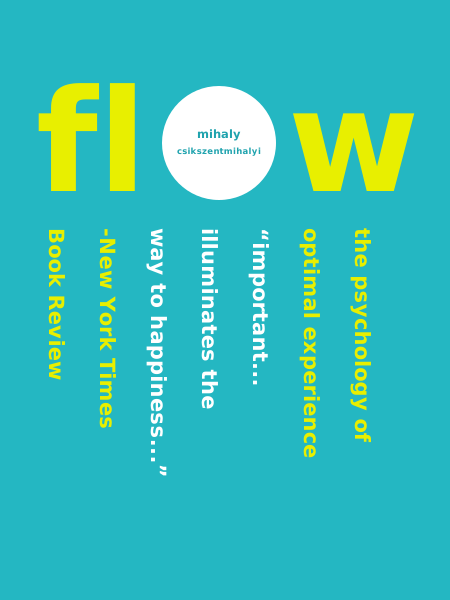
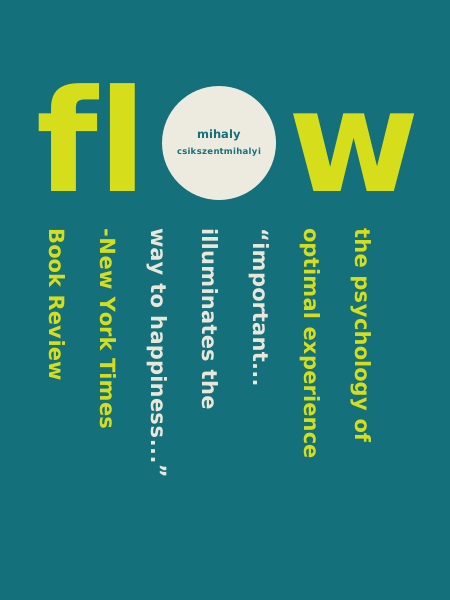
Flow
Mihaly Csikszentmihalyi · 1990
Editorial rating
- Evidence
- 7/10
- Actionability
- 6/10
- Originality
- 9/10
The thesis
The best moments in life aren't passive or relaxing - they occur when we're stretched to our limits in pursuit of something difficult and worthwhile. This state of complete absorption, where challenge matches skill and time seems to disappear, is called "flow." Happiness isn't something that happens to you; it's something you create by ordering your consciousness.
Who this is for
Knowledge workers seeking deeper engagement, creatives trying to understand their best work sessions, anyone who feels that leisure isn't delivering the happiness they expected, and people curious about the psychology of peak performance.
My favorite quote
The best moments usually occur when a person's body or mind is stretched to its limits in a voluntary effort to accomplish something difficult and worthwhile.
Why it matters
We assume happiness comes from relaxation. Csikszentmihalyi's research shows it comes from purposeful challenge.
Do this
Identify one activity where you regularly lose track of time. What conditions enable that? How can you create more of them?
Start here
Match challenge to skill - at the edge of your ability: Flow occurs in the channel between boredom (too easy) and anxiety (too hard). Find tasks where the challenge slightly exceeds your current skill. Too easy and you'll be bored. Too hard and you'll be anxious. The sweet spot is just beyond your comfort zone - demanding enough to require full attention, achievable enough to maintain confidence.
Critical summary
Csikszentmihalyi, co-founder of positive psychology, presents decades of research on "optimal experience" - those moments when people report being happiest and most engaged. Using the Experience Sampling Method (pagers that prompted subjects to record their state throughout the day), he identified the conditions that produce flow.
What it gets right
- Flow concept is genuinely novel and validated by research
- Counterintuitive insight: we're happier at work (in flow) than at leisure (passive)
- Universal - flow appears across cultures, ages, and activities
- Integrates consciousness, attention, and happiness into coherent framework
- Influenced countless subsequent books on focus and performance
What it misses
- Meanders through many chapters that repeat the same ideas
- Written for popular audience but can feel academic and dense
- Limited discussion of privilege - not everyone has the luxury to seek flow
- Some claims (like finding flow in concentration camps) feel tone-deaf
- Less practical "how-to" than readers expect
Evidence is original research but presented without academic rigor. The Experience Sampling Method is legitimate, but claims about happiness and meaning are harder to verify.
Key concepts
Flow
A state of complete absorption in an activity, where challenge matches skill, time distorts, and self-consciousness disappears.
Autotelic Personality
People who do things for their own sake, not external rewards. They find flow more easily.
Psychic Entropy
Mental disorder caused by conflicting goals, unclear feedback, and unmanaged attention.
Negentropy
The opposite - ordered consciousness focused on clear goals.
The Paradox of Work
People report more flow at work than at leisure, yet claim to prefer leisure.
Attention as Energy
Attention is limited "psychic energy." How you invest it determines your quality of life.
Core insights
-
Flow requires immediate feedback
You need to know how you're doing, in real-time, to stay in the zone.
-
Clear goals are essential
Ambiguity disrupts flow. Know exactly what you're trying to accomplish.
-
The activity must be intrinsically rewarding
External motivations (money, recognition) can undermine flow.
-
Self-consciousness disappears
In flow, you're not thinking about yourself - you're absorbed in the task.
-
Time distorts
Hours feel like minutes (or minutes like hours, depending on the activity).
-
Flow is domain-agnostic
You can find it in sports, work, conversations, reading - anywhere challenge meets skill.
Implementation steps
Today
- List 3 activities where you've experienced flow. What were the conditions?
- Identify one task today where you can eliminate distractions and create flow conditions.
This week
- For one work session, set a clear goal, eliminate interruptions, and seek immediate feedback
- Track when you feel bored vs. anxious. This reveals the challenge-skill mismatch.
This month
- Redesign one recurring task to create more flow conditions (clearer goals, faster feedback, appropriate challenge)
- Experiment with "autotelic" activities - doing things for their own sake, not outcomes
Ongoing
- Before starting work, clarify: What am I trying to accomplish? How will I know I'm making progress?
- Gradually increase challenge as skills improve - stagnation kills flow
Suggested 30-day practice plan
An editorial application plan created by Monolithic Vault - an interpretation of the book's ideas, not part of the original book.
- Day 1
Reflect on your last flow experience. What conditions enabled it?
- Day 2
Set a clear goal for one work session and eliminate all distractions
- Day 3
Create a feedback mechanism - check progress every 25 minutes
- Day 7
Identify where you're bored (challenge too low) or anxious (challenge too high). Adjust.
- Day 14
Turn one passive leisure activity into an active, challenging one
- Day 21
Experiment with an autotelic activity - something you do purely for the experience
- Day 30
Audit your week: How many hours were spent in flow? What can you change?
Free PDF summary
Take this analysis with you: a designed two-page field-notes sheet with the thesis, my favorite quote, the key concepts and core insights, and the full 30-day checklist. Print it or keep it - free, no signup.
Go deeper
If this analysis earned your attention, the full book goes further than any summary can. The original is always the primary source.