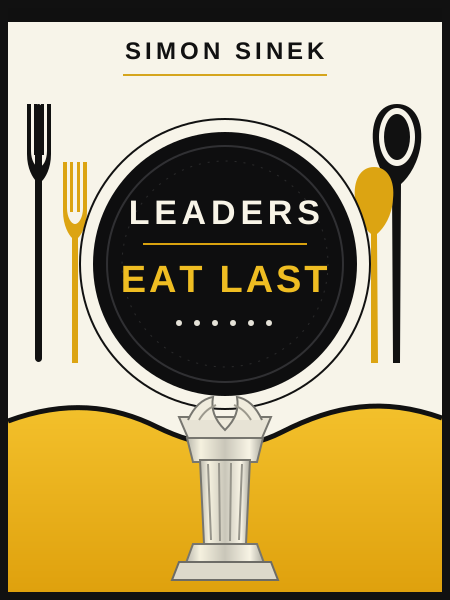
Leaders Eat Last
Simon Sinek · 2014
Editorial rating
- Evidence
- 5/10
- Actionability
- 6/10
- Originality
- 6/10
The thesis
Great leaders create a "Circle of Safety" where employees feel protected from internal threats (politics, layoffs, blame) so they can focus their energy on external challenges and opportunities. When people feel safe, they give their best. When they feel threatened, they protect themselves - at the organization's expense.
Who this is for
Leaders struggling with low trust and high turnover, managers wanting to understand why culture matters, and anyone curious about the biology behind why some teams thrive while others implode.
My favorite quote
The true price of leadership is the willingness to place the needs of others above your own.
Why it matters
Leadership isn't a perk or a reward - it's a responsibility. The title doesn't mean you eat first; it means you sacrifice first.
Do this
Identify one way you currently prioritize your own comfort over your team's needs. Change it this week.
Start here
The Circle of Safety: When leaders extend the circle of safety to include everyone - not just executives - people stop watching their backs and start watching for opportunities. Cortisol (stress hormone) drops, oxytocin (bonding hormone) rises, and suddenly the organization can focus outward instead of infighting. Your job as leader: expand that circle.
Critical summary
Sinek builds on his "Start with Why" framework by exploring the biological and anthropological basis for why trust-based leadership works. The book draws heavily on neurochemistry (dopamine, serotonin, oxytocin, cortisol) and evolutionary psychology.
What it gets right
- Compelling explanation of why psychological safety matters
- "Circle of Safety" is a useful mental model
- Contrasts healthy cultures (Costco) vs. toxic ones (GE under Welch)
- Makes the case that short-term thinking destroys long-term value
- Military examples illustrate servant leadership effectively
What it misses
- Neuroscience claims are oversimplified - brain chemistry isn't this tidy
- Feels padded - core ideas could be conveyed in half the pages
- Limited actionable guidance compared to "Start with Why"
- Some examples (generational differences) feel dated or stereotyped
- Solutions are idealistic; less guidance for leaders without full authority
Evidence blends evolutionary psychology, military anecdotes, and corporate case studies. Compelling narrative but limited rigorous research.
Key concepts
Circle of Safety
The boundary within which people feel protected from internal dangers. Expand it to include everyone.
E.D.S.O. Chemicals
Endorphins (pain masking), Dopamine (achievement), Serotonin (pride/status), Oxytocin (trust/love). Leaders trigger the right ones.
Cortisol
The stress hormone. Chronic cortisol from workplace fear destroys health, trust, and performance.
The Abstraction
Numbers abstract humanity. The more abstract people become (headcount, FTEs), the easier it is to harm them.
Integrity
The alignment between what you say and what you do. Trust is destroyed when these diverge.
Core insights
-
Leaders eat last - literally
In the Marines, the most senior person eats after everyone else. This signals: "Your needs come before mine."
-
Safety enables risk-taking
People innovate when they don't fear punishment for failure. Fear creates cover-your-ass cultures.
-
Layoffs destroy trust
Every layoff tells survivors: "You're expendable." The productivity gains rarely offset the trust destruction.
-
Short-termism is the enemy
Quarterly thinking sacrifices long-term trust for short-term numbers.
-
Proximity builds empathy
When leaders are physically and emotionally distant, they make decisions that harm people without feeling it.
-
Dopamine addiction is real
Chasing metrics, bonuses, and achievements creates organizational dopamine addiction - never satisfied, always needing more.
Implementation steps
Today
- Walk the floor. Have a real conversation with someone you don't usually talk to.
- Ask yourself: Who on my team might feel outside the Circle of Safety?
This week
- Identify one policy that creates fear or internal competition. Flag it for change.
- Share a personal story or vulnerability with your team
This month
- Review layoff policies: Is there a no-layoff commitment you could make?
- Create a ritual that signals "your needs matter" - coffee with new hires, team lunches, etc.
Ongoing
- Before any decision, ask: "Does this expand or shrink the Circle of Safety?"
- Protect your team from organizational politics - absorb pressure, don't pass it down
Suggested 30-day practice plan
An editorial application plan created by Monolithic Vault - an interpretation of the book's ideas, not part of the original book.
- Day 1
Map your Circle of Safety - who's in, who might feel out?
- Day 2
Have a genuine conversation with someone on the periphery
- Day 3
Identify one fear-inducing policy or practice
- Day 7
Share something personal with your team (a struggle, a failure)
- Day 14
Make one decision that prioritizes long-term trust over short-term metrics
- Day 21
Ask your team: "What makes you feel safe or unsafe here?"
- Day 30
Review: Has the Circle expanded? What's still blocking trust?
Free PDF summary
Take this analysis with you: a designed two-page field-notes sheet with the thesis, my favorite quote, the key concepts and core insights, and the full 30-day checklist. Print it or keep it - free, no signup.
Go deeper
If this analysis earned your attention, the full book goes further than any summary can. The original is always the primary source.