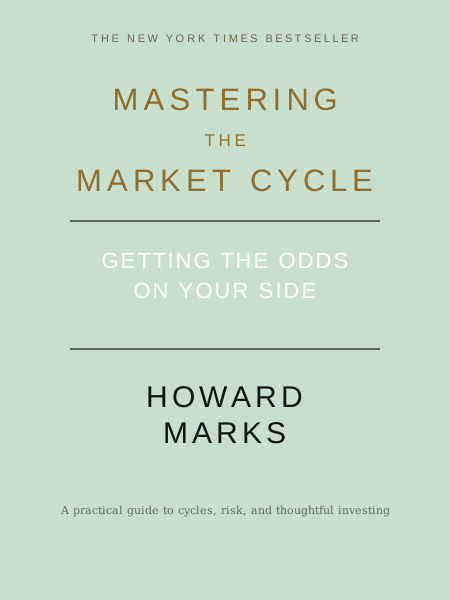
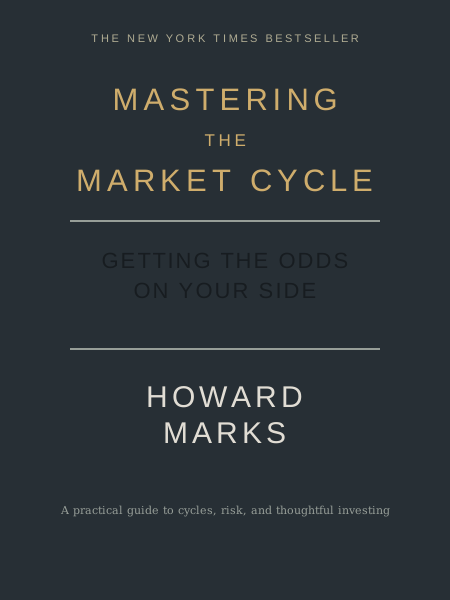
Mastering the Market Cycle
Howard Marks · 2018
Editorial rating
- Evidence
- 8/10
- Actionability
- 7/10
- Originality
- 7/10
The thesis
You can't predict the future, but you can assess where we are in the current cycle - and that's almost as valuable. Markets swing like a pendulum between euphoria and despair, and knowing which extreme is nearest helps you position your portfolio for better odds.
Who this is for
Active investors who want a framework for adjusting aggressiveness based on market conditions, institutional investors managing through multiple cycles, and anyone who suspects "it's different this time" is usually wrong.
My favorite quote
The greatest source of investment risk is the belief that there is no risk.
Why it matters
Risk tolerance peaks at exactly the wrong moment - when prices are highest and the margin of safety is smallest. The absence of perceived risk is itself the risk.
Do this
Review your current portfolio. Where are you assuming everything will work out? That's where you're most exposed.
Start here
Watch the pendulum, not the fundamentals. Market sentiment swings between "flawless" (everything will work out) and "hopeless" (nothing will work out), but spends almost no time in the middle. Your job is to recognize which extreme we're closest to and adjust accordingly - more aggressive when fear dominates, more defensive when greed reigns.
Critical summary
Howard Marks expands on the cycle concepts from The Most Important Thing into a full treatment of market, credit, and psychological cycles. The book argues that while predicting exact timing is impossible, assessing where we are in various cycles is both possible and essential.
Marks examines multiple interconnected cycles: economic, profit, credit, real estate, and psychological. His key insight is that small fluctuations in the economy produce large fluctuations in corporate profits, which produce even larger fluctuations in market prices - all amplified by human psychology swinging between risk tolerance and risk aversion.
What it gets right
- Compelling framework for thinking about cycles without pretending to time them precisely
- Credit cycle analysis is particularly insightful - explains why credit "window" opens and slams shut
- Practical guidance on positioning (aggressive vs. defensive) based on cycle assessment
- Honest about what you can and can't know
What it misses
- Can feel repetitive - same psychological drivers underlie all cycles, restated many times
- Less actionable than The Most Important Thing - more framework than tactics
- Some material overlaps heavily with his first book and his memos
- Doesn't help much with identifying cycle turns in advance
Evidence comes from Marks's 50+ years of experience in distressed debt, where cycle awareness is survival. The principles are sound, though application requires judgment the book can't fully teach.
Key concepts
The Pendulum
Markets swing between euphoria and despair, rarely stopping at the midpoint. Your job is knowing which extreme is nearest.
Credit Cycle
The availability of capital swings from "wide open" to "slammed shut" faster than any other cycle - and drives the others.
Risk Attitudes
When investors feel there's no risk, risk is actually highest. When they see risk everywhere, opportunities abound.
Excesses and Corrections
Rather than ups and downs, think excesses and their inevitable corrections. Trends go too far before reversing.
The Wealth Effect
When people feel rich, they spend more, which creates actual growth - until it reverses.
Capitulation
The final stage when investors abandon positions at the worst possible moment, compounding earlier errors.
Core insights
-
Cycles are inevitable - but timing is unknowable
You can't predict when cycles will turn, but you can position for what comes next based on where you are now.
-
The credit window is the most powerful cycle
When credit is easy, everything looks good; when it slams shut, even good assets can't find buyers.
-
Psychological extremes provide signals
When everyone is optimistic, be cautious. When everyone is terrified, be aggressive. Contrarianism isn't just attitude - it's strategy.
-
Risk is highest when it feels lowest
Maximum risk coincides with maximum optimism, maximum credit availability, and maximum prices.
-
Don't wait for the bottom
Buying early in a downturn is better than waiting for a bottom you'll never identify in real time.
Implementation steps
Today
- Assess current market sentiment: closer to euphoria or despair?
- Identify one area where you're assuming "things will work out"
This week
- Create a simple checklist of cycle indicators (credit spreads, sentiment surveys, valuation metrics)
- Review your portfolio's current aggressive/defensive positioning
This month
- Read Howard Marks's latest memo (free on Oaktree's website) for current cycle assessment
- Identify one position to reduce if we're late in the cycle, or add if we're early
Ongoing
- Track credit conditions - when lending becomes easy and indiscriminate, be cautious
- Resist capitulation during downturns; resist euphoria during upturns
Suggested 30-day practice plan
An editorial application plan created by Monolithic Vault - an interpretation of the book's ideas, not part of the original book.
- Day 1
Create your "where are we in the cycle?" assessment for current markets
- Day 2
Review credit spreads and lending standards - tight or loose?
- Day 3
Survey your own risk tolerance - are you feeling optimistic or fearful? (Your emotions mirror the market's)
- Day 7
Adjust one portfolio position based on cycle assessment
- Day 14
Read financial headlines with "cycle goggles" - what sentiment do they reveal?
- Day 21
Compare your current positioning to 2008 or 2020 - would you have survived?
- Day 30
Write your own "where are we now" memo to crystallize your thinking
Free PDF summary
Take this analysis with you: a designed two-page field-notes sheet with the thesis, my favorite quote, the key concepts and core insights, and the full 30-day checklist. Print it or keep it - free, no signup.
Go deeper
If this analysis earned your attention, the full book goes further than any summary can. The original is always the primary source.