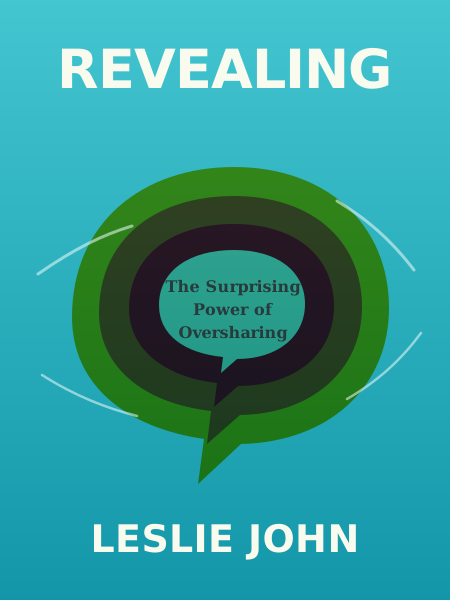
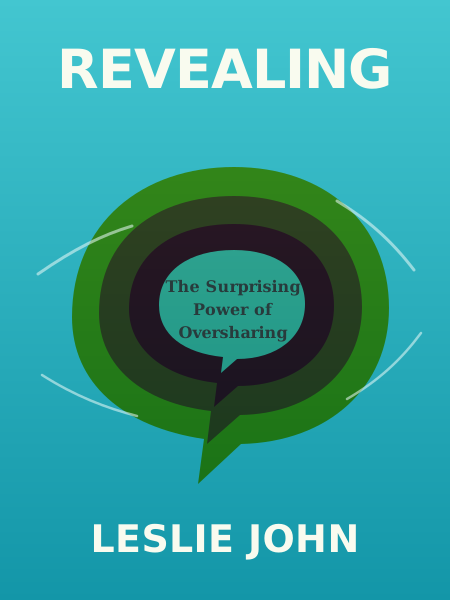
Revealing
Leslie John · 2026
Editorial rating
- Evidence
- 7/10
- Actionability
- 7/10
- Originality
- 5/10
The thesis
Most people systematically under-share, not overshare, and that habitual silence carries a real, chronically underestimated cost to trust, relationships, and career advancement.
Who this is for
Consultants and leaders who default to a polished, guarded "front stage" persona with clients and teams, and who want a research-based way to decide when openness actually pays off.
My favorite quote
We live in fear of saying too much... but what if we've been worrying about the wrong thing?
Why it matters
It challenges the default professional instinct to withhold, which most consultants are trained into rather than taught to question.
Do this
In your next client meeting, disclose one genuine uncertainty or limitation instead of projecting total confidence, and notice the response.
Start here
Use the four-quadrant disclosure check before deciding whether to share something: the rewards of revealing, the risks of revealing, the rewards of concealing, and the risks of concealing. Most people only weigh the first two and never register what silence is actually costing them.
Critical summary
John, a Harvard Business School behavioral scientist and privacy researcher, builds the book on over a decade of controlled experiments (not just anecdote) showing that people consistently overestimate the social and professional cost of disclosure and underestimate the cost of staying silent. The central mechanism is reciprocity: disclosure triggers disclosure, which is how strangers become collaborators and colleagues become people who can do hard things together.
What the book does well: it's genuinely grounded in experimental psychology rather than pure motivational writing, the "extraversion illusion" (mistaking talkativeness for openness) and the distinction between transparency (showing how you think) and vulnerability (showing what you feel) are both useful, precise concepts that hold up in a professional setting, not just a therapy context. The job-interview and workplace-disclosure sections translate directly into consulting and client-facing work.
Where it falls short: the genre is crowded. Bradford and Robin's "Connect," David Brooks's "How to Know a Person," and Alison Wood Brooks's "Talk" all cover closely overlapping ground on disclosure, trust, and being known, and at least one reviewer who's read all of them notes the anecdotes and framing repeat across the category rather than breaking new territory. The book is also, by John's own design, part-memoir, some readers find the amount of personal self-disclosure about her own life exceeds what's needed to make the research points, which is a slightly awkward irony for a book about calibrating disclosure. As with most books in this genre, "sharing appropriately builds trust" is a robust finding, but "appropriately" is doing a lot of work, the book is better at making the case for disclosure in general than at giving a sharp, situation-specific rule for exactly how much to reveal in a high-stakes client or negotiation context.
Key concepts
The Four-Quadrant Disclosure Check
Weigh rewards and risks of both revealing and concealing, not just the risks of revealing. Use it before a difficult client conversation where you're tempted to stay vague.
The Extraversion Illusion
Talkative, socially warm people aren't necessarily open or vulnerable, sociability and disclosure are different traits. Don't assume your most talkative team member is your most transparent one.
Transparency vs. Vulnerability
Transparency is cognitive openness (explaining how you think or work), vulnerability is emotional openness (admitting uncertainty or difficulty). Use transparency more freely at work, save vulnerability for moments that call for it.
Disclosure Reciprocity
When one person discloses, others feel both permission and social pressure to reciprocate. Model one honest disclosure early in a client relationship to accelerate trust.
Discerning Authenticity
The old "keep your front stage polished" playbook is outdated; selectively appropriate openness now reads as more competent and trustworthy, not less. Relevant when advising leaders who default to over-polished communication.
Core insights
-
Under-sharing has a real, underestimated cost
People overweight the risk of saying too much and underweight the cost of staying silent. Consequence: build in a deliberate check for "what is my silence costing here" in client and team communication.
-
Sharing appropriately builds trust faster than almost any other mechanism
Relevant for accelerating new client relationships, one calibrated disclosure early can do more than months of polished competence signaling.
-
Transparency is a lower-risk, high-value disclosure category
Explaining your reasoning or process is often undervalued compared to emotional vulnerability, and it's easier to deploy professionally.
-
Disclosure decisions are best made deliberately, not reactively
The anxious, in-the-moment "did I say too much" spiral is usually the wrong lens, the four-quadrant check is a better tool.
-
The book's own structure illustrates its limits
The heavy use of personal memoir shows how easily "appropriate" disclosure can tip into "too much," which is worth remembering when advising clients on their own communication style.
Implementation steps
Today
- Identify one situation where you're withholding out of habit rather than a clear risk assessment.
- Run it through the four-quadrant check before your next interaction.
This week
- Practice transparency (explaining your reasoning) rather than vulnerability in one client meeting, and notice the effect on trust.
- Watch for the extraversion illusion in your own team, who talks the most, and who actually discloses the most?
This month
- Introduce one deliberate, appropriate disclosure early in a new client relationship, and track how it affects the pace of trust-building.
- Coach one team member on the difference between transparency and oversharing.
Ongoing
- Make the four-quadrant disclosure check a standard tool before high-stakes conversations, not just an occasional exercise.
Suggested 30-day practice plan
An editorial application plan created by Monolithic Vault - an interpretation of the book's ideas, not part of the original book.
- Day 1
Read the chapters on the extraversion illusion and the four-quadrant check.
- Day 3
Apply the four-quadrant check to one real decision.
- Day 7
Practice transparency in a client meeting.
- Day 14
Model one appropriate disclosure early in a new relationship.
- Day 21
Coach a colleague on transparency vs. vulnerability.
- Day 30
Review whether deliberate disclosure changed the pace or depth of trust in a specific relationship.
Free PDF summary
Take this analysis with you: a designed two-page field-notes sheet with the thesis, my favorite quote, the key concepts and core insights, and the full 30-day checklist. Print it or keep it - free, no signup.
Go deeper
If this analysis earned your attention, the full book goes further than any summary can. The original is always the primary source.