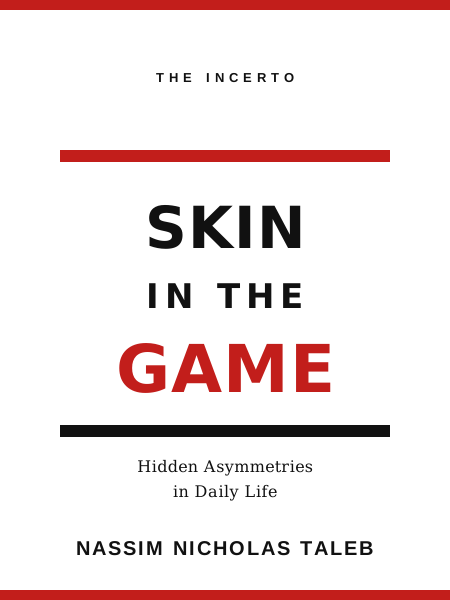
Skin in the Game
Nassim Nicholas Taleb · 2018
Editorial rating
- Evidence
- 6/10
- Actionability
- 6/10
- Originality
- 8/10
The thesis
People making decisions must bear the consequences of those decisions. When decision-makers are insulated from downside risk - politicians who start wars but don't fight, bankers who gamble with deposits but keep bonuses - systems become fragile, unethical, and eventually collapse. Symmetry between risk and reward is the foundation of functioning societies.
Who this is for
Executives designing incentive systems, investors evaluating management quality, policy-minded professionals questioning institutional failures, and anyone frustrated by experts who face no consequences for being wrong - from financial advisors to foreign policy hawks.
My favorite quote
Never trust anyone who doesn't have skin in the game. Without it, fools and crooks will benefit, and their mistakes will never come back to haunt them.
Why it matters
This is the book's thesis in one sentence. It explains everything from the 2008 financial crisis to bad medical advice to failed foreign interventions.
Do this
Before taking advice from anyone, ask: "What do they lose if they're wrong?" If the answer is "nothing," discount their opinion heavily.
Start here
Apply the Silver Rule before the Golden Rule: "Do not do unto others what you would not have them do unto you." This negative formulation is more actionable than "do unto others" because it defines clear boundaries. Before any decision affecting others, ask: "Would I accept this if the roles were reversed?" If not, don't do it.
Critical summary
Taleb, former options trader turned philosopher, completes his five-book "Incerto" series with an ethical manifesto. His central argument: skin in the game - bearing consequences for your decisions - is necessary for fairness, learning, and system stability. Those shielded from downside risk (bureaucrats, academics, certain executives) make increasingly reckless decisions because they don't pay for their mistakes.
The book weaves through ethics, risk management, religion, and politics with Taleb's characteristic aggression. He introduces useful concepts: the "Intellectual Yet Idiot" (IYI) who theorizes without real-world accountability, the "minority rule" explaining how small intolerant groups can dictate outcomes, and the "Lindy effect" suggesting time-tested ideas outlast trendy theories.
What it gets right
- The asymmetry critique is devastating: bankers kept bonuses from pre-crash gambles while taxpayers absorbed losses
- The minority rule explains phenomena from kosher food availability to political extremism
- Connects ancient wisdom (Hammurabi's Code) to modern incentive design
What it misses or overstates
- The book reads like a cantankerous cab ride (The Economist's apt description) - stream-of-consciousness structure, frequent score-settling
- Taleb's attacks on specific academics (Pinker, Thaler, Dawkins) feel personal rather than substantive
- The "survival = rationality" argument has holes: plenty of irrational beliefs have survived centuries
- Self-congratulatory tone and constant references to his trading success become grating
- Ideas that sound compelling in the abstract often fail in the particular (Guardian critique)
- Limited practical guidance for implementing skin-in-the-game principles in organizations
The core insight is powerful and underappreciated. The packaging is frustrating. Read for the ideas; skim the vendettas.
Key concepts
Skin in the Game (SITG)
Bearing downside risk for your decisions. Before trusting any advisor, ask what they lose if wrong.
The Silver Rule
"Do not do unto others what you would not have them do unto you." More actionable than the Golden Rule because it sets clear limits.
Intellectual Yet Idiot (IYI)
Credentialed experts who theorize without accountability. Their errors cost them nothing. Discount their confidence.
The Lindy Effect
The longer something has survived, the longer it will likely survive. Books read for 100 years will outlast bestsellers.
Minority Rule
A small intolerant minority can dictate outcomes for the majority (kosher/halal food, peanut-free policies). Use to understand social dynamics.
Ergodicity
The difference between what happens to one person over time vs. many people at once. Personal ruin isn't captured by average returns.
Core insights
-
Asymmetry corrupts systems
When decision-makers keep upside but transfer downside to others, they take increasingly reckless risks. Look for this pattern everywhere.
-
Talk is cheap; action reveals belief
"Don't tell me what you think, tell me what's in your portfolio." What people risk shows what they truly believe.
-
Survival is the ultimate rationality
Practices that seem irrational (religious rituals, superstitions) may have survived because they aided group survival. Respect Lindy.
-
Soul in the game beats skin in the game
Beyond financial risk, care about reputation, craft, and legacy. Artisans who sign their work produce better work.
-
Beware the Bob Rubin trade
Named after the Citigroup exec who made $120M then left before the crash. Identify who profits from volatility they create.
Implementation steps
Today
- List 3 people whose advice you follow. What do they lose if they're wrong?
- Identify one decision you're making where you bear no downside. How does that affect your judgment?
This week
- Audit your organization's incentive structures: where is risk and reward asymmetric?
- Apply the Silver Rule to one difficult decision: "Would I accept this if roles were reversed?"
This month
- Propose one structural change that aligns incentives better (clawback provisions, deferred compensation, etc.)
- Identify your IYIs: which "experts" in your life have no skin in the game?
Ongoing
- Before major decisions, ask: "Who bears the downside if this fails?"
- Favor time-tested (Lindy) approaches over novel theories when stakes are high
- Build "soul in the game" - care about your reputation and craft beyond financial incentives
Suggested 30-day practice plan
An editorial application plan created by Monolithic Vault - an interpretation of the book's ideas, not part of the original book.
- Day 1
Read Prologue and Part 1; identify 3 areas in your life with asymmetric risk/reward
- Day 2
Apply "What do they lose?" filter to advice you've recently received
- Day 3
Map the IYIs in your professional sphere - who theorizes without accountability?
- Day 7
Conduct incentive audit of your team or organization; note asymmetries
- Day 14
Propose one structural fix for misaligned incentives
- Day 21
Practice Silver Rule for one week on all decisions affecting others
- Day 30
Review: where have you increased symmetry? Where does asymmetry persist?
Free PDF summary
Take this analysis with you: a designed two-page field-notes sheet with the thesis, my favorite quote, the key concepts and core insights, and the full 30-day checklist. Print it or keep it - free, no signup.
Go deeper
If this analysis earned your attention, the full book goes further than any summary can. The original is always the primary source.