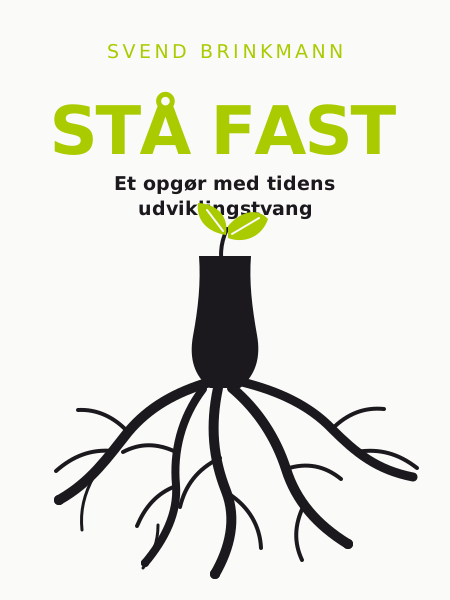
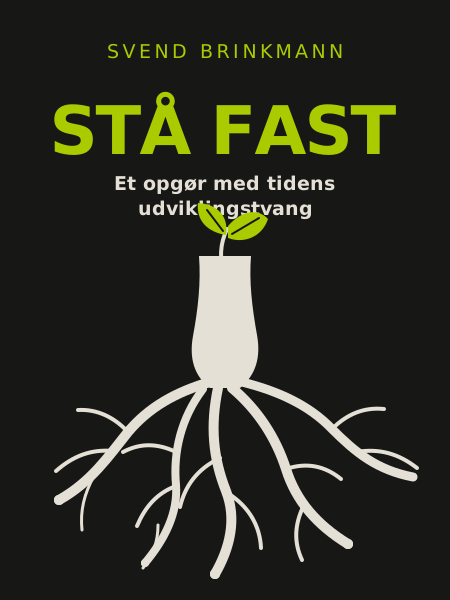
Stå fast
Svend Brinkmann · 2014
Editorial rating
- Evidence
- 5/10
- Actionability
- 7/10
- Originality
- 8/10
The thesis
A stable life requires commitments, duties, and limits that do not change whenever your feelings or the market demand a new version of you. Constant self-development can become dependence when every discomfort is treated as evidence that you need another transformation.
Who this is for
Professionals exhausted by permanent change programs, people trapped in self-optimization, managers tired of compulsory enthusiasm, and readers who need permission to say no without turning resistance into cynicism.
My favorite quote
Det har ingen værdi at være sig selv, men det har til gengæld værdi at gøre sin pligt over for sine medmennesker.
Why it matters
Brinkmann replaces authenticity as the supreme good with responsibility to people and principles outside the self.
Do this
Do one necessary thing today because it serves another person, even if it does not match your mood or personal brand.
Start here
Practice the no hat. Decline one request that conflicts with an existing duty, value, or limit, and give a short reason without turning the refusal into a confession about your feelings.
Critical summary
Svend Brinkmann wrote Stå fast as a deliberately inverted self-help book during a period when flexibility, coaching, authenticity, and positive thinking had become default virtues in Danish working life. His target is development compulsion: the demand to keep moving, adapting, finding potential, and interpreting every problem as a personal growth opportunity. The response is a seven-step counter-program influenced by Stoicism. Stop constantly searching your inner feelings for guidance. Focus on negative possibilities so loss and limitation become thinkable. Put on the no hat and protect commitments from endless opportunity. Control feelings rather than treating emotional expression as automatically authentic. Fire the coach who makes permanent self-reinvention seem necessary. Read novels instead of biographies and self-help books because fiction expands attention beyond the self. Dwell on the past rather than worshipping whatever is new. The instructions are intentionally exaggerated. Brinkmann uses provocation to expose how strange the opposite commandments already are: always say yes, stay positive, follow passion, forget history, and remain endlessly employable. Beneath the satire sits a serious ethical claim that identity is built through relationships, duties, institutions, and practices, not discovered as a pure voice hidden inside the individual.
What it gets right
- Names the exhaustion produced when organizations present every imposed change as an exciting opportunity for personal development
- Restores refusal, doubt, grief, criticism, and loyalty as legitimate responses rather than defects in attitude
- Shifts moral attention from self-expression toward obligations, shared institutions, literature, history, and other people
What it overstates or misses
- Caricatures coaching, therapy, positive psychology, and emotional reflection even though each can be useful when practiced carefully
- Advice to suppress feelings can be misread as emotional avoidance, especially by readers already trained to ignore distress
- Selects Stoic themes that support resistance while giving less attention to the tradition's emphasis on active moral improvement
The evidence is philosophical, cultural, and rhetorical rather than a balanced review of psychological research. That is partly the point: the book offers a counterweight, not a neutral handbook. Its best ideas work when translated into boundaries, acceptance, and principled commitment; its weakest slogans become harmful when applied literally to illness, trauma, or necessary change. The verdict: an excellent corrective dose that should never become the whole prescription.
Key concepts
Development Compulsion
The cultural demand to treat stability as failure and every part of life as a project requiring continuous improvement.
The No Hat
Refuse opportunities that violate priorities, duties, or limits instead of saying yes merely to appear flexible and positive.
Negative Visualization
Imagine loss and difficulty to prepare realistically and appreciate what already exists without demanding permanent optimism.
Duty Before Authenticity
Judge actions by their ethical effect on others, not only by whether they feel true to your current inner state.
Rootedness
Build identity through durable relationships, practices, history, and commitments that remain when moods and trends change.
Core insights
-
Endless Growth Creates Dependence
A person taught that every discomfort requires development will always need another coach, method, course, or identity update.
-
A Good No Protects a Better Yes
Refusal preserves attention for obligations that were chosen before the newest opportunity arrived.
-
Feelings Inform but Do Not Command
Emotional awareness matters, but strong feelings do not automatically determine the right action.
-
Negativity Can Be Honest and Useful
Criticism, grief, and anticipated difficulty reveal problems that compulsory positivity tries to privatize or silence.
-
The Self Is Relational
Character emerges through promises kept, roles inhabited, and people served rather than through endless introspection.
Implementation steps
Today
- Decline one nonessential request with a clear sentence that refers to an existing priority or limit.
- Write one current problem without adding a lesson, silver lining, or demand that it make you stronger.
This week
- Replace one hour of self-improvement content with a novel, history book, or conversation about someone else's experience.
- Keep one promise despite a temporary loss of motivation and observe the difference between mood and commitment.
This month
- Identify three values or duties you will not renegotiate whenever a new trend, role, or opportunity appears.
- Remove one recurring source of compulsory optimization, such as performance tracking, coaching content, or constant goal revision.
Ongoing
- Use feelings as information while letting reason, responsibility, and consequences determine action.
- Maintain relationships and institutions that give you roots strong enough to resist unnecessary change.
Suggested 30-day practice plan
An editorial application plan created by Monolithic Vault - an interpretation of the book's ideas, not part of the original book.
- Day 1
Name one area where constant self-improvement has created more pressure than progress.
- Day 3
Say no to one request that conflicts with an established commitment.
- Day 7
Practice negative visualization by considering a realistic loss and identifying what deserves appreciation now.
- Day 14
Finish one week without changing a goal merely because motivation fluctuated.
- Day 21
Read a work of fiction and record what it revealed about a life unlike your own.
- Day 30
Write a personal resistance guide listing what you will adapt, what you will question, and what you will stand firm on.
Free PDF summary
Take this analysis with you: a designed two-page field-notes sheet with the thesis, my favorite quote, the key concepts and core insights, and the full 30-day checklist. Print it or keep it - free, no signup.
Go deeper
If this analysis earned your attention, the full book goes further than any summary can. The original is always the primary source.