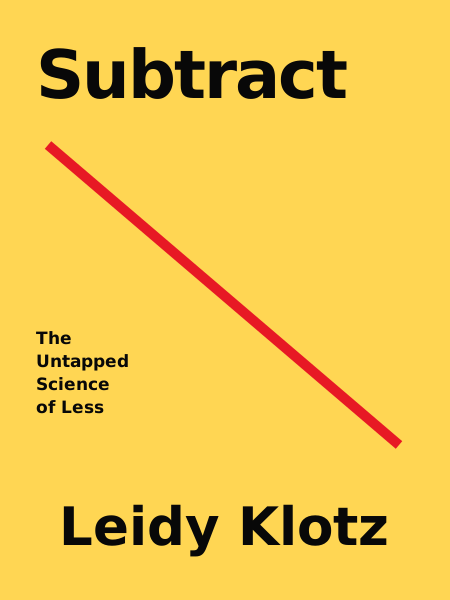
Subtract
Leidy Klotz · 2021
Editorial rating
- Evidence
- 8/10
- Actionability
- 6/10
- Originality
- 8/10
The thesis
When we try to improve things, we instinctively add - more features, more rules, more commitments. But subtraction is systematically overlooked, even when removing is the better solution. This cognitive bias costs us efficiency, clarity, and resources.
Who this is for
Product designers and engineers who keep adding features, managers drowning in processes they never question, and anyone whose to-do list, schedule, or possessions have grown beyond control.
My favorite quote
Saying no is not subtracting.
Why it matters
This distinguishes between declining new additions (saying no) and actively removing what's already there (subtracting). Both matter, but subtraction is the neglected skill.
Do this
Look at your calendar for next week. Instead of asking what to add, ask: which existing meeting can be removed entirely?
Start here
Before making any change, explicitly ask: "What could I subtract?" Klotz's research shows we systematically overlook subtraction as an option - even when it's the better solution. Whether you're planning a trip, designing a product, or organizing your schedule, force yourself to consider what you could remove before adding anything new.
Critical summary
Klotz, a professor of engineering at the University of Virginia, began his research after watching his three-year-old son solve a Lego problem by removing a block while Klotz instinctively reached to add one. The resulting studies, published in Nature, established "subtraction neglect" as a robust phenomenon.
What it gets right
- Research is rigorous - experiments are well-designed and the effect replicates across domains
- Distinguishes subtraction from minimalism or "less is more" platitudes
- Historical examples are compelling (San Francisco's freeway, Bruce Springsteen's album editing)
- Identifies biological, cultural, and economic forces that bias us toward addition
What it misses
- The book itself could use some subtraction - some anecdotes wander
- Light on practical frameworks for implementing subtraction in organizations
- Cultural analysis (Western vs. Asian philosophy) feels speculative
- Less accessible than comparable pop-science books; occasionally reads like extended academic paper
The core insight - that we systematically fail to consider subtraction - is genuinely novel and empirically supported. This isn't just "less is more" recycled; Klotz has identified a specific cognitive blind spot with real consequences for design, policy, and personal life.
Key concepts
Subtraction Neglect
The systematic tendency to overlook subtraction as a way to improve things, even when it's optimal.
Addition vs. Subtraction
Adding creates something new; subtracting removes something existing. Both can solve problems, but we default to adding.
Saying No ≠ Subtracting
Declining new additions is different from actively removing what's already there. Both matter.
Loss Aversion in Subtraction
We resist removing things partly because we experience it as loss, even when the net is positive.
Subtractive Change
In complex systems, sometimes the only way forward is to remove elements rather than add new ones.
Field vs. Object Orientation
Cultures that see things as interconnected systems may find subtraction more natural than object-focused cultures.
Core insights
-
Subtraction is invisible
When you remove something, the thing you removed is no longer there to remind you it worked.
-
Addition feels like progress
Adding creates visible evidence of effort. Subtracting leaves... nothing. Organizations reward visible effort.
-
Even cues don't fully fix the bias
When researchers reminded participants that they could subtract, they did more - but still defaulted to addition.
-
Subtraction requires more cognitive effort
Your brain must first consider what exists, then imagine it gone. Addition is cognitively cheaper.
-
Some domains urgently need subtraction
Climate change, regulation, schedules - overshoot problems require removal, not more additions.
Implementation steps
Today
- Review your to-do list: what three items could you delete rather than complete?
- Look at one current project: what feature, step, or requirement could be removed?
This week
- Audit your calendar: which recurring meeting provides least value? Propose eliminating it
- Review one process at work: which steps exist from legacy rather than necessity?
This month
- Before any new initiative, explicitly ask: "Could subtraction solve this instead?"
- Declutter one physical space - experience how removing creates value
Ongoing
- Build subtraction into decision templates: "What could we remove?" as standard agenda item
- Celebrate subtractive wins as visibly as additive ones
Suggested 30-day practice plan
An editorial application plan created by Monolithic Vault - an interpretation of the book's ideas, not part of the original book.
- Day 1
Audit to-do list; delete three items that don't truly need doing
- Day 2
Review calendar; identify one meeting to propose eliminating
- Day 3
Ask "What could we subtract?" in one work discussion
- Day 7
Conduct one process audit; remove at least one unnecessary step
- Day 14
Declutter one physical area; note how removal feels
- Day 21
Introduce "What could we remove?" as standing question in team meeting
- Day 30
Reflect - where has subtraction created more value than addition would have?
Free PDF summary
Take this analysis with you: a designed two-page field-notes sheet with the thesis, my favorite quote, the key concepts and core insights, and the full 30-day checklist. Print it or keep it - free, no signup.
Go deeper
If this analysis earned your attention, the full book goes further than any summary can. The original is always the primary source.