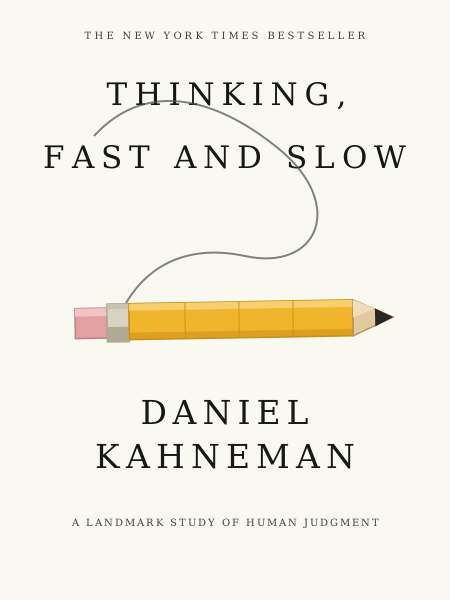
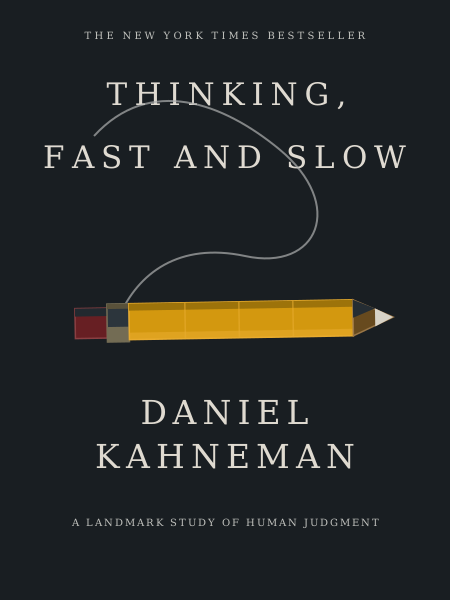
Thinking, Fast and Slow
Daniel Kahneman · 2011
Editorial rating
- Evidence
- 8/10
- Actionability
- 5/10
- Originality
- 9/10
The thesis
Your mind operates through two systems: System 1 (fast, automatic, intuitive) and System 2 (slow, effortful, analytical). Most errors in judgment stem from System 1's shortcuts hijacking decisions that require System 2's scrutiny.
Who this is for
Consultants and analysts who need to make high-stakes decisions under uncertainty, anyone who wants to understand why smart people consistently make predictable errors, and leaders who need to design better decision-making processes.
My favorite quote
Nothing in life is as important as you think it is, while you are thinking about it.
Why it matters
This "focusing illusion" explains why we overvalue whatever currently has our attention - whether it's a problem, opportunity, or fear.
Do this
Before your next major decision, write down three other things you're not currently thinking about that might matter more.
Start here
Use pre-mortems for major decisions: Before committing, imagine it's a year later and the decision failed catastrophically. Write down all the reasons why. This activates System 2 and surfaces risks your intuition missed. Takes 10 minutes, prevents months of regret.
Critical summary
Kahneman, a Nobel laureate psychologist, synthesizes decades of research on cognitive biases into a unified framework. The book's core model - System 1 vs. System 2 - provides a memorable lens for understanding why we make irrational decisions despite knowing better.
What it gets right
- The dual-system model is genuinely useful for self-awareness
- Anchoring, loss aversion, and availability bias are well-documented and actionable
- Prospect theory (we feel losses ~2x more than equivalent gains) has massive practical implications
- The book respects reader intelligence while remaining accessible
What it misses or overstates
- Many studies cited have failed to replicate during psychology's replication crisis
- Chapter 4 on priming is largely discredited - Kahneman later admitted the evidence was weaker than he believed
- The book offers diagnosis without much prescription - knowing about biases doesn't automatically fix them
- At 500 pages, it's roughly twice as long as it needs to be
- Some examples feel cherry-picked to support predetermined conclusions
Evidence quality: Mixed. Kahneman's own work on heuristics and prospect theory is robust and has replicated well. However, studies he cites from other researchers - particularly priming and embodied cognition research - have not held up. A meta-analysis found only 6 of 13 empirical chapters have an R-index above 50% for replicability. Read as "an eminent psychologist's perspective" rather than settled science.
Key concepts
System 1
Fast, automatic thinking - pattern recognition, intuitions, snap judgments. Use it for routine decisions; distrust it for novel situations.
System 2
Slow, effortful thinking - analysis, logic, calculation. Deploy it deliberately when stakes are high.
WYSIATI (What You See Is All There Is)
We build coherent stories from limited information without noticing what's missing. Ask "What don't I know?"
Anchoring
First numbers heard bias subsequent estimates. In negotiations, make the first offer.
Loss Aversion
Losses hurt ~2x more than equivalent gains feel good. Frame choices accordingly.
Availability Heuristic
We judge probability by how easily examples come to mind. Recent events loom larger than statistics.
Core insights
-
Your confidence is not evidence
Feeling certain about a judgment tells you nothing about its accuracy. System 1 generates confident answers whether or not they're correct.
-
Substitution is invisible
When facing hard questions, your brain secretly swaps in easier ones without telling you. "Is this a good investment?" becomes "Do I like the CEO?"
-
The planning fallacy is universal
We systematically underestimate time, cost, and risk while overestimating benefits. Outside view beats inside view.
-
Regression to the mean isn't punishment
Extreme performance tends toward average - not because success causes complacency, but because of statistics. Don't over-correct after outliers.
-
Hindsight bias corrupts learning
Once you know an outcome, you can't accurately remember what you believed before. Keep prediction records.
-
Experienced vs. remembered self
The self who lives through an experience and the self who remembers it have different preferences. The ending dominates memory.
Implementation steps
Today
- Take the Cognitive Reflection Test (bat and ball problem) to calibrate your System 1 overconfidence
- Identify one upcoming decision and write "What am I not considering?" at the top of your notes
This week
- Run a pre-mortem on your most important current project
- Notice when you're substituting "How do I feel about this?" for "Is this actually good?"
This month
- Start a prediction journal: Write specific predictions with probabilities, then track outcomes
- Implement "reference class forecasting" for estimates - find similar past projects and use their actual timelines
Ongoing
- Before major decisions, actively seek disconfirming evidence
- When surprised by an outcome, ask "What should I have known?" before hindsight bias sets in
Suggested 30-day practice plan
An editorial application plan created by Monolithic Vault - an interpretation of the book's ideas, not part of the original book.
- Day 1
Read the bat-and-ball problem explanation, notice where your intuition fails
- Day 2
List 3 recent decisions where you felt very confident - examine the basis for that confidence
- Day 3
Identify one area where availability bias affects your judgment (recent news, vivid stories)
- Day 7
Run your first pre-mortem on an active project; document 5+ failure modes
- Day 14
Review your prediction journal - are you well-calibrated? Adjust confidence levels
- Day 21
Use reference class forecasting on your next estimate; compare to your intuitive guess
- Day 30
Teach WYSIATI to a colleague - test whether you can explain it clearly
Free PDF summary
Take this analysis with you: a designed two-page field-notes sheet with the thesis, my favorite quote, the key concepts and core insights, and the full 30-day checklist. Print it or keep it - free, no signup.
Go deeper
If this analysis earned your attention, the full book goes further than any summary can. The original is always the primary source.