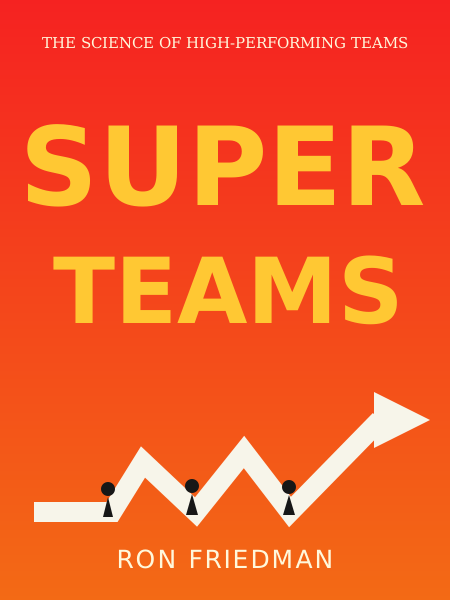
Superteams
Ron Friedman · 2026
Editorial rating
- Evidence
- 6/10
- Actionability
- 8/10
- Originality
- 5/10
The thesis
The best teams don't collaborate the most, agree the most, or work the longest hours. They differ in how they manage focus, energy, and feedback, and that can be replicated.
Who this is for
Managers and team leads tired of meeting-heavy, underperforming teams who want a concrete, research-based direction instead of another generic "teamwork matters" course.
My favorite quote
The most successful teams aren't the ones that collaborate most, get along best, or put in the longest hours.
Why it matters
It challenges the widespread assumption that more collaboration and more meetings automatically produce better results.
Do this
Count your team's meeting hours this week, and cut one recurring meeting that doesn't lead to a decision.
Start here
Introduce the rule "no decision, no meeting." If a meeting doesn't end with a concrete decision or action, it should either be restructured or eliminated. According to Friedman, it's the single simplest change that frees up the most time in a team.
Critical summary
Friedman, known for "The Best Place to Work" and "Decoding Greatness", surveyed over 6,000 professionals across industries and identified the roughly 8% who score highest on self-reported team performance, "superteams." The book maps what these teams do differently: they deliberately manage attention and energy, they give each other peer-to-peer feedback more often than average, and they actively seek input early instead of waiting for leadership approval.
What the book does well: it's concrete. Recommendations like cutting meeting time in half, asking better decision questions, and designing rest as a performance factor rather than a concession are directly usable in consulting work. The cases span widely (the Succession writers' room, ABBA's studio, NASA labs), making the book an easy read full of retellable stories for client workshops.
What should be taken with a grain of salt: the method relies on self-reported performance, teams rating themselves as high-performing compared to teams that don't. That's not the same as independently measured output or financial results, and there's an obvious risk that "superteams" are simply teams good at feeling good, which correlates with, but isn't identical to, actual performance. The book is also very recent (June 2026), so there's no independent, critical review yet to weigh the conclusions against, only publisher and author-driven material. Much of the content also overlaps with already established work: Duhigg's "Smarter Faster Better", Lencioni's "The Five Dysfunctions of a Team", and Edmondson's work on psychological safety. The originality lies more in the new data collection than in the conclusions themselves.
Key concepts
No Decision, No Meeting
Every meeting should end with a decision or action, or it should be eliminated or redesigned. Use it as a filter on your own meeting calendar this week.
Feedback Seeking
Superteams are characterized by members actively seeking feedback early, rather than only receiving it top-down. Introduce a "show your work early" practice on client projects.
Energy Management over Time Management
It's not the number of hours but how focus, breaks, and recovery are managed that separates top teams. Build actual breaks into project plans, not just deadlines.
Peer-to-Peer Feedback Rate
Top teams receive markedly more feedback from colleagues than from managers. Create a regular round where team members give each other feedback before it goes to the client.
The 8% Benchmark
Only about 8% of teams in the study qualify as superteams, a reminder that most organizational "best practices" aren't the norm, they're the exception.
Core insights
-
Less collaboration, more results
Constant collaboration disrupts focused individual work. Consequence: create explicit "no meeting" blocks in the team's calendar.
-
Smart decisions come from the right question, not more data
One well-chosen question can make decisions up to 30% smarter according to the study. Test it on your next client decision.
-
Praise only works if it's experienced as motivating, not critical
Top teams give feedback that's experienced as motivating twice as often. Train yourselves on the framing, not just the frequency.
-
Burnout is a design problem, not a willpower problem
Recovery is structured into top teams' work, not left to individual self-discipline. Relevant for the overwork culture in consulting.
-
Self-reported data has a built-in bias
It's worth checking the book's conclusions against actual deliverables and client satisfaction, not just the team's own sense of being a "superteam."
Implementation steps
Today
- Review this week's meetings and mark which ones didn't end with a decision.
- Cancel or restructure one of them.
This week
- Introduce a regular peer-feedback round in one active project team.
- Test one "better question" instead of another status round at your next decision meeting.
This month
- Build real recovery blocks into a project plan, not just deadlines.
- Measure meeting time before and after introducing the "no decision, no meeting" rule.
Ongoing
- Check quarterly whether the team's own sense of performance matches actual deliverables and client feedback, not just self-report.
Suggested 30-day practice plan
An editorial application plan created by Monolithic Vault - an interpretation of the book's ideas, not part of the original book.
- Day 1
Map your current meeting pattern and note how many actually ended with a decision.
- Day 3
Introduce "no decision, no meeting" on one recurring meeting.
- Day 7
Test peer-to-peer feedback in one project group.
- Day 14
Introduce a recovery block in the project plan.
- Day 21
Measure meeting time and compare it to the baseline.
- Day 30
Evaluate whether the changes moved anything actually measurable, not just perceived satisfaction.
Free PDF summary
Take this analysis with you: a designed two-page field-notes sheet with the thesis, my favorite quote, the key concepts and core insights, and the full 30-day checklist. Print it or keep it - free, no signup.
Go deeper
If this analysis earned your attention, the full book goes further than any summary can. The original is always the primary source.