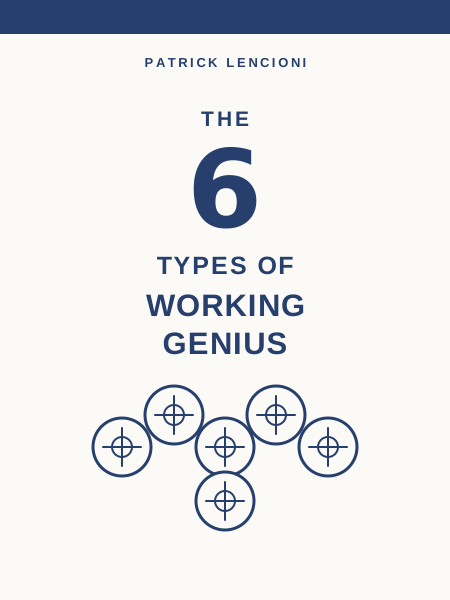
The 6 Types of Working Genius
Patrick Lencioni · 2022
Editorial rating
- Evidence
- 4/10
- Actionability
- 9/10
- Originality
- 7/10
The thesis
People burn out not only from too much work but from spending too much time in work that drains them. Teams perform better when every stage of work is covered by people naturally energized to do it.
Who this is for
Managers redesigning roles, founders whose team starts well but finishes poorly, and capable employees confused about why certain tasks exhaust them despite strong performance.
My favorite quote
we have to ideate, activate, and implement.
Why it matters
The sentence captures the full arc of work and exposes why teams stall when they value only ideas or execution.
Do this
Place your current project under ideation, activation, or implementation and name the missing contribution.
Start here
Map work before mapping people. Every project moves through ideation, activation, and implementation, and each stage needs two distinct contributions. Most team friction becomes easier to diagnose when you ask which kind of work is missing instead of who is underperforming.
Critical summary
Patrick Lencioni developed the Working Genius model after noticing that some tasks energized him while others made him miserable even when he could perform them competently. He presents the idea through a business fable, then explains six contributions arranged across three stages of work. Ideation begins with Wonder, which notices unmet potential and asks whether something should change, and Invention, which creates an original response. Activation requires Discernment, the intuitive judgment that evaluates ideas, and Galvanizing, the energy that rallies people into motion. Implementation depends on Enablement, the willingness to support what others need, and Tenacity, the drive to finish and verify results. Lencioni argues that most people have two geniuses that give energy, two competencies they can perform without much joy, and two frustrations that drain them. Teams should cover all six rather than expect every person to contribute equally at every stage.
What it gets right
- Separates capability from energy, explaining why a high performer can still be badly matched to recurring work
- Gives teams a shared vocabulary for workflow gaps without turning every problem into a personality conflict
- Makes role redesign practical by focusing on tasks and project stages rather than demanding immediate career changes
What it overstates or misses
- Presents a proprietary six-part model with little independent validation or evidence that the categories are stable traits
- Encourages tidy labels that may understate learning, context, incentives, and the need to perform unpleasant work
- Uses a long fable to deliver a framework that can be explained clearly in a few pages
The book's evidence is largely Lencioni's consulting experience, internal assessment data, and reader recognition rather than peer-reviewed organizational psychology. That does not make the model useless, but it should be treated as a conversation tool, not a diagnosis of permanent human wiring. Its practical value appears when teams map real work, redistribute recurring tasks, and notice missing stages. The verdict: skip the mystique, keep the workflow map.
Key concepts
Wonder
The natural tendency to notice unrealized potential and ask whether a better possibility exists; use it before rushing into solutions.
Invention
The drive to create original ideas or answers from a blank page; give it a clear question rather than a vague demand for creativity.
Discernment
The intuitive ability to evaluate ideas and spot what fits; invite it before enthusiasm turns into commitment.
Galvanizing
The energy to rally people around a decision and generate movement; use it when a sound idea remains inert.
Enablement and Tenacity
The paired implementation gifts of helping others move and ensuring work reaches completion; protect both from being treated as lesser support roles.
Core insights
-
Competence can hide misfit
Being good at a task does not mean it is sustainable, so track energy as well as performance when designing roles.
-
Projects fail between stages
A team can generate excellent ideas yet stall without discernment, mobilization, support, or disciplined completion.
-
Every genius has a blind spot
People tend to undervalue work that feels easy to them and judge colleagues for contributions they cannot see.
-
Role design beats wholesale reinvention
Small changes to meetings, ownership, and recurring tasks can improve fit without changing jobs.
-
Labels should start conversations
Use the model to test patterns in actual work, not to excuse avoidance or freeze people into boxes.
Implementation steps
Today
- List five recurring tasks and mark each as energizing, neutral, or draining.
- Identify which of the six contributions is missing from one stalled project.
This week
- Map a real project across ideation, activation, and implementation with a named owner for each contribution.
- Ask each teammate which task others assume they enjoy but actually find draining.
This month
- Reassign or rotate one recurring responsibility that sits in a person's frustration zone.
- Redesign one meeting so it has a clear stage, purpose, and required type of contribution.
Ongoing
- Review role fit quarterly using observed tasks and energy, not assessment labels alone.
- Make every team member capable of covering frustrations while concentrating most time in geniuses and competencies.
Suggested 30-day practice plan
An editorial application plan created by Monolithic Vault - an interpretation of the book's ideas, not part of the original book.
- Day 1
Complete a personal task inventory and estimate time spent in genius, competency, and frustration work.
- Day 3
Predict your two geniuses before taking or reviewing the assessment.
- Day 7
Compare the model with feedback from two colleagues who see your work closely.
- Day 14
Map the team's current project across all six contributions and identify one gap.
- Day 21
Test one role or workflow adjustment and track energy, speed, and quality.
- Day 30
Keep the changes that improved results and discard labels unsupported by actual behavior.
Free PDF summary
Take this analysis with you: a designed two-page field-notes sheet with the thesis, my favorite quote, the key concepts and core insights, and the full 30-day checklist. Print it or keep it - free, no signup.
Go deeper
If this analysis earned your attention, the full book goes further than any summary can. The original is always the primary source.