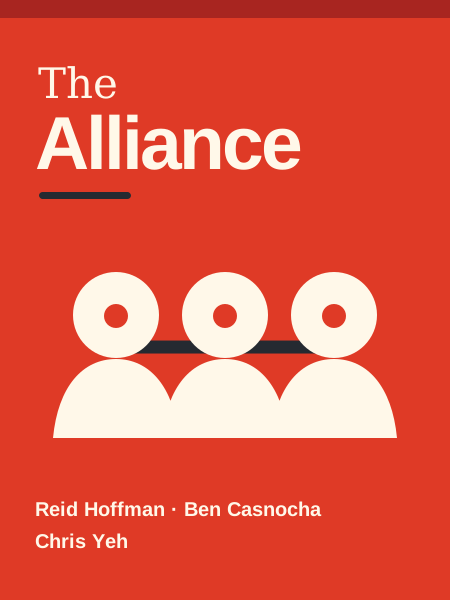
The Alliance
Reid Hoffman, Ben Casnocha, Chris Yeh · 2014
Editorial rating
- Evidence
- 6/10
- Actionability
- 8/10
- Originality
- 7/10
The thesis
The old employer-employee compact is broken. Lifetime employment is dead, but pure free agency doesn't build trust. The solution: think of employment as an alliance - a mutually beneficial deal with explicit terms between independent players, structured around "tours of duty."
Who this is for
Managers struggling to retain entrepreneurial talent, HR leaders designing modern employment frameworks, and employees who want honest conversations about their career trajectory within a company.
My favorite quote
The fundamental paradox of the tour of duty: acknowledging that the employee might leave is actually the best way to build trust, and thus develop the kind of relationship that convinces great people to stay.
Why it matters
Counter-intuitive but true. Pretending employees will stay forever creates dishonesty. Acknowledging reality builds trust.
Do this
In your next 1-on-1 with a direct report, ask: "What job do you want after this one - here or elsewhere?" Watch trust increase.
Start here
Tours of Duty: Define employment as explicit, time-bounded missions (2-5 years typically). Each tour has clear objectives and success criteria. When the tour ends, negotiate the next one - or part ways honestly. This replaces vague promises with concrete commitments.
Critical summary
Reid Hoffman (LinkedIn co-founder), Ben Casnocha, and Chris Yeh propose a third way between lifetime employment (dead) and free agency (corrosive to trust). The "alliance" framework treats employment as a series of explicit tours of duty with mutual obligations.
The book outlines three tour types: Rotational (entry-level programs), Transformational (personalized missions that change both employee and company), and Foundational (long-term commitments for key leaders). It also covers network intelligence (leveraging employee networks for business insight) and alumni networks (maintaining relationships after departure).
What it gets right
- Framework is genuinely practical and implementable
- Tours of duty language clarifies fuzzy employment expectations
- Network intelligence chapter adds real value
- Alumni network concept is underutilized by most companies
What it misses
- Silicon Valley bias - not all industries work like tech startups
- Power imbalance between employer/employee is underacknowledged
- Some tactics feel manipulative if implemented cynically
- LinkedIn promotion throughout (Hoffman is the founder)
Evidence is primarily from Hoffman's experience at LinkedIn and PayPal. Useful but narrow.
Key concepts
Tour of Duty
A defined period (2-5 years) with explicit mission, success criteria, and mutual commitments. Not employment-at-will, not lifetime employment.
Rotational Tour
Standardized entry-level programs. Interchangeable employees in predefined roles.
Transformational Tour
Personalized mission that transforms both the employee's career and the company's capabilities.
Foundational Tour
Long-term commitment where the employee's identity merges with the company's mission.
Network Intelligence
Using employees' external networks to gather market insights and competitive information.
Corporate Alumni Network
Maintaining relationships with former employees as brand ambassadors and business resources.
Core insights
-
Honesty beats loyalty theater
Pretending employees will stay forever creates distrust. Acknowledge reality to build real loyalty.
-
Tours should be explicit
Vague promises ("you'll gain valuable experience") lose to concrete commitments ("in 3 years, you'll have shipped X and learned Y").
-
Invest in their employability
Help employees become more marketable - even if they leave. They'll stay longer and work harder.
-
Alumni are assets, not traitors
Former employees who leave on good terms become customers, partners, and referral sources.
-
Alignment conversations beat performance reviews
Regularly discuss how the tour is serving both parties, not just whether goals are met.
Implementation steps
Today
- For one direct report, draft what their "tour of duty" might be
- List 5 former employees you've lost touch with
This week
- Have an alignment conversation: ask a direct report what job they want after this one
- Reconnect with one valuable former colleague
This month
- Define tour of duty parameters for your team: what does success look like? What's the timeline?
- Propose or pilot a corporate alumni program
Ongoing
- Conduct quarterly alignment check-ins (not just performance reviews)
- Treat departures as graduations, not betrayals
Suggested 30-day practice plan
An editorial application plan created by Monolithic Vault - an interpretation of the book's ideas, not part of the original book.
- Day 1
List your direct reports; classify each by tour type (Rotational, Transformational, Foundational)
- Day 2
Draft a "tour of duty" for one employee - mission, timeline, success criteria
- Day 3
Have an honest conversation about that employee's career aspirations
- Day 7
Reach out to 3 former colleagues/employees
- Day 14
Discuss the alliance framework with your leadership team
- Day 21
Create a simple alumni communication channel (LinkedIn group, email list)
- Day 30
Review: has honesty about employment increased trust?
Free PDF summary
Take this analysis with you: a designed two-page field-notes sheet with the thesis, my favorite quote, the key concepts and core insights, and the full 30-day checklist. Print it or keep it - free, no signup.
Go deeper
If this analysis earned your attention, the full book goes further than any summary can. The original is always the primary source.