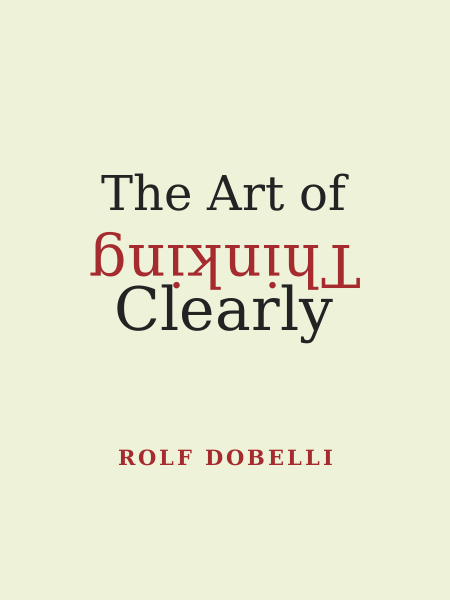
The Art of Thinking Clearly
Rolf Dobelli · 2013
Editorial rating
- Evidence
- 5/10
- Actionability
- 7/10
- Originality
- 4/10
The thesis
We systematically make predictable thinking errors - cognitive biases - that sabotage decisions. By recognizing these 99 common biases when they occur, we can avoid them and make clearer choices in work, investing, and life. Awareness, not intelligence, is the antidote to systematic irrationality.
Who this is for
Investors tired of emotional decisions, managers who need to recognize team biases, and anyone frustrated by repeatedly making the same mistakes despite "knowing better." Useful as quick reference guide more than deep dive.
My favorite quote
Rational decision making requires you to forget about the costs incurred to date. No matter how much you have already invested, only your assessment of the future costs and benefits counts.
Why it matters
Names the sunk cost fallacy - our tendency to throw good money after bad because we've "already invested so much."
Do this
Today, identify one project you're continuing only because of past investment (time, money, ego). Ask: "If I started from zero today, would I choose this?" If no, exit.
Start here
Recognize survivorship bias: We study successful entrepreneurs, ignoring thousands who failed using identical strategies. We see impressive swimmers' bodies and think swimming creates that physique - actually, that physique is why they became swimmers (selection factor, not result). Whenever you see success, ask: "How many tried this and failed?" If you don't know, you're probably overestimating your odds.
Critical summary
Rolf Dobelli, Swiss businessman and novelist (not psychologist), compiled 99 cognitive biases into 3-page chapters, originally written as newspaper columns in Germany, Netherlands, and Switzerland. He aggregates research from Kahneman, Taleb, Cialdini, and others into accessible vignettes - each bias gets a name, explanation, anecdote, and advice.
The book's structure: Literally a list. No central thesis, no overarching framework, no progression. Each chapter stands alone. You can start at chapter 47 or read in random order. This is both strength (easy to dip in/out) and weakness (no deeper synthesis).
99 biases covered include
- Survivorship bias: Focus on winners, miss the graveyard of losers
- Sunk cost fallacy: Continue because of past investment, ignoring future costs/benefits
- Confirmation bias: Seek evidence supporting existing beliefs, ignore disconfirming data
- Social proof: "Everyone's doing it" feels like correctness
- Swimmer's body illusion: Confuse selection factor (natural physique) with result (training)
- Hindsight bias: "I knew it all along" after the fact
- Availability bias: Overweight vivid, recent, emotional information
- Clustering illusion: See patterns in random data
- Reciprocity: Feel obligated to return favors, even unwanted ones
- Decision fatigue: Willpower erodes throughout day (shop on full stomach)
- And 89 more...
What it gets right
- Accessible: Short chapters, plain language, real-world examples make dense psychology digestible
- Practical recognition: Helps spot biases in moment they occur - "Wait, is this sunk cost fallacy?"
- Comprehensive catalog: 99 biases is more than most people know. Good reference list
- Honest about limitations: Dobelli admits he falls for these biases despite knowing them. Awareness helps but doesn't eliminate
- Cross-domain applicability: Business, investing, relationships, personal life - biases operate everywhere
What it misses or overstates
- No original research: Dobelli is not psychologist. He's synthesizer. All biases come from Kahneman, Taleb, Cialdini, Ariely, etc. with attribution (mostly)
- Plagiarism accusations: Nassim Taleb publicly accused Dobelli of plagiarizing examples from Antifragile manuscript. Changed character names but kept stories verbatim
- Just a list: "BuzzFeed post in book form" (critic's phrase). No central argument, no framework connecting biases, no deeper synthesis of why these errors happen or how they relate
- Robs biases of context: By reducing each to 3-page standalone, misses larger psychological systems they're part of. Kahneman's Thinking, Fast and Slow explains why biases exist (System 1 vs 2); Dobelli just catalogs them
- Superficial treatment: Just when you're intrigued, chapter ends and shepherds you to next bias. Frustrating
- No new insights: Anyone who's read Kahneman, Taleb, or Cialdini will recognize nearly everything. This is aggregation, not innovation
- Doesn't teach correction: Recognizing bias ≠ avoiding it. Book teaches awareness but not debiasing techniques
Evidence quality: Weak. Zero original research. Dobelli references experiments (Asch conformity, Solomon Asch line test, etc.) but these are secondhand from others' books. He's Wikipedia of cognitive biases - useful compilation but not authoritative source. For rigorous understanding, go to original researchers (Kahneman, Tversky, Thaler, Taleb).
Critical reception: Goodreads 3.98/5 (40K+ ratings). #1 bestseller in Germany for 80+ weeks. Translated to 40+ languages. Readers split: some call it "life-changing reference guide," others "pale imitation of Thinking, Fast and Slow." Common praise: accessible, practical. Common critique: superficial, no original contribution, better to read source material.
One reviewer: "I got 99 cognitive biases but a psychology degree ain't one." Another: "Great launching pad for best of what others figured out."
This works best as quick reference encyclopedia - dip in when you need reminder of specific bias. Works least as deep education - for that, read Kahneman or Taleb directly.
Key concepts
Survivorship Bias
We focus on successes (Harvard grads who thrived) and miss failures (Harvard grads who struggled, or brilliant people who never went). Distorts probability assessment. Today: before copying success strategy, ask "How many tried this and failed?"
Sunk Cost Fallacy
Past investment (time, money, ego) keeps us committed to losing propositions. Only future costs/benefits matter. This week: audit one ongoing project - would you start it today knowing what you know? If no, exit.
Confirmation Bias
We seek evidence supporting beliefs, ignore contradicting evidence. Antidote: actively seek disconfirming evidence. Tomorrow: take one strong opinion, spend 10 minutes finding best counter-argument.
Social Proof
"Everyone's doing it" = feels correct. Groups can be collectively wrong (financial bubbles, fashion trends). This month: identify one decision where you're following crowd - evaluate independently.
Swimmer's Body Illusion
Confuse selection factor (swimmers have good frames because that's who becomes swimmers) with result (swimming creates frame). Today: identify one area where you're confusing cause with selection.
Core insights
-
"Most biases served evolutionary purposes but misfire in modern contexts"
Fear of snakes made sense on savanna. Fear of public speaking (more people than snakes) is misfiring threat detection. Our brains evolved for different world.
-
"True experts recognize limits of what they know and don't know"
Beware "chauffeur knowledge" - people who memorize answers without understanding. Real expertise knows its boundaries.
-
"The more we invest, the greater sunk costs, the greater urge to continue becomes"
Dangerous when we've invested time, money, energy, love. Creates "can't quit now" trap that keeps us in losing situations.
-
"We couldn't do without stories, but they explain nothing"
Human brains crave narrative. Media tells driver's story after bridge collapse - ignores structural engineering. Story bias obscures actual causes.
-
"Pay people enough to take money off table"
(This is actually Dan Pink's insight, not Dobelli's original). Once basic needs met, extrinsic rewards often backfire. But if underpaid, motivation is impossible.
Implementation steps
Today
- Identify one decision you're facing - which biases might be distorting it? (Confirmation? Sunk cost? Social proof?)
- Catch yourself in one bias - name it aloud: "This is [bias name]"
- Ask before copying success: "How many people tried this and failed?"
This week
- Audit one ongoing commitment - are you continuing due to sunk costs or genuine future value?
- Practice seeking disconfirming evidence - pick one belief, find best counter-argument
- When making decision, ask: "Am I following crowd (social proof) or evaluating independently?"
This month
- Keep bias log - track which biases trip you up most frequently
- Before major decision, review relevant biases (investing? Read survivorship + confirmation. Hiring? Read halo effect + in-group bias)
- Teach one bias to colleague - teaching reinforces recognition
Ongoing
- Use book as reference - when stuck on decision, scan relevant chapters
- Build debiasing routines (audit for confirmation bias quarterly, check sunk costs before continuing projects)
- Accept you'll still fall for biases - awareness reduces frequency but doesn't eliminate
Suggested 30-day practice plan
An editorial application plan created by Monolithic Vault - an interpretation of the book's ideas, not part of the original book.
- Day 1
Read 5 chapters (survivorship bias, sunk cost fallacy, confirmation bias, social proof, hindsight bias) - these are most common
- Day 3
Identify one decision you're facing, map which biases might apply
- Day 7
Catch yourself in bias 3 times this week - name it aloud when you notice
- Day 10
Audit one major ongoing project - is sunk cost fallacy keeping you committed?
- Day 14
Practice seeking disconfirming evidence daily - pick belief, find counter-argument
- Day 21
Share 3 biases with friend or colleague - teaching improves retention
- Day 30
Review which biases affect you most - build specific debiasing strategies for your top 3
Free PDF summary
Take this analysis with you: a designed two-page field-notes sheet with the thesis, my favorite quote, the key concepts and core insights, and the full 30-day checklist. Print it or keep it - free, no signup.
Go deeper
If this analysis earned your attention, the full book goes further than any summary can. The original is always the primary source.