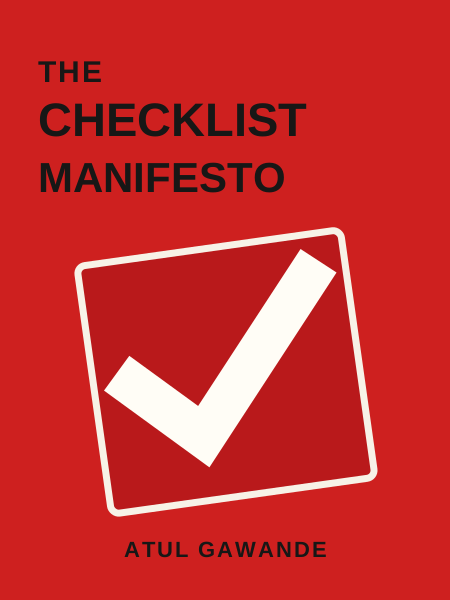
The Checklist Manifesto
Atul Gawande · 2009
Editorial rating
- Evidence
- 9/10
- Actionability
- 9/10
- Originality
- 8/10
The thesis
Modern complexity has exceeded individual human capacity. The answer isn't smarter people - it's simple checklists that ensure the routine gets done, freeing experts to focus on the non-routine. Checklists don't replace skill; they extend it.
Who this is for
Professionals in high-stakes environments (healthcare, aviation, construction), managers overseeing complex projects, and anyone whose work involves sequences where missing one step creates outsized consequences.
My favorite quote
We don't like checklists. They can be painstaking. They're not much fun. But I don't think the issue here is mere laziness. The real obstacle is pride.
Why it matters
This identifies the psychological barrier - admitting you need a checklist feels like admitting inadequacy. Overcoming that ego is the first step.
Do this
Identify one recurring error in your work, then write a three-item checklist to prevent it. Test it this week.
Start here
Create a pause point checklist for your highest-stakes process. Not a comprehensive manual - just 5-9 items covering the "killer" steps that, if missed, cause failure. Read-Do format (read step, do step) for linear tasks; Do-Confirm format (work from memory, then confirm nothing was missed) for expert work.
Critical summary
Gawande, a surgeon and public health researcher, discovered that medicine's explosion of knowledge had outpaced practitioners' ability to apply it reliably. The solution came from an unexpected source: aviation's checklist culture, which transformed flying from deadly to routine.
What it gets right
- Powerful evidence: WHO Safe Surgery Checklist reduced deaths 47% across eight hospitals worldwide
- Clear taxonomy: distinguishes simple (follow recipe), complicated (requires expertise and coordination), and complex (emergent, unpredictable) problems
- Humble framing: checklists as "cognitive net" for experts, not insult to intelligence
- Building construction model shows how multiple specialties coordinate via standardized communication
What it misses
- Underestimates resistance - implementing checklists in existing cultures is harder than the book suggests
- Designing good checklists is genuinely difficult; bad checklists create false confidence
- Some domains genuinely resist standardization; checklist fetishism can miss forest for trees
- Limited guidance on when to quit/escalate vs. when to persist with the checklist
The book's core insight - that failure in complex systems is more often inaptitude (failure to apply knowledge correctly) than ignorance (lack of knowledge) - is profound. Evidence quality is strong, particularly the WHO surgical data.
Key concepts
Inaptitude vs. Ignorance
Ignorance is not knowing. Inaptitude is knowing but failing to apply correctly. Checklists address inaptitude.
Read-Do vs. Do-Confirm
Read-Do: read each step, do it, move on. Do-Confirm: work from experience, then pause and verify. Choose format based on expertise level and task type.
Pause Points
Moments where the team stops and verifies before proceeding. Creates forcing functions for communication.
Killer Items
The 5-9 steps that, if skipped, cause catastrophic failure. Only these belong on the checklist - not everything.
Communication Forcing Functions
Checklists that require team members to introduce themselves and voice concerns before starting. Reduces hierarchy barriers.
The "Stupid" Check
The most valuable checklist items often seem obvious - but obvious things get skipped under pressure.
Core insights
-
Complexity defeats heroes
No individual can hold modern complexity in their head. Systems beat superstars.
-
Checklists free experts for judgment
By offloading routine verification, experts preserve cognitive resources for the unexpected.
-
Two minutes prevents two hours
The WHO surgical checklist takes 2 minutes and catches errors that would require hours to fix (if fixable at all).
-
Coordination failures kill
In construction, aviation, and medicine, most failures come from handoffs and communication gaps - not individual incompetence.
-
Ego is the obstacle
Professionals resist checklists because needing one feels like admitting weakness. This resistance costs lives.
Implementation steps
Today
- Identify one high-stakes recurring task in your work
- List 3-5 "killer items" that, if missed, cause significant problems
- Write a draft checklist; keep it under 9 items and 60 seconds to complete
This week
- Test your checklist in real conditions; note what's missing or unclear
- Time it - if over 90 seconds, it's too long; pare down to essentials
- Get feedback from one colleague who does the same task
This month
- Revise checklist based on testing; create a one-page, readable format
- Introduce pause point with team before a recurring high-stakes activity
- Build a second checklist for a different process
Ongoing
- Review checklists quarterly - are items still relevant? Any new failure modes?
- Resist adding items without removing others; fight scope creep
- Model checklist use publicly to normalize the practice
Suggested 30-day practice plan
An editorial application plan created by Monolithic Vault - an interpretation of the book's ideas, not part of the original book.
- Day 1
List recurring errors in your work; identify one for checklist development
- Day 2
Write first draft checklist (5-9 killer items)
- Day 3
Test checklist in real task; note friction points
- Day 7
Revise based on testing; share with one colleague for feedback
- Day 14
Implement revised checklist consistently; track whether errors decrease
- Day 21
Create second checklist for different process; begin testing
- Day 30
Review both checklists; document lessons learned; share with team
Free PDF summary
Take this analysis with you: a designed two-page field-notes sheet with the thesis, my favorite quote, the key concepts and core insights, and the full 30-day checklist. Print it or keep it - free, no signup.
Go deeper
If this analysis earned your attention, the full book goes further than any summary can. The original is always the primary source.