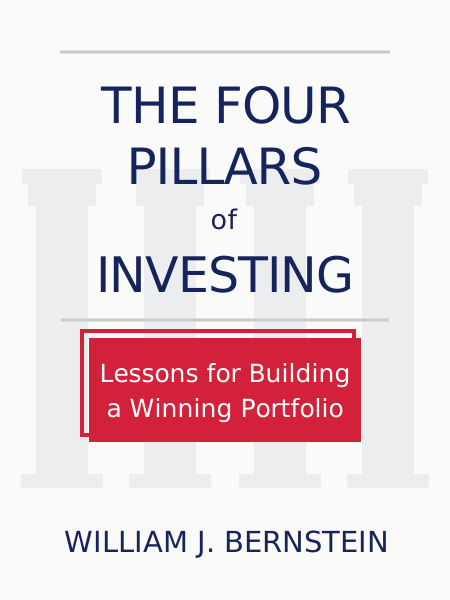
The Four Pillars of Investing
William J. Bernstein · 2002
Editorial rating
- Evidence
- 9/10
- Actionability
- 8/10
- Originality
- 7/10
The thesis
Successful investing rests on four pillars: understanding investment theory (risk and return), studying financial history (what's possible), recognizing investor psychology (how we sabotage ourselves), and knowing the investment business (who's really on your side). Master all four, and you can build wealth without Wall Street's help.
Who this is for
DIY investors who want to understand why they should index rather than just being told to, professionals seeking a rigorous foundation for personal investing, and anyone tired of financial advice that treats them like children.
My favorite quote
There is no asset-allocation fairy.
Why it matters
Many investors believe some optimal portfolio exists that will maximize returns and minimize risk. It doesn't. You must choose a reasonable allocation based on your risk tolerance, then stick with it through thick and thin.
Do this
Stop searching for the "perfect" portfolio. Pick a sensible allocation you can live with for 30 years, and rebalance annually.
Start here
The market is smarter than you - and that's good news. Because stock-picking and market timing don't work reliably, you can stop trying. Asset allocation (how much in stocks, bonds, domestic, foreign) is the only factor you control that actually matters. Index the whole market at low cost, rebalance periodically, and outperform most professionals without breaking a sweat.
Critical summary
William Bernstein, a neurologist turned investment advisor, wrote The Four Pillars as a comprehensive guide for self-directed investors. First published in 2002 and updated in 2023, it remains one of the most thorough defenses of passive, index-based investing available.
The four pillars structure the book: Theory (risk-return relationship, efficient markets), History (bubbles, crashes, what's actually happened), Psychology (behavioral biases that destroy returns), and Business (how Wall Street really makes money - from you). Each pillar reinforces the same conclusion: low-cost, diversified index funds beat active management for most investors.
What it gets right
- Rigorous but accessible - Bernstein explains the math without drowning readers in it
- Historical perspective that most investors lack - if you understand the past, you're less surprised by the present
- Scathing critique of the investment industry that's both accurate and actionable
- Practical portfolio construction advice in final chapters
What it misses
- Can be technical - some readers find it dry despite Bernstein's attempts at wit
- Strongly partisan for indexing - doesn't seriously engage with arguments for active management
- Limited discussion of when active strategies might make sense (distressed debt, small value, etc.)
- Some sections feel repetitive as each pillar reinforces the same conclusions
Evidence is strong: academic research, historical data, and logical argument all point the same direction. Bernstein isn't selling anything except the message.
Key concepts
Risk-Return Tradeoff
Higher returns require accepting higher risk. There's no free lunch - anyone promising otherwise is lying or confused.
Efficient Markets
Prices reflect available information. You can't consistently beat the market because prices already incorporate what's known.
Asset Allocation
How you divide your portfolio (stocks/bonds, domestic/foreign) matters more than which stocks you pick.
Rebalancing
Periodically returning to your target allocation forces you to buy low and sell high - systematically.
Behavioral Biases
Humans are wired to make investment mistakes - chasing winners, fleeing losers, overtrading.
Expense Ratio
The single best predictor of fund performance. Lower costs = higher returns for you.
Core insights
-
Stock-picking and market-timing don't work
Professional money managers rarely beat their benchmarks over long periods, and individual investors do worse.
-
History teaches humility
Every generation thinks their crisis is unprecedented. It isn't. Understanding financial history reduces panic.
-
Your biggest enemy is yourself
Behavioral biases - fear, greed, overconfidence - destroy more wealth than bad markets.
-
Wall Street is not your friend
The investment industry profits from activity, not from your returns. Their interests oppose yours.
-
Diversification is the only free lunch
Spreading risk across uncorrelated assets reduces volatility without sacrificing expected return.
Implementation steps
Today
- Calculate your current expense ratios across all accounts
- Determine your current asset allocation (stocks/bonds/cash percentages)
This week
- Research low-cost index funds for each asset class you want to own
- Check if your 401(k) has low-cost index options you're not using
This month
- Create a target asset allocation based on your risk tolerance and time horizon
- Consolidate to 3-5 low-cost index funds covering your target allocation
Ongoing
- Rebalance annually (or when allocations drift more than 5% from target)
- Ignore financial news; it's designed to make you trade, which hurts you
Suggested 30-day practice plan
An editorial application plan created by Monolithic Vault - an interpretation of the book's ideas, not part of the original book.
- Day 1
Calculate your current net worth and asset allocation
- Day 2
List all investment accounts and their expense ratios
- Day 3
Define your risk tolerance - how much could you watch drop 50% without selling?
- Day 7
Design your target allocation (stocks/bonds, domestic/international)
- Day 14
Research the lowest-cost index funds available for your target allocation
- Day 21
Execute trades to move toward target allocation
- Day 30
Set a calendar reminder to rebalance in one year
Free PDF summary
Take this analysis with you: a designed two-page field-notes sheet with the thesis, my favorite quote, the key concepts and core insights, and the full 30-day checklist. Print it or keep it - free, no signup.
Go deeper
If this analysis earned your attention, the full book goes further than any summary can. The original is always the primary source.