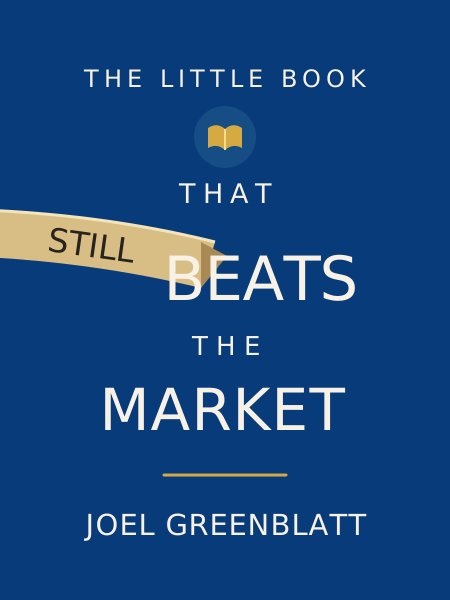

The Little Book That Still Beats the Market
Joel Greenblatt · 2010
Editorial rating
- Evidence
- 7/10
- Actionability
- 9/10
- Originality
- 8/10
The thesis
Investors can outperform by repeatedly buying profitable businesses at cheap prices, but the edge only survives for people willing to follow the rules through long stretches of ugly performance.
Who this is for
Independent investors who want a rules-based stock screen, finance professionals testing a value strategy, and stock pickers whose emotions keep overriding their stated process.
My favorite quote
Buying good businesses at bargain prices is the secret to making lots of money.
Why it matters
The sentence compresses the whole method into quality, price, and patience rather than prediction.
Do this
Screen one company today using both return on capital and earnings yield before reading its story or stock chart.
Start here
Treat the Magic Formula as a ranking system, not an oracle. Rank eligible companies by return on capital and earnings yield, combine the rankings, and study the best names as a diversified group rather than betting everything on one apparent bargain.
Critical summary
Joel Greenblatt updated his 2005 investing primer after the financial crisis, extending the original data through 2009 and defending a deliberately simple idea: buy good businesses at bargain prices. The Magic Formula converts those words into two rankings. Earnings yield, calculated with operating earnings relative to enterprise value, measures cheapness. Return on capital, based on operating earnings relative to the tangible capital required by the business, measures quality. Investors exclude financials and utilities, rank the remaining companies on both measures, gradually buy roughly 20 to 30 of the highest combined rankings, hold each position for about a year, and repeat. The mechanics matter, but Greenblatt argues that the real advantage is behavioral. The portfolio will contain unfashionable companies and can trail the market for years, which drives impatient investors away and preserves the opportunity.
What it gets right
- Turns value investing into a repeatable process that limits storytelling, forecasting, and impulsive stock selection
- Combines price and business quality instead of treating every statistically cheap company as equally attractive
- Warns clearly that temporary underperformance is not a bug but the psychological cost of following the strategy
What it overstates or misses
- Presents historical backtests with more confidence than their sensitivity to dates, accounting choices, and portfolio construction deserves
- Treats two accounting ratios as adequate proxies for quality and value, despite leverage, cyclicality, acquisitions, and intangible assets
- Uses exclusions and tax timing designed around United States markets, leaving international investors to rebuild important parts themselves
The evidence is stronger than a collection of investing anecdotes because Greenblatt supplies a defined method, long historical tests, and an updated crisis period. Independent tests have often found some value in the quality plus value combination, but usually with lower returns, higher volatility, and longer disappointing stretches than the headline claims suggest. Transaction costs, taxes, stale financial statements, survivorship issues, and factor exposure can all narrow the apparent advantage. The formula is best used as a disciplined screening engine, not as permission to stop thinking.
Key concepts
Earnings Yield
Divide operating earnings by enterprise value to estimate how much operating profit the business produces relative to its total purchase price.
Return on Capital
Compare operating earnings with the tangible capital required to run the business, then favor companies that produce more with less.
Combined Ranking
Rank every eligible company on cheapness and quality, add the two positions, and investigate the lowest combined totals first.
Portfolio Approach
Hold a basket of roughly 20 to 30 ranked companies because the method predicts group outcomes, not the fate of one stock.
Behavioral Edge
Expect multi-year underperformance and decide in advance whether you can follow the process without abandoning it at the worst moment.
Core insights
-
Cheap Is Not Enough
Low prices often reflect bad economics, so pair valuation with evidence that the business can earn strong returns on its operating capital.
-
Quality Is Price Sensitive
A wonderful company can still be a poor investment when the purchase price already assumes years of exceptional execution.
-
Rules Reduce Narrative Risk
Ranking companies before reading management stories prevents an attractive explanation from excusing an unattractive valuation.
-
Diversification Makes the Formula Workable
Some selections will fail badly, so the edge depends on owning the ranked group rather than identifying a single champion.
-
Underperformance Protects the Edge
A strategy that looked superior every quarter would attract unlimited capital and disappear, so discomfort is part of the mechanism.
Implementation steps
Today
- Write the two screening questions at the top of an investing note: Is the business good, and is the stock cheap?
- Calculate a rough earnings yield and return on capital for one company using its latest annual report.
This week
- Build a spreadsheet that ranks at least 30 eligible companies on both measures and combines the results.
- Review two top-ranked companies each day for debt, cyclicality, accounting distortions, and obvious business deterioration.
This month
- Create a paper portfolio of 20 ranked companies and record the exact entry rules, exclusions, and rebalancing date.
- Compare the screen with a broad index and a pure value screen to see what the quality measure changes.
Ongoing
- Rebalance on a fixed annual schedule rather than reacting to headlines, forecasts, or short-term price moves.
- Audit every holding for data errors and structural business changes before replacing it with the next ranked candidate.
Suggested 30-day practice plan
An editorial application plan created by Monolithic Vault - an interpretation of the book's ideas, not part of the original book.
- Day 1
Define your investable universe, minimum company size, sector exclusions, and data source.
- Day 3
Calculate earnings yield and return on capital for five companies by hand.
- Day 7
Finish the first combined ranking and inspect the ten highest-ranked companies for obvious distortions.
- Day 14
Build a diversified 20-stock paper portfolio with equal position sizes and written sell rules.
- Day 21
Stress-test the process against cyclical earnings, high debt, acquisitions, and businesses dominated by intangible assets.
- Day 30
Decide whether to adopt the screen, modify it, or use it only as an idea generator, then document the reason.
Free PDF summary
Take this analysis with you: a designed two-page field-notes sheet with the thesis, my favorite quote, the key concepts and core insights, and the full 30-day checklist. Print it or keep it - free, no signup.
Go deeper
If this analysis earned your attention, the full book goes further than any summary can. The original is always the primary source.