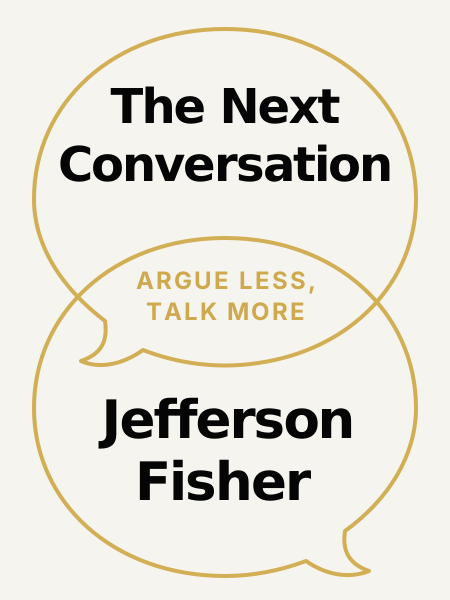
The Next Conversation
David Fischer · 2020
Editorial rating
- Evidence
- 6/10
- Actionability
- 9/10
- Originality
- 5/10
The thesis
Your organization's talent problems exist because you're not having the right conversations at the right time. By mastering four specific conversation types - Assess, Listen, Confront, Close - leaders can systematically identify and close talent gaps before they become crises instead of firing people who could have been developed.
Who this is for
Managers who struggle with direct feedback, HR professionals redesigning performance systems, and consultants who need to quickly assess client team capabilities. Essential for anyone who delays difficult conversations until they become crises.
My favorite quote
Every day you don't have the conversation is a day you're lying to your employee about their future.
Why it matters
Reframes conflict avoidance as a moral failure, not a kindness. Your discomfort is not worth their wasted time and false hope.
Do this
Identify the one performance conversation you've been avoiding longest. Schedule it within 48 hours.
Start here
Use the Can/Is/Will Assessment: For every team member, answer three distinct questions: (1) Can they do it? (capability) (2) Are they doing it? (current performance) (3) Will they do it? (future fit). Conflating these creates bad decisions - like promoting based on past performance into roles requiring different capabilities. If more than 60% of your team "exceeds expectations," your expectations are wrong.
Critical summary
Fischer's central argument is brutally simple: managers delay difficult discussions until they become crises. The predictable pattern: firing someone instead of developing them, losing top performers because no one asked what they needed, promoting the wrong person because nobody honestly assessed readiness.
The Four-Conversation Framework operates as a continuous cycle, not annual events:
Assess: Objectively evaluate capability against role requirements. Separate "Can they?" from "Are they?" from "Will they?" Most managers give inflated ratings to avoid conflict, creating a talent mirage.
Listen: Structured one-on-ones focused solely on understanding employee perspective - not status updates or coaching. Strategic intelligence gathering to identify misalignments before they become resignations.
Confront: Address performance gaps directly and immediately. Fischer argues that avoiding confrontation is cruel, not kind. Structure: state the gap, explain the impact, establish clear expectations, agree on next steps. No sandwiches.
Close: Decisions about next steps - promote, develop in place, move laterally, or exit. Should be logical conclusions to the previous three conversations, not surprises.
What it gets right
- The sequence matters - you can't confront without assessing, can't close without listening
- Conflict avoidance is the root cause of most talent problems, not lack of process
- Most performance systems are designed to avoid lawsuits, not develop people
What it misses
- Framework isn't revolutionary - it's systematic honesty repackaged
- Light on organizational politics, HR constraints, union environments
- Assumes psychological safety to be this direct; ignores toxic cultures
- The "Close" conversation needs deeper exploration of mechanics
Evidence is case studies from consulting work rather than academic research - practical pattern-recognition, not scientifically validated.
Key concepts
Talent Gap
The measurable distance between current capability and role requirements. Stop saying "performance issues" - identify the specific skill or behavior gap.
Assess Conversation
Structured evaluation using Can/Is/Will against role standards. Complete before every project kickoff.
Listen Conversation
One-on-one focused solely on understanding employee perspective. Ask: "What's working, what's not, what do you want in 12 months?" Then shut up.
Confront Conversation
Direct discussion of performance gap with zero ambiguity. State gap → explain impact → set expectation → agree next steps.
Conversation Debt
Accumulated organizational cost of avoided discussions. Every month delayed = hours managing around the problem + team morale hit.
Talent Mirage
False sense of bench strength from inflated assessments. If >70% "meets or exceeds expectations," you have grade inflation.
Core insights
-
Delayed feedback is dishonesty
Every month you wait to address a performance gap is a month you steal from that person's development or job search.
-
Most "listening" is waiting to talk
If your one-on-ones follow the same agenda every time, you're processing status updates and calling it management.
-
If more than 60% "exceeds expectations," your expectations are wrong
Grade inflation masks real gaps and makes actual high performers invisible.
-
The best time for confrontation is when you notice the gap
Waiting for the "right time" or "more evidence" is code for avoiding discomfort.
-
If someone is surprised by termination, you failed
Shock at a negative outcome means management failure at the previous three conversations.
Implementation steps
Today
- Create Talent Gap Heat Map: List each person and role requirements. Rate Can/Is/Will on 1-3 scale. Red flag anyone with a 1.
- Audit your feedback pattern: Review last 10 performance discussions. Count specific behavioral feedback vs. vague praise/criticism.
This week
- Schedule 30-minute Listen conversations with each direct report. Single question: "What's working, what's not, what do you want in the next 12 months?"
- Identify your most avoided Confrontation conversation. Schedule it within 48 hours.
This month
- Redesign performance review template to force Can/Is/Will clarity. Add mandatory section: "Specific gaps between current performance and role requirements."
- Build Confrontation Script Library: Document 5 common performance gaps with opening statements using formula: "[Specific behavior] is impacting [specific outcome]. Here's what needs to change."
Ongoing
- Implement 90-day Assess-Listen-Confront cycles each quarter
- Block recurring monthly "listen only" slots with each team member - make them sacred
Suggested 30-day practice plan
An editorial application plan created by Monolithic Vault - an interpretation of the book's ideas, not part of the original book.
- Day 1
Complete talent gap heat map for entire team (3 hours)
- Day 2
Schedule listen conversations with all direct reports for this week
- Day 3
Conduct first listen conversation; take notes; identify one surprise
- Day 7
Identify most overdue confrontation; schedule within 48 hours using structure: state gap → explain impact → set expectation
- Day 14
Install recurring monthly listen slots on calendar for next 6 months
- Day 21
Create confrontation script library for 5 most common performance gaps
- Day 30
Schedule close conversations for anyone where 90+ days of data shows clear pattern; document Q2 cycle plan
Free PDF summary
Take this analysis with you: a designed two-page field-notes sheet with the thesis, my favorite quote, the key concepts and core insights, and the full 30-day checklist. Print it or keep it - free, no signup.
Go deeper
If this analysis earned your attention, the full book goes further than any summary can. The original is always the primary source.