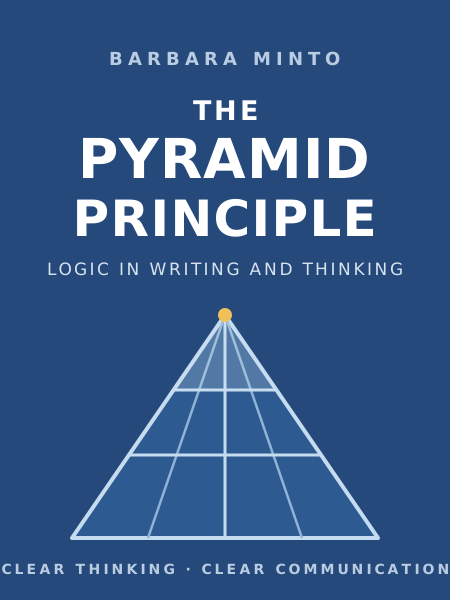
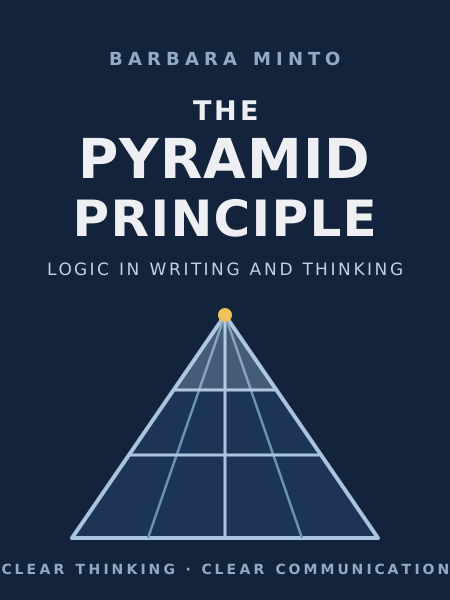
The Pyramid Principle
Barbara Minto · 1987
Editorial rating
- Evidence
- 5/10
- Actionability
- 10/10
- Originality
- 9/10
The thesis
Clear business communication starts with the answer and then groups supporting ideas beneath it in a logical hierarchy. Weak writing is often weak thinking that has been arranged in the order it occurred to the writer.
Who this is for
Consultants, analysts, executives, and project leads who must turn complicated evidence into concise emails, recommendations, reports, and presentations for busy decision-makers.
My favorite quote
The mind automatically sorts information into distinctive pyramidal groupings in order to comprehend it.
Why it matters
Readers understand complex material faster when related ideas arrive pre-grouped and their shared conclusion is stated first.
Do this
Rewrite the opening of your next business email so the requested decision appears in the first sentence.
Start here
State the governing answer first, then support it with a small set of logically parallel reasons. Each reason should raise a question that the next level answers. If the structure cannot survive that question-and-answer test, the thinking is not ready for the slide.
Critical summary
Barbara Minto developed the Pyramid Principle after joining McKinsey and repeatedly reorganizing reports whose individual sentences were acceptable but whose ideas arrived in the wrong order. Her central rule is simple: communicate from the top down. Begin with the main answer, recommendation, or conclusion, then place the supporting ideas below it in groups. The idea above must summarize those below, the ideas within a group must be logically alike, and they must appear in a defensible order such as time, structure, or degree. Vertical relationships work through question and answer: a statement creates a question in the reader's mind, and the level beneath answers it. Horizontal relationships use either deductive reasoning, where one statement leads to another, or inductive reasoning, where similar observations support a broader conclusion. Minto also uses Situation, Complication, Question, Answer to introduce the subject through facts the reader accepts, a change that creates tension, the resulting question, and the proposed answer. MECE grouping helps prevent overlap and omission, though Minto treats it as a discipline for thinking rather than a decorative consulting acronym.
What it gets right
- Forces writers to expose the recommendation early instead of making executives excavate it from background and analysis
- Links clear communication to logical grouping, making gaps, duplication, and unsupported conclusions easier to detect
- Provides a reusable structure for emails, reports, presentations, problem definitions, and executive summaries
What it overstates or misses
- Claims that the mind naturally processes pyramids without offering much empirical evidence for that psychological explanation
- Can encourage rigid, repetitive documents when writers force every topic into identical groups of three
- Requires considerable practice, yet the dense exposition often makes the method harder to learn than the final structure appears
The method rests mainly on Minto's consulting experience, formal logic, and decades of successful professional use rather than experimental communication research. Its value does not depend on proving that every mind literally builds pyramids; the structure works because it makes relationships between claims visible and testable. The book is difficult to read but brutally effective once its rules become habit.
Key concepts
Governing Thought
Put the document's main answer or recommendation at the top so every lower point has a clear purpose.
Vertical Logic
Ensure each statement raises a natural question that is answered by the ideas directly beneath it.
Horizontal Logic
Group supporting ideas through either a valid deductive chain or an inductive set of comparable points.
SCQA
Establish the Situation, introduce the Complication, surface the Question, and then present the Answer.
MECE
Divide a subject into categories that do not overlap and collectively cover the relevant ground.
Core insights
-
Lead With the Answer
Busy readers should learn the recommendation before they decide how deeply to inspect the supporting analysis.
-
Grouping Reveals Thinking Errors
If several bullets cannot share one accurate summary sentence, they probably do not belong together.
-
Order Must Carry Meaning
Arrange ideas by time, structure, or importance rather than by the order in which you discovered them.
-
Introductions Create the Question
Good context does not dump background; it guides the reader toward the precise question the document answers.
-
Synthesis Is More Than Summarizing
A strong top-level statement explains what the supporting facts mean together, not merely what they contain.
Implementation steps
Today
- Open a recent email and move the requested decision or conclusion into the first sentence.
- Take five existing bullets and group them under two or three summary statements that accurately describe each set.
This week
- Draft one recommendation using SCQA before writing any supporting paragraphs or building slides.
- Review one document each day and test whether every heading summarizes the material directly beneath it.
This month
- Rebuild a client presentation so every slide title states a conclusion and the slide sequence forms one coherent argument.
- Create a reusable one-page template with sections for the governing thought, key question, supporting groups, and evidence.
Ongoing
- Separate the discovery order of your analysis from the communication order used for the final audience.
- Test each group for overlap, missing categories, logical similarity, and a meaningful order before publishing it.
Suggested 30-day practice plan
An editorial application plan created by Monolithic Vault - an interpretation of the book's ideas, not part of the original book.
- Day 1
Rewrite one business message with the answer in the opening line and no unnecessary preamble.
- Day 3
Build a three-level pyramid for a current recommendation using only short idea statements.
- Day 7
Test every vertical link by asking what question the higher statement creates.
- Day 14
Convert the pyramid into a five-slide presentation with conclusion-led titles.
- Day 21
Ask a colleague to explain the recommendation after reading only the slide titles and opening paragraph.
- Day 30
Create a personal review checklist for governing thoughts, SCQA, grouping, order, and supporting evidence.
Free PDF summary
Take this analysis with you: a designed two-page field-notes sheet with the thesis, my favorite quote, the key concepts and core insights, and the full 30-day checklist. Print it or keep it - free, no signup.
Go deeper
If this analysis earned your attention, the full book goes further than any summary can. The original is always the primary source.