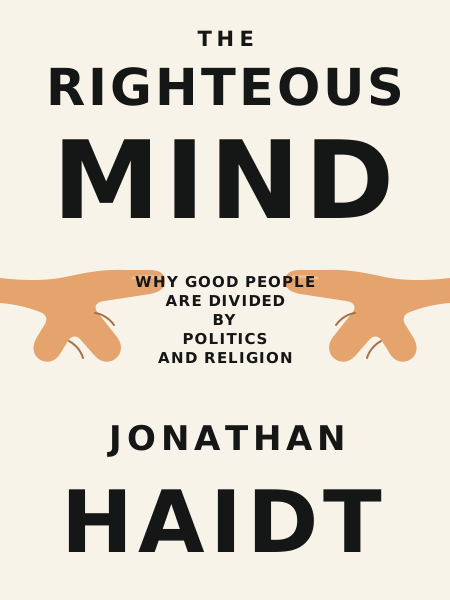
The Righteous Mind
Jonathan Haidt · 2012
Editorial rating
- Evidence
- 8/10
- Actionability
- 7/10
- Originality
- 9/10
The thesis
Moral judgment usually begins as an intuition and recruits reasoning afterward, so political persuasion fails when it attacks arguments without first understanding the values underneath them.
Who this is for
Leaders managing ideological conflict, communicators trying to reach people outside their social tribe, and readers who keep mistaking moral disagreement for stupidity or bad faith.
My favorite quote
Morality binds and blinds.
Why it matters
The same values that create trust inside a group can make competing moral worlds nearly invisible.
Do this
Before rebutting a political claim today, identify the moral concern the other person may be protecting.
Start here
Use the elephant and rider model: intuition is the elephant, while conscious reasoning is the rider that usually explains where the elephant already went. To change a mind, speak to the intuition first through respect, trust, stories, and shared values, then offer reasons the rider can accept.
Critical summary
Jonathan Haidt built this argument from decades of research in moral and cultural psychology, beginning with moral dumbfounding experiments in which people condemned harmless taboo violations but struggled to explain why. He organizes the book around three claims. First, intuitions come first and strategic reasoning follows, captured by the image of a rider serving an elephant. Second, morality is broader than harm and fairness: Moral Foundations Theory proposes care, fairness, loyalty, authority, sanctity, and liberty as recurring moral concerns. Third, morality binds people into cooperative groups while blinding them to rival moral narratives. The framework explains why factual corrections rarely settle political fights and why liberals and conservatives can hear the same proposal as morally opposite.
What it gets right
- Replaces the flattering picture of reason as an impartial judge with a more realistic account of motivated reasoning
- Shows why political language works better when translated into the listener's moral vocabulary rather than repeated more loudly
- Treats loyalty, authority, sacredness, and group belonging as genuine moral forces instead of dismissing them as irrational leftovers
What it overstates or misses
- Presents six foundations with more neatness than the disputed factor structure and cross-cultural evidence fully justify
- Risks turning broad political tendencies into stereotypes that hide differences within liberals, conservatives, nations, classes, and generations
- Moves quickly from descriptive psychology to claims about what ideological groups contribute, without always separating evidence from Haidt's pluralist preference
The evidence combines experiments, surveys, cross-cultural fieldwork, evolutionary arguments, and political data, which is unusually broad for a public psychology book. Yet several pillars rely on self-report measures, provocative vignettes, and an evolving taxonomy rather than fixed psychological modules. Later criticism has questioned whether some foundations are distinct, whether purity scenarios were unusually weird, and whether morality can instead be reduced to perceived harm or cooperation. Those disputes weaken the map without erasing the central finding that moral judgment is intuitive, social, and plural. The blunt verdict: an excellent manual for understanding moral conflict, but not a final periodic table of morality.
Key concepts
The Elephant and the Rider
Intuition moves first and reasoning usually justifies it, so establish emotional and moral alignment before presenting evidence.
Social Intuitionist Model
Moral judgments arise rapidly through intuition and are then shaped by social interaction; ask what triggered the judgment before debating its logic.
Moral Foundations
Care, fairness, loyalty, authority, sanctity, and liberty offer a vocabulary for diagnosing why the same issue feels different across groups.
Moral Dumbfounding
People can feel certain that an act is wrong while lacking a defensible reason, revealing that explanation is not always the source of judgment.
Hive Switch
Shared rituals, threats, and collective goals can temporarily reduce self-interest and produce intense group cohesion, for good or ill.
Core insights
-
Reasons Often Serve Intuitions
Winning an argument rarely changes the judgment that generated it, so begin by changing the relationship or frame.
-
Fairness Has Competing Meanings
Equality and proportionality can both feel fair; clarify which definition is operating before treating disagreement as hypocrisy.
-
Political Tribes Hear Different Moral Frequencies
A message framed only around care may miss listeners focused on loyalty, liberty, authority, or earned reward.
-
Groups Make Cooperation Possible and Dangerous
Belonging enables sacrifice and trust while making outsiders easier to caricature, so build identity without demanding blindness.
-
Understanding Is Not Agreement
Reconstructing another moral world accurately improves persuasion and judgment without requiring you to endorse its conclusions.
Implementation steps
Today
- Choose one political opinion you dislike and write the strongest moral value that could support it.
- Replace one accusation about motive with a neutral description of the value conflict involved.
This week
- Map one disputed workplace decision across care, fairness, loyalty, authority, sanctity, and liberty.
- In one disagreement each day, summarize the other person's moral concern before presenting your response.
This month
- Rewrite one important message in two versions using different moral foundations for different audiences.
- Track which conversations become less defensive when you lead with shared identity or shared concern.
Ongoing
- Treat immediate moral certainty as a signal to investigate your own elephant before judging someone else's.
- Keep diverse relationships strong enough that competing moral narratives arrive through people rather than caricatures.
Suggested 30-day practice plan
An editorial application plan created by Monolithic Vault - an interpretation of the book's ideas, not part of the original book.
- Day 1
Identify a recurring disagreement and write your automatic moral judgment without defending it.
- Day 3
Name the foundations emphasized by your position and the strongest opposing position.
- Day 7
Hold one conversation in which you ask questions until the other person says you understand their view.
- Day 14
Reframe one proposal using a moral foundation your usual language neglects.
- Day 21
Review three disagreements and separate intuition, social identity, evidence, and post hoc reasoning.
- Day 30
Create a reusable moral translation checklist for political, organizational, or family conflicts.
Free PDF summary
Take this analysis with you: a designed two-page field-notes sheet with the thesis, my favorite quote, the key concepts and core insights, and the full 30-day checklist. Print it or keep it - free, no signup.
Go deeper
If this analysis earned your attention, the full book goes further than any summary can. The original is always the primary source.