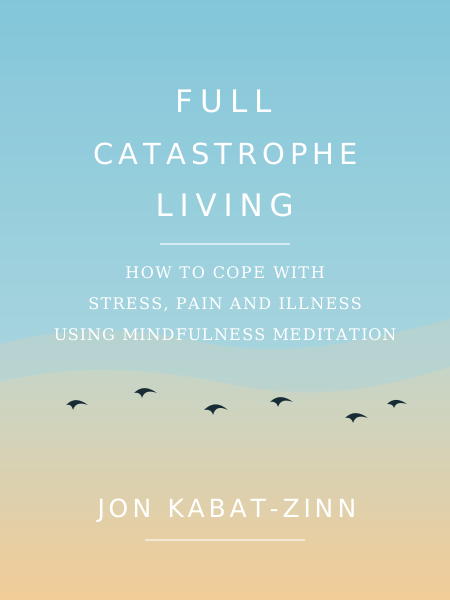
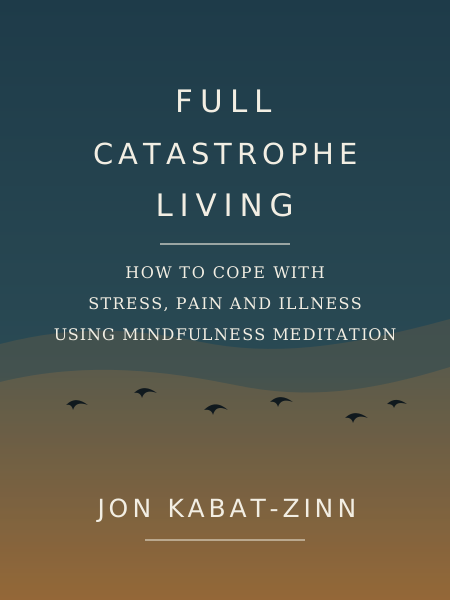
Full Catastrophe Living
Jon Kabat-Zinn · 1990
Editorial rating
- Evidence
- 8/10
- Actionability
- 9/10
- Originality
- 9/10
The thesis
You cannot eliminate stress, pain, or illness from life - but you can change your relationship to them through mindfulness. By training attention to rest in the present moment non-judgmentally, you reduce suffering even when discomfort remains.
Who this is for
People with chronic pain or illness whom medicine can't fully treat, professionals burned out from constant doing mode, and anyone whose inner critic makes everything worse than it needs to be.
My favorite quote
You can't stop the waves, but you can learn to surf.
Why it matters
This reframes the goal from controlling life to skillfully navigating it, which is actually achievable.
Do this
Right now, take three conscious breaths - notice the sensation of breathing without trying to change it. That's mindfulness.
Start here
The problem isn't stress - it's your reaction to stress. Practice 10 minutes of daily breath-focused meditation to create gap between stimulus (email, pain, conflict) and response (panic, rumination, avoidance). That gap is where choice lives.
Critical summary
Kabat-Zinn founded the Stress Reduction Clinic at UMass Medical Center in 1979, where physicians sent patients with "unsolvable" chronic conditions - pain that drugs couldn't touch, anxiety that therapy didn't fix. His 8-week Mindfulness-Based Stress Reduction (MBSR) program produced measurable improvements. This 600-page book is the written version: Buddhist meditation secularized for mainstream Americans, heavy on practice instructions, light on mysticism.
What it gets right
- The 7 attitudinal foundations (non-judging, patience, beginner's mind, trust, non-striving, acceptance, letting go) are concrete and buildable
- Detailed instructions for body scan, sitting meditation, walking meditation, yoga - you can actually do these
- The "uncoupling" concept: you can separate sensory pain from emotional suffering and cognitive interpretation. Chronic pain patients report same sensation level but dramatically less distress.
- Emphasis on formal practice: 45 minutes daily for 8 weeks. This isn't casual "be present" - it's disciplined training.
- The biopsychosocial model: health is interconnected physical-mental-social system, not just biology
What it misses
- The book is LONG and repetitive - same concepts appear in 5 different chapters
- Can feel like "just meditate your problems away," which minimizes real structural issues (poverty, discrimination, unsafe environments)
- Light on what to do when meditation surfaces trauma - some people need therapy before/alongside meditation
- The 45-minute daily practice is a huge time commitment few can sustain
- "Non-doing" is conceptually slippery and gets over-explained
Evidence quality: Strong. Multiple RCTs on MBSR show reduced pain, anxiety, and depression. The 2013 revised edition cites the "exponential" growth in mindfulness research post-1990. Herbert Benson's work on the relaxation response is foundational. The biopsychosocial model (George Engel) is mainstream medicine. That said, some benefits get overstated - mindfulness won't cure cancer, but it helps you cope with treatment.
The book launched the secular mindfulness movement. If you want clinical MBSR, this is the textbook. If you want quick intro, read "Wherever You Go, There You Are" instead (also Kabat-Zinn, much shorter).
Key concepts
Mindfulness
Awareness that arises from paying attention on purpose, in the present moment, non-judgmentally. Practice this right now by noticing three things you can hear.
The Body Scan
45-minute practice of moving attention through body parts systematically, noticing sensations without judging. Try 10-minute version tonight before sleep.
Automatic Pilot
Operating unconsciously out of habit/reactivity. Most people live entire lives this way. Mindfulness is the antidote.
Non-Striving
In meditation, not trying to achieve anything or go anywhere. This is hard for achievers. The goal is to be, not do.
Beginner's Mind
Approaching each moment as if for the first time, without preconceptions. Tomorrow, eat breakfast with beginner's mind - notice textures, temperatures, flavors.
Core insights
-
You are not your thoughts
Thoughts are events in awareness, not truth or commands. This creates space to choose responses rather than react automatically.
-
Pain ≠ suffering
Physical pain is sensation. Suffering is the resistance, catastrophizing, and emotional overlay. Mindfulness reduces suffering without changing pain.
-
The present is the only time you have
Past is memory, future is imagination. Life happens now. Missing the present means missing your life.
-
Stress comes from mismatch between demand and perceived resources
Mindfulness doesn't reduce demands but increases your sense of internal resources (patience, clarity, resilience).
-
"Being" mode complements "doing" mode
Western culture is 99% doing (achieving, fixing, improving). Being (simply being aware, without agenda) restores balance.
Implementation steps
Today
- Set a timer for 10 minutes, focus on your breath, notice when mind wanders, gently return attention to breath
- During one routine activity (shower, meal, walk), do it with full attention - notice sensations
This week
- Establish daily 10-minute sitting meditation practice at same time each day
- Practice "STOP" technique when stressed: Stop, Take a breath, Observe sensations/thoughts, Proceed mindfully
This month
- Increase to 20-30 minutes daily meditation
- Attend a local MBSR 8-week course or use Kabat-Zinn's guided audio program
- Body scan before sleep 3x/week
Ongoing
- Maintain daily practice even when (especially when) "too busy"
- Notice automatic pilot moments and consciously shift to present-moment awareness
Suggested 30-day practice plan
An editorial application plan created by Monolithic Vault - an interpretation of the book's ideas, not part of the original book.
- Day 1
Read Part I, do first 10-minute breath-focused meditation
- Day 2
Practice 10 minutes again - notice the mind's resistance to stillness
- Day 3
Add informal practice - eat one meal mindfully (no phone, no multitasking)
- Day 7
Review first week - when was practice easiest? Hardest? No judgment, just observe
- Day 14
Increase to 20 minutes daily, add walking meditation 2x/week
- Day 21
Body scan practice before bed - notice difference in sleep quality
- Day 30
Reflect on changes - pain/stress levels, reactivity, presence. Continue practice indefinitely
Free PDF summary
Take this analysis with you: a designed two-page field-notes sheet with the thesis, my favorite quote, the key concepts and core insights, and the full 30-day checklist. Print it or keep it - free, no signup.
Go deeper
If this analysis earned your attention, the full book goes further than any summary can. The original is always the primary source.