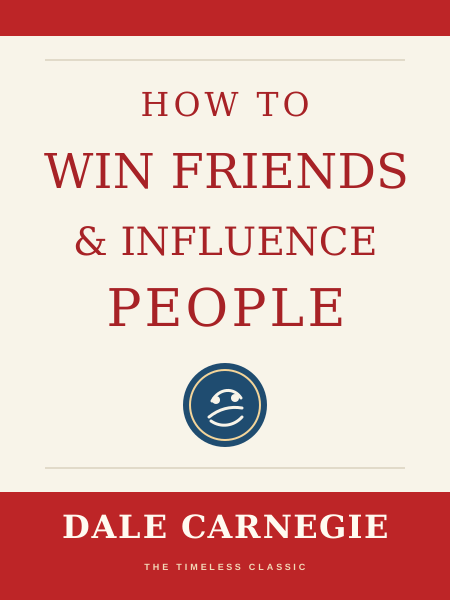
How to Win Friends and Influence People
Dale Carnegie · 1936
Editorial rating
- Evidence
- 7/10
- Actionability
- 10/10
- Originality
- 7/10
The thesis
Influence over people is not gained through criticism, argument, or coercion - but by genuinely changing your own behavior to focus on the other person's interests and fulfilling their "craving to be appreciated" and feel important.
Who this is for
Professionals at all levels seeking to improve networking and leadership skills, managers who struggle with motivating teams, and anyone who wants to replace conflict and argument with cooperation and persuasive influence.
My favorite quote
You can make more friends in two months by becoming interested in other people than you can in two years by trying to get other people interested in you.
Why it matters
This quote reframes the entire effort of influence as an outward focus (curiosity and listening) rather than an inward one (self-promotion), which is counter-intuitive but fundamentally effective.
Do this
In your next conversation, commit to asking three genuinely curious questions about the other person's interests before volunteering any information about yourself.
Start here
The single most fundamental principle is: Don't criticize, condemn, or complain. Criticism triggers defensiveness, wounds pride, and destroys goodwill. Instead of pointing out flaws, use sincere appreciation and focus on acknowledging the effort and positive qualities you see in others to create a foundation of trust.
Critical summary
Originally published in 1936, this classic text is essentially a comprehensive guide to applied social psychology, though written decades before the field was formalized. Carnegie’s central premise is that human beings are creatures of emotion, pride, and vanity, not logic. Therefore, to influence anyone, you must appeal to their deepest need: the craving to be appreciated and feel important.
The book is structured into four main sections, each containing a collection of principles (often 9-12 items long): 1) Fundamental Techniques in Handling People (e.g., Don't criticize); 2) Six Ways to Make People Like You (e.g., Be genuinely interested); 3) Twelve Ways to Win People to Your Way of Thinking (e.g., Avoid arguments); and 4) Be a Leader (e.g., Ask questions instead of giving orders).
What it gets right
- The book's strength is its radical, simple focus on empathy (seeing things from the other person's angle) and sincerity (true appreciation, not flattery).
- The principles are timeless and immediately actionable, providing specific scripts for handling conflict (e.g., talking about your own mistakes first) and delivering feedback (indirectly).
What it misses or overstates
- While the principles are powerful, they can be misread as manipulative if the core requirement of sincerity is removed. Carnegie insists the principles must be genuine.
- The anecdotal evidence, while compelling, is dated (historical figures and early 20th-century businessmen) and lacks modern scientific validation, although the concepts are supported by contemporary psychology.
Evidence quality relies primarily on historical case studies and the long-term success of the Dale Carnegie training courses.
Key concepts
Craving to be Appreciated
The deepest, most powerful driving force in human nature; it is a fundamental emotional need for recognition and validation. Satisfy this need sincerely with everyone you meet.
Genuine Interest
The key to making friends and building influence is to focus on the other person's interests, problems, and goals, not your own. Ask open-ended questions and listen 75% of the time.
"Fish prefer worms"
A metaphor used to illustrate that to influence someone, you must appeal to their eager wants and desires, not your own. You must bait the hook with what the fish wants. Frame every request in terms of how it benefits them.
Avoid Arguments
The only way to get the best of an argument is to avoid it, as even if you "win," you lose the other person's goodwill and pride. Instead, seek common ground and admit mistakes quickly and emphatically.
A Person's Name
The sweetest and most important sound in any language; using it makes the person feel recognized and important. Make a conscious effort to remember and use names frequently.
Core insights
-
Criticism is a boomerang
Criticism is futile and dangerous because it forces the other person to justify themselves and breeds deep resentment.
-
Be interested, not interesting
You build relationships far faster by being a deep, attentive listener and encouraging others to talk about themselves than by attempting to impress them with your own stories.
-
If you must find fault, talk about your own mistakes first
Before criticizing, humbly acknowledge your own imperfections or contributions to the problem; this disarms the listener and makes them more receptive.
-
Use questions, not orders
Ask questions that lead the other person to your desired conclusion, allowing them to feel the idea is theirs. This stimulates creativity and creates buy-in.
-
Praise every improvement
Encourage change by being "hearty in your approbation and lavish in your praise," focusing on the slightest progress rather than past failures.
Implementation steps
Today
- No Criticism Rule: Commit to not criticizing, condemning, or complaining about anyone - including traffic or weather - for the next 24 hours.
- The Name: Learn and use the full name of at least one new acquaintance or colleague you interact with today.
This week
- Find the Worm: Identify one person you need to influence and write down three things they want (their "worms"). Frame your next request to them around one of those wants.
- Be a Listener: In every meeting or social interaction, practice listening 75% of the time. Encourage others to talk about their achievements or interests.
This month
- Admit Mistakes: When you are wrong, practice admitting it quickly and emphatically, even in a small way ("That was my oversight, I'll fix it").
- Indirect Feedback: When you need to point out a mistake, start by talking about a similar mistake you made in the past before calling attention to theirs.
Ongoing
- Lavish Praise: Look for sincere things to appreciate in others and express that appreciation specifically and publicly (if appropriate) every day.
- Reputation: Give people a fine reputation to live up to (e.g., "I know you are the most organized person on the team, can you help us structure this?") and they will work to maintain it.
Suggested 30-day practice plan
An editorial application plan created by Monolithic Vault - an interpretation of the book's ideas, not part of the original book.
- Day 1
Commit to the "No Criticism" rule for 30 days.
- Day 2
Practice remembering and using three people's names sincerely.
- Day 3
Force yourself to smile at three strangers or hesitant colleagues.
- Day 7
Use sincere appreciation with five different people, being specific about their contribution.
- Day 14
Avoid an argument entirely by refusing to contradict the other person's opinion (Principle 1).
- Day 21
Ask questions instead of giving one direct order, letting the other person feel the idea is theirs.
- Day 30
Review your journal: count how many times you practiced honest appreciation versus criticism.
Free PDF summary
Take this analysis with you: a designed two-page field-notes sheet with the thesis, my favorite quote, the key concepts and core insights, and the full 30-day checklist. Print it or keep it - free, no signup.
Go deeper
If this analysis earned your attention, the full book goes further than any summary can. The original is always the primary source.