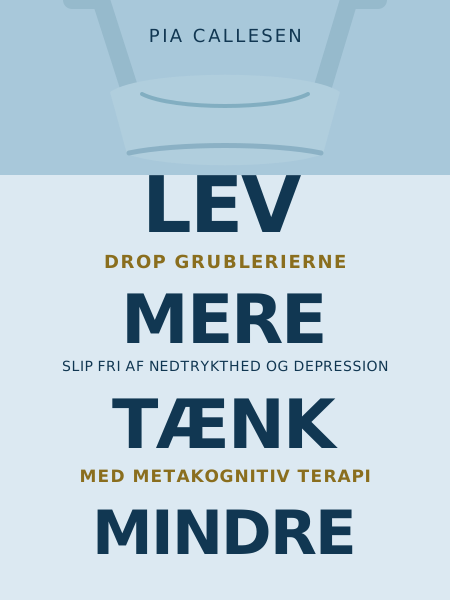

Lev mere, tænk mindre
Pia Callesen · 2017
Editorial rating
- Evidence
- 7/10
- Actionability
- 8/10
- Originality
- 7/10
The thesis
Negative thoughts are not what keep distress alive. The larger problem is the time and attention spent worrying, monitoring, and analysing them as if every thought requires an answer.
Who this is for
People who lose hours to rumination, professionals replaying conversations after work, and readers with recurring low mood who want a practical introduction to metacognitive therapy alongside appropriate professional care.
My favorite quote
Man kan ikke styre sine tanker, men man kan styre, om man giver dem opmærksomhed.
Why it matters
The distinction removes the impossible task of controlling which thoughts appear and replaces it with the trainable choice of whether to keep engaging.
Do this
Let one uncomfortable thought remain unanswered for ten minutes while you deliberately return attention to the task in front of you.
Start here
Postpone rumination instead of trying to eliminate every negative thought. When a trigger thought appears, note it without analysis and reserve a short, fixed period later in the day for deliberate worrying; many thoughts will no longer feel urgent when that period arrives.
Critical summary
Pia Callesen trained in metacognitive therapy under its founder, Adrian Wells, and used Lev mere, tænk mindre to translate the clinical model into a short Danish self-help book. Her central distinction is between involuntary trigger thoughts and the voluntary mental routines that follow them. A thought such as "What if I fail?" may appear automatically, but hours of rumination, threat monitoring, memory checking, and emotional analysis are maintained by beliefs that thinking is useful, necessary, or impossible to stop. Metacognitive therapy calls this pattern the cognitive attentional syndrome. Rather than debating whether each negative thought is true, Callesen asks readers to change how much attention they give it. The main tools are detached mindfulness, shifting attention outward, postponing rumination to a scheduled period, and testing beliefs such as "I have no control over my worrying." Her conveyor-belt image captures the method: thoughts can pass through awareness without being picked up, inspected, and carried around all day. The practical appeal is substantial because the reader does not need to replace every dark thought with a positive one or excavate a complete explanation for every feeling.
What it gets right
- Separates the arrival of a thought from the decision to continue processing it
- Offers concrete experiments that can weaken the belief that rumination is uncontrollable
- Reduces the exhausting habit of treating self-analysis as the only path out of emotional pain
What it overstates or misses
- The language can imply that people should be able to think their way out of serious depression without enough clinical support
- Gives limited space to trauma, social conditions, biology, medication, and practical problems that cannot be solved by attention control alone
- Presents a promising therapy with more certainty than the still-developing independent evidence base warrants
A 2020 randomized trial involving 174 adults found higher self-reported recovery after metacognitive therapy than after cognitive behavioural therapy, but not a significant difference on the clinician-rated depression scale. The study used only two therapists, one treated most participants, and the therapy's originator was part of the research team, so independent replication matters. The verdict: a sharp and useful method for rumination, weakened only when its confidence outruns the evidence.
Key concepts
Trigger Thoughts
Automatic thoughts can appear without permission; practice noticing one without treating its arrival as a command to analyse it.
Cognitive Attentional Syndrome
Rumination, worry, threat monitoring, and unhelpful coping strategies combine to prolong distress after the original trigger has passed.
Metacognitive Beliefs
Beliefs about thinking, such as "worry keeps me safe" or "I cannot stop," determine whether a thought receives minutes or hours of attention.
Detached Mindfulness
Observe a thought as a temporary mental event without suppressing, disputing, solving, or obeying it.
Rumination Postponement
Move repetitive thinking to a fixed daily window so urgency is tested rather than automatically trusted.
Core insights
-
Attention Is More Controllable Than Thought Arrival
Mental events appear automatically, but you can train where attention goes next.
-
Analysis Can Become the Maintenance Problem
Thinking harder about sadness may feel responsible while repeatedly reactivating the same emotional material.
-
Useful Worry Should Produce an Action
If ten minutes of thought creates no decision, information, or next step, more of the same is unlikely to help.
-
Control Beliefs Change Through Experiments
Postponing worry for twenty minutes teaches more than merely telling yourself that worrying is controllable.
-
A Thought Does Not Need a Verdict
Some thoughts lose force only after you stop deciding whether they are true, dangerous, or meaningful.
Implementation steps
Today
- Choose one recurring thought and label it "a trigger thought" instead of continuing its story.
- Set a fifteen-minute rumination period for later and postpone deliberate analysis until then.
This week
- Practice five minutes of attention shifting each day by moving focus between sounds, sights, and physical sensations around you.
- Record each time you postpone rumination and whether the thought still feels worth analysing at the scheduled time.
This month
- Identify your strongest positive and negative beliefs about worrying, then design a small behavioural test for each one.
- Replace one habitual coping strategy, such as reassurance seeking or repeated checking, with detached observation and a concrete external action.
Ongoing
- Treat recurring thoughts as signals to redirect attention rather than invitations to begin another internal investigation.
- Seek qualified mental health support when low mood is severe, persistent, worsening, or accompanied by thoughts of self-harm.
Suggested 30-day practice plan
An editorial application plan created by Monolithic Vault - an interpretation of the book's ideas, not part of the original book.
- Day 1
Track trigger thoughts and estimate how many minutes you spend processing each one.
- Day 3
Introduce one fixed daily rumination period and postpone worry outside that window.
- Day 7
Review which thoughts disappeared, weakened, or produced no useful action after being postponed.
- Day 14
Test the belief that worrying is uncontrollable by deliberately starting and stopping a five-minute worry exercise.
- Day 21
Reduce one checking, reassurance, avoidance, or monitoring habit that keeps attention fixed on threat.
- Day 30
Write a personal response plan for future trigger thoughts using postponement, detached mindfulness, and outward attention.
Free PDF summary
Take this analysis with you: a designed two-page field-notes sheet with the thesis, my favorite quote, the key concepts and core insights, and the full 30-day checklist. Print it or keep it - free, no signup.
Go deeper
If this analysis earned your attention, the full book goes further than any summary can. The original is always the primary source.