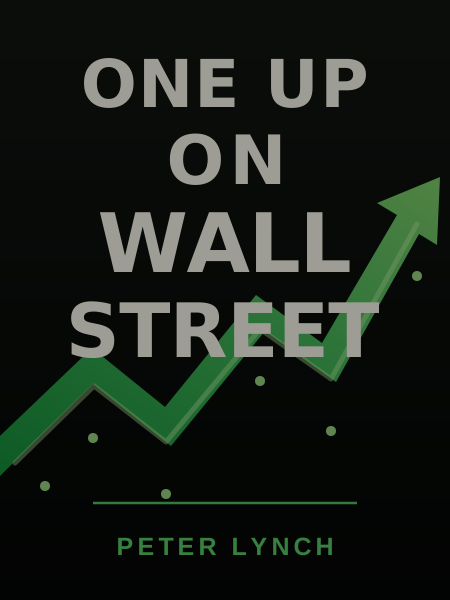
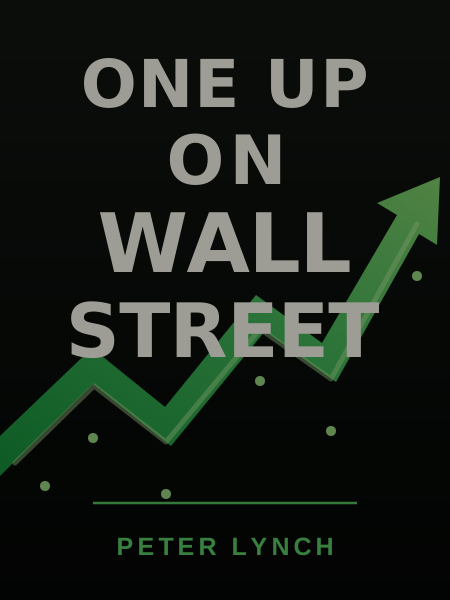
One Up On Wall Street
Peter Lynch · 1989
Editorial rating
- Evidence
- 7/10
- Actionability
- 8/10
- Originality
- 7/10
The thesis
Individual investors have structural advantages over Wall Street professionals - you encounter great investment opportunities in your daily life before analysts discover them. By investing in what you understand and doing basic research, ordinary people can beat the experts.
Who this is for
Individual investors frustrated by conflicting expert advice, professionals who want to leverage their industry knowledge for stock picking, and anyone who believes Wall Street has an information monopoly worth breaking.
My favorite quote
Behind every stock is a company. Find out what it's doing.
Why it matters
This strips away the mystique of investing. Stocks aren't abstract numbers - they're ownership stakes in businesses you can understand and evaluate.
Do this
Pick one company whose products you use daily and spend 30 minutes researching their business model, competition, and recent earnings reports.
Start here
Invest in what you know: The edge individual investors have over professionals isn't analytical sophistication - it's proximity to actual products and services. When you notice a restaurant chain that's always packed, a product everyone at work uses, or a service your kids are obsessed with, you've spotted a potential "tenbagger" before Wall Street analysts notice.
Critical summary
Lynch managed Fidelity's Magellan Fund to 29% annual returns for 13 years, making it the best-performing mutual fund in the world. His central argument is democratizing: you don't need an MBA or Bloomberg terminal to pick winning stocks. You need curiosity about the businesses behind the products you already use.
The book's core framework categorizes stocks into six types (slow growers, stalwarts, fast growers, cyclicals, turnarounds, and asset plays), each with different characteristics and strategies. Lynch provides practical checklists for evaluating each type, including key ratios, warning signs, and optimal holding periods.
What it gets right
- Concrete, repeatable methodology for evaluating companies
- Emphasis on doing your own research rather than following tips
- Humility about what individual investors can and can't do well
What it misses
- Written in 1989 - many examples feel dated and require contextual adjustment
- "Invest in what you know" is often misinterpreted as "invest in companies you like"
- Underestimates how efficiently markets price in consumer trends today
- Requires significant time for research that passive investors may not have
Evidence comes from Lynch's own track record and specific stock picks, making it credible but potentially non-replicable. His success may reflect skill, but also occurred during a specific market era.
Key concepts
Tenbagger
A stock that appreciates tenfold from your purchase price. A few tenbaggers transform an average portfolio into an exceptional one.
The Six Stock Categories
Slow growers, stalwarts, fast growers, cyclicals, turnarounds, and asset plays - each requires different analysis and holding strategies.
P/E Ratio as Valuation Tool
Compare a company's price-to-earnings ratio to its growth rate and historical average. A P/E below the growth rate suggests undervaluation.
The Two-Minute Drill
You should be able to explain your investment thesis in two minutes or less - including why it's undervalued and what will make it grow.
Invest What You Can Afford to Lose
Never put money in stocks that you need in the next few years or that you can't stomach losing.
Dullness is an Advantage
Boring businesses (funeral homes, waste management) often make great investments because analysts ignore them.
Core insights
-
Wall Street follows - it doesn't lead
By the time analysts notice a trend, much of the appreciation has already happened. You, as a consumer, notice earlier.
-
Understand the business, not the stock
The stock price will eventually reflect business performance. Focus on what the company is actually doing.
-
Avoid "whisper stocks" and hot tips
If everyone is talking about it, the price already reflects the hype. The best opportunities are ignored or misunderstood.
-
Know why you own it
Write down your thesis when you buy. If the thesis changes, sell. If the price drops but the thesis holds, consider buying more.
-
Diversify, but not too much
Lynch held hundreds of stocks, but most of his returns came from a handful of big winners. Own enough to benefit from winners, not so many you dilute them.
Implementation steps
Today
- List 5 companies whose products or services you know intimately (as customer, employee, or supplier)
- Check each company's P/E ratio and recent earnings growth
This week
- Categorize your current holdings into Lynch's six categories
- For one company, read the most recent earnings call transcript
This month
- Build a watch list of 10 potential investments from your daily observations
- Research one watch list company thoroughly: competitive position, growth trajectory, balance sheet
Ongoing
- Keep a stock journal: note your thesis when buying and review quarterly
- Maintain a "what I'm noticing" log of products and businesses that stand out
Suggested 30-day practice plan
An editorial application plan created by Monolithic Vault - an interpretation of the book's ideas, not part of the original book.
- Day 1
List every stock you own and write a one-sentence thesis for each
- Day 2
Identify 3 companies from your daily life you find interesting
- Day 3
Look up basic financials (P/E, growth rate, debt) for those 3 companies
- Day 7
Read one annual report cover-to-cover for a company you're considering
- Day 14
Categorize your watch list by Lynch's six categories - which type is each?
- Day 21
Paper trade one position based on your research (track without buying)
- Day 30
Evaluate your paper trade - was your thesis correct? What did you learn?
Free PDF summary
Take this analysis with you: a designed two-page field-notes sheet with the thesis, my favorite quote, the key concepts and core insights, and the full 30-day checklist. Print it or keep it - free, no signup.
Go deeper
If this analysis earned your attention, the full book goes further than any summary can. The original is always the primary source.