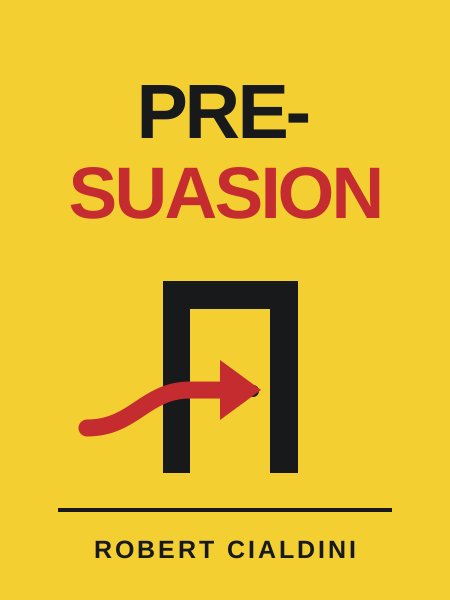
Pre-Suasion
Robert Cialdini · 2016
Editorial rating
- Evidence
- 8/10
- Actionability
- 7/10
- Originality
- 8/10
The thesis
The most influential communicators don't just craft great messages - they engineer the moment before the message to make audiences receptive. By directing attention to carefully chosen stimuli (a question, an image, an association), you prime people to say yes before they even hear your pitch.
Who this is for
Marketers struggling with conversion rates, salespeople facing skeptical prospects, negotiators needing an edge, and anyone who needs to persuade people who aren't naturally inclined to agree with them.
My favorite quote
The best persuaders become the best through pre-suasion - the process of arranging for recipients to be receptive to a message before they encounter it.
Why it matters
You don't win arguments during the argument. You win them in the seconds before, by controlling what people are thinking about.
Do this
Before your next pitch, ask the client "What makes for a successful partnership for you?" Their answer primes them to evaluate you against their own criteria - which you can then address.
Start here
Master the opening question. Cialdini's research shows that a well-timed question immediately before your request dramatically increases compliance. Want someone to help you? Don't ask "Can you help me?" Ask "Do you consider yourself a helpful person?" first. They say yes (most people do), and now they've publicly committed to that identity - making your subsequent request harder to refuse. This works because associations formed in the moment shape decisions in the next moment.
Critical summary
Robert Cialdini, author of the legendary Influence (1984), spent 30 years studying how top persuaders work. His revelation: they don't just perfect their pitch - they manipulate the pre-pitch environment. Pre-suasion is about directing attention. What you focus people on immediately before your message changes how they interpret that message.
The book is dense with social psychology research: priming effects, agenda-setting theory, the mere exposure effect, and attentional bias. Cialdini shows that associations ("flowers -> romance") activate automatically, and clever communicators exploit this. A guy asking for phone numbers in a mall doubled his success rate when approaching women near a florist vs. a shoe store. Why? Flowers unconsciously prime romantic thoughts.
What it gets right
- Attention = importance: "What we attend to, we deem important." By directing focus, you manipulate perceived significance.
- "What's focal is causal": We attribute causality to whatever we're looking at. Show a problem, then your solution, and you become the solution.
- The moment before matters more than the pitch: Cialdini proves that timing - asking the right question, showing the right image - beats improving your core message.
- Ethical discussion: Unlike typical persuasion books, Cialdini addresses when these tactics become manipulative
What it misses
- Overreliance on lab studies: Most evidence comes from controlled experiments with undergrads. Real-world persuasion involves savvy, skeptical audiences who've seen these tricks.
- Diminishing returns with sophistication: Once you know someone is priming you, the effect weakens. Cialdini doesn't adequately address inoculation.
- Cultural blindness: Pre-suasion assumes universal psychological mechanisms, but priming effects vary significantly across cultures. "Authority" cues work differently in Germany vs. Brazil.
- Dark arts potential: The book's ethical chapter is thin. These techniques are potent tools for manipulation - Cialdini waves this away too easily.
- Implementation difficulty: Knowing that "flowers prime romance" is fascinating. Knowing when to deploy flower imagery in your B2B SaaS pitch is much harder. The book is heavy on theory, light on tactical application.
Evidence quality is strong - Cialdini cites peer-reviewed studies throughout. But it's also cherry-picked: he highlights studies supporting his thesis and glosses over failed replications or contradictory findings.
Key concepts
Pre-Suasion
Capturing and channeling attention before a message to make recipients receptive. "What we present first changes the way people experience what we present next."
Attentional Priming
Directing focus to an idea (security, adventure, luxury) activates related concepts, biasing subsequent judgments. Show someone a photo of a runner before pitching your product, and they'll associate it with speed.
The Unity Principle
People say yes to those they consider "us." Establish shared identity (location, origin, interests) before your ask - it triggers in-group favoritism.
Channeled Attention
You can't persuade everyone all the time, but you can create a "privileged moment" where your target is unusually receptive. Identify when attention naturally focuses (crisis, opportunity, novelty) and strike then.
Questions as Openers
Asking someone to confirm a positive trait ("Are you adventurous?") before proposing something adventurous increases compliance by 50%+.
Core insights
-
"What's accessible in mind becomes probable in action"
If I get you thinking about "quality," you'll judge my product through that lens. If I prime "price," you'll fixate on cost. Savvy persuaders control the frame by controlling attention.
-
The press doesn't tell you what to think - it tells you what to think about
Agenda-setting theory. By giving topics coverage, media makes them seem important, biasing decisions. The same applies to any communicator.
-
Opening with a concession works
Cialdini proves that admitting a weakness first ("Our setup costs aren't the lowest...") makes audiences trust your subsequent strengths ("...but you'll recoup them quickly"). Acknowledging a flaw signals honesty.
-
Context is content
A charity asking for donations while showing images of suffering children doesn't just provide information - it emotionally primes empathy. The environment shapes the decision.
-
Timing beats content
The best message delivered at the wrong moment fails. The decent message delivered when someone's attention is focused succeeds. Persuasion is about controlling when as much as what.
Implementation steps
Today
- Identify one upcoming persuasion attempt (sales call, meeting, negotiation)
- Ask yourself: "What concept do I want them thinking about when I make my pitch?" (quality, speed, security, fairness, innovation)
This week
- Before your pitch, ask an opening question that primes the concept: "What does innovation mean to you?" or "How important is reliability in this decision?"
- Use an image, story, or analogy that activates the association you want
This month
- Experiment with "leading questions" to establish identity: "Would you say you're someone who values cutting-edge solutions?"
- Review a failed pitch - did you control attention, or did the conversation drift to unhelpful topics?
Ongoing
- Before every persuasive interaction, design the pre-suasive moment: What will you show, say, or ask in the 30 seconds before your main message?
- Study when your audience's attention naturally focuses (quarterly planning, crisis, new leadership) - those are your windows
Suggested 30-day practice plan
An editorial application plan created by Monolithic Vault - an interpretation of the book's ideas, not part of the original book.
- Day 1
Read Cialdini's chapter on attention - diagram how you currently open pitches
- Day 2
Identify three concepts you want associated with your product/idea (e.g., security, innovation, simplicity)
- Day 3
Craft opening questions for each: "How important is [concept] to you?"
- Day 7
Test one pre-suasive opener in a low-stakes pitch - did it work?
- Day 14
Add visual priming - if pitching speed, show images of motion; if pitching trust, use warm colors and testimonials
- Day 21
Analyze a competitor's pitch - what are they priming (intentionally or not)? Can you counter-prime?
- Day 30
Reflect - are you now seeing pre-suasion everywhere? Good. Use it ethically.
Free PDF summary
Take this analysis with you: a designed two-page field-notes sheet with the thesis, my favorite quote, the key concepts and core insights, and the full 30-day checklist. Print it or keep it - free, no signup.
Go deeper
If this analysis earned your attention, the full book goes further than any summary can. The original is always the primary source.