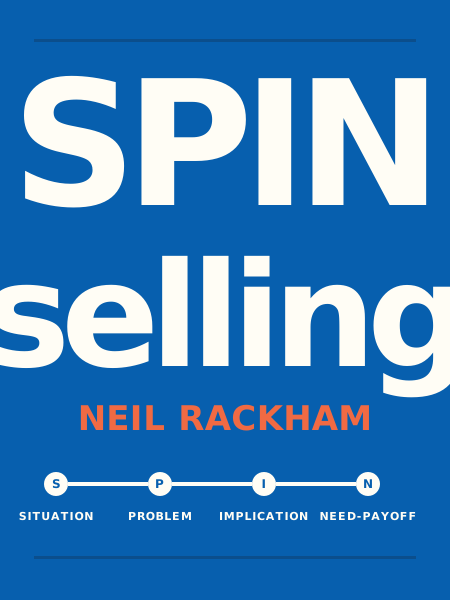
SPIN Selling
Neil Rackham · 1988
Editorial rating
- Evidence
- 8/10
- Actionability
- 9/10
- Originality
- 8/10
The thesis
Complex sales are won less by persuasive pitching than by questions that help buyers recognize a problem, understand its consequences, and articulate the value of solving it.
Who this is for
Consultants, account executives, solution sellers, and technical specialists handling expensive B2B decisions with several stakeholders, long sales cycles, and no obvious single close.
My favorite quote
Questions persuade more powerfully than any other form of verbal behavior.
Why it matters
Buyers trust conclusions they help construct more than benefits delivered as a polished sales speech.
Do this
Before your next discovery call, replace one product statement with an Implication question about the cost of the client's current problem.
Start here
Spend less time collecting background facts and more time expanding the consequences of a problem the buyer already recognizes. A strong Implication question connects an operational issue to lost time, risk, cost, or strategic delay, making the value of change larger without requiring a hard sell.
Critical summary
Neil Rackham and his Huthwaite team built SPIN Selling from a twelve-year study of more than 35,000 sales calls, focusing on why techniques that worked in small transactions often failed in larger, higher-risk purchases. The model organizes discovery into four question types. Situation questions establish facts, but successful sellers use them sparingly because buyers dislike supplying information the seller could have researched. Problem questions uncover dissatisfaction and produce implied needs. Implication questions enlarge those needs by tracing their operational, financial, or personal consequences. Need-payoff questions ask buyers to describe the usefulness of solving the problem, converting an implied need into an explicit need tied to value. Rackham places this investigation inside four broad call stages: opening, investigating, demonstrating capability, and obtaining commitment. In complex sales, the goal is usually an advance such as access to another stakeholder, agreement to a workshop, or permission to develop a proposal, not an artificial attempt to close the entire deal.
What it gets right
- Separates complex B2B decisions from small transactional sales where pressure, scripts, and repeated closing attempts can work differently
- Shows why implication and Need-payoff questions create stronger value than a feature-heavy explanation delivered before the buyer feels urgency
- Defines progress through observable advances rather than pleasant meetings, vague interest, or a promise to stay in touch
What it overstates or misses
- The research was conducted and commercialized by Huthwaite, while the underlying dataset and coding choices are not available for independent inspection
- Modern buyers often complete substantial research before meeting a seller, reducing the value of basic Situation questions and raising expectations for informed insight
- A rigid SPIN sequence can feel manipulative when the seller uses questions to steer toward a predetermined solution rather than investigate honestly
The evidence is unusually substantial for a sales book because it rests on observed behavior across thousands of calls rather than anecdotes alone. Still, it is observational, proprietary, and rooted in the selling environment of the 1970s and 1980s, so exact causal claims deserve caution. The core pattern survives because it turns discovery from polite fact gathering into collaborative economic reasoning. This is the best practical framework for improving a complex sales conversation, provided the questions serve the buyer rather than trap them.
Key concepts
Situation Questions
Confirm only the facts necessary to understand the account, and research everything else before the call.
Problem Questions
Surface difficulties, dissatisfaction, and friction that reveal an implied need worth investigating further.
Implication Questions
Explore how a problem affects cost, risk, productivity, customers, or strategic goals until its significance becomes clear.
Need-Payoff Questions
Ask the buyer to explain how solving the problem would help, allowing value to be stated in the buyer's own language.
Advance
Define a successful call by a concrete next action that moves the sale forward, not by friendliness or general interest.
Core insights
-
Large Sales Magnify Risk
Buyers become more cautious as price, visibility, implementation effort, and the personal cost of a wrong decision increase.
-
Implied Needs Are Not Enough
A complaint creates interest, but an explicit need linked to consequences creates a reason to act.
-
Questions Build Value Before Solutions
The buyer must understand the size of the problem before the price of the solution can look reasonable.
-
Benefits Must Match Explicit Needs
A capability becomes persuasive only when it directly answers a need the buyer has already acknowledged.
-
Progress Requires Commitment
End each meeting with a specific advance owned by named people and attached to a date.
Implementation steps
Today
- Write four questions for one live opportunity: one Situation, one Problem, one Implication, and one Need-payoff question.
- Replace the phrase "Would it make sense to follow up?" with one specific advance you can request at the end of the meeting.
This week
- Review two recent discovery calls and classify every major question by SPIN type to identify where the conversation became shallow.
- Practice one Implication question daily that connects a technical issue to cost, delay, risk, or stakeholder impact.
This month
- Build a discovery guide for your most common client problem with researched facts, likely problems, consequence paths, and value questions.
- Track each sales meeting as an advance, continuation, or no-sale outcome and compare the pattern with your current pipeline stages.
Ongoing
- Research the account before meetings so Situation questions do not waste the buyer's time or expose weak preparation.
- Treat the SPIN sequence as a thinking aid rather than a script, adapting the order when the buyer has already defined the problem clearly.
Suggested 30-day practice plan
An editorial application plan created by Monolithic Vault - an interpretation of the book's ideas, not part of the original book.
- Day 1
Select one active opportunity and draft a four-part SPIN question plan for the next conversation.
- Day 3
Conduct the conversation and record which questions produced new information, urgency, or buyer-owned value.
- Day 7
Review the call and rewrite weak Situation or Problem questions as stronger Implication questions.
- Day 14
Use Need-payoff questions with a second stakeholder and compare how each person defines value differently.
- Day 21
Audit five opportunities for explicit needs, economic consequences, decision criteria, and a concrete next advance.
- Day 30
Create a reusable discovery template and a coaching checklist based on the patterns that improved your real calls.
Free PDF summary
Take this analysis with you: a designed two-page field-notes sheet with the thesis, my favorite quote, the key concepts and core insights, and the full 30-day checklist. Print it or keep it - free, no signup.
Go deeper
If this analysis earned your attention, the full book goes further than any summary can. The original is always the primary source.