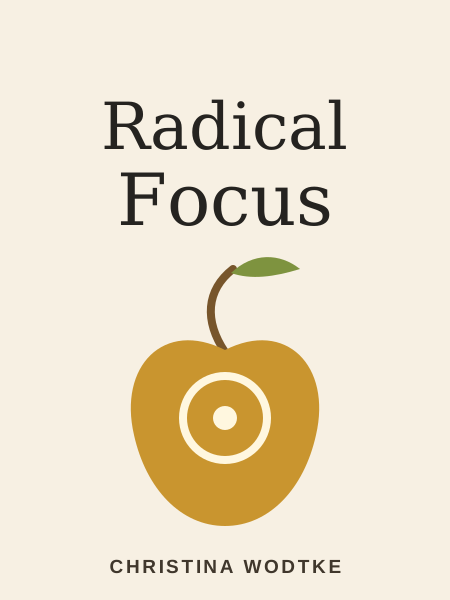
Radical Focus
Christina Wodtke · 2016
Editorial rating
- Evidence
- 6/10
- Actionability
- 9/10
- Originality
- 6/10
The thesis
Most teams fail to achieve goals not because they set wrong goals, but because they don't stay focused on them. Objectives and Key Results (OKRs) succeed when combined with a weekly rhythm of commitment and celebration - without consistent check-ins, even perfect goals become forgotten wallpaper.
Who this is for
Startup founders drowning in "shiny object syndrome," product managers struggling to align distributed teams, and anyone who's set ambitious quarterly goals only to rediscover them unchanged on the last day of the quarter.
My favorite quote
OKRs aren't about hitting targets, but about learning what you are really capable of.
Why it matters
The goal isn't perfection - it's calibration. You should hit about 70% of your key results. If you hit 100%, you weren't ambitious enough.
Do this
Set one 90-day goal with a 50% chance of success. If you're certain you'll hit it, it's not stretching you.
Start here
Set one company Objective with three Key Results. That's it. Not five objectives. Not ten key results. One and three. The Objective is qualitative and inspiring ("Become the market leader in specialty tea"). Key Results are quantitative and measurable ("$500K revenue, 25% repeat customers, 4.5 app store rating"). Meet every Monday to commit to weekly priorities and every Friday to celebrate wins.
Critical summary
Christina Wodtke, drawing from experience at LinkedIn, Zynga, and Yahoo, presents OKRs through a business fable about struggling tea startup founders. The fictional format makes dry goal-setting methodology surprisingly engaging, though some readers find the story simplistic.
The book's real value isn't the OKR explanation (well-covered elsewhere) but the emphasis on rhythm and focus. Wodtke argues that most OKR implementations fail not from poor goal-setting but from lack of weekly attention. The Monday Commitment meetings and Friday Celebrations are where OKRs actually work.
What it gets right
- The fable format makes concepts memorable and emotionally resonant
- Emphasis on single objectives fights the "everything is a priority" trap
- The weekly cadence (commit Monday, celebrate Friday) is practical and specific
- Differentiates OKRs from "health metrics" - what you're pushing vs. what you're maintaining
- Acknowledges that first OKR attempts usually fail; sets realistic expectations
What it misses
- Some readers find the fable too elementary; "could be a blog post" is common criticism
- Less detailed than Doerr's "Measure What Matters" on OKR mechanics
- The four-quadrant tracking system is introduced but not fully explained
- Primarily focused on startups; scaling OKRs to large organizations gets limited attention
- Grammar and editing issues in early editions distracted some readers
This is a practical, no-nonsense introduction to OKRs that prioritizes application over theory. It's shorter and more actionable than alternatives, though less comprehensive.
Key concepts
Objectives
Qualitative, inspirational goals that answer "Where are we going?" Should excite the team. Set one per quarter.
Key Results
Quantitative measures that answer "How will we know we're there?" Aim for 50% confidence of achievement - stretch goals, not easy wins.
The Monday Commitment Meeting
Weekly meeting to check OKR progress, adjust confidence levels, and commit to three priorities that move the needle.
Friday Celebrations
End-of-week recognition of wins, however small. Counteracts Monday's intensity with celebration.
Health Metrics
Things you need to maintain (customer satisfaction, uptime) that aren't OKRs. Not everything belongs in your Objective.
Confidence Levels
Rate your confidence (1-10) of hitting each Key Result weekly. Watch the trend - dropping confidence requires intervention.
Core insights
-
One objective is enough
Multiple objectives mean no priorities. Set one company OKR, then cascade to team OKRs that feed it.
-
Weekly rhythm beats quarterly planning
OKRs without weekly attention decay into ignored wallpaper. The meetings are the system.
-
50% confidence is the target
If you're certain you'll hit a Key Result, it's not ambitious enough. OKRs should feel uncomfortable.
-
Failing is learning
You should hit about 70% of Key Results. 100% means sandbagging; below 50% means miscalibration.
-
Health metrics aren't OKRs
Not everything needs to improve. Some things just need to not break. Separate maintenance from growth.
Implementation steps
Today
- Write down every current "priority" you're tracking - count them
- Identify the single most important outcome for next quarter
- Draft one Objective statement that inspires (no numbers)
This week
- Gather your team to collaboratively set three Key Results for your Objective
- Assign a 1-10 confidence level to each Key Result
- Schedule recurring Monday Commitment and Friday Celebration meetings
This month
- Run four weekly cycles of the OKR rhythm
- Track confidence level changes - investigate drops
- Resist adding new objectives mid-quarter (capture ideas for next quarter)
Ongoing
- At quarter end, grade OKRs and reflect on calibration
- Set next quarter's OKR based on learning (not arbitrary targets)
- Expand to team OKRs only after company OKR rhythm is solid
Suggested 30-day practice plan
An editorial application plan created by Monolithic Vault - an interpretation of the book's ideas, not part of the original book.
- Day 1
Brain-dump every current "priority" - identify the one that matters most
- Day 2
Draft three versions of an inspiring Objective statement
- Day 3
With your team, define three measurable Key Results
- Day 7
Hold first Monday Commitment meeting - commit to three weekly priorities
- Day 14
Assess confidence levels; celebrate any wins Friday
- Day 21
Review whether weekly priorities are moving Key Results
- Day 30
Grade progress, adjust approach, and decide if you'll continue OKRs next quarter
Free PDF summary
Take this analysis with you: a designed two-page field-notes sheet with the thesis, my favorite quote, the key concepts and core insights, and the full 30-day checklist. Print it or keep it - free, no signup.
Go deeper
If this analysis earned your attention, the full book goes further than any summary can. The original is always the primary source.