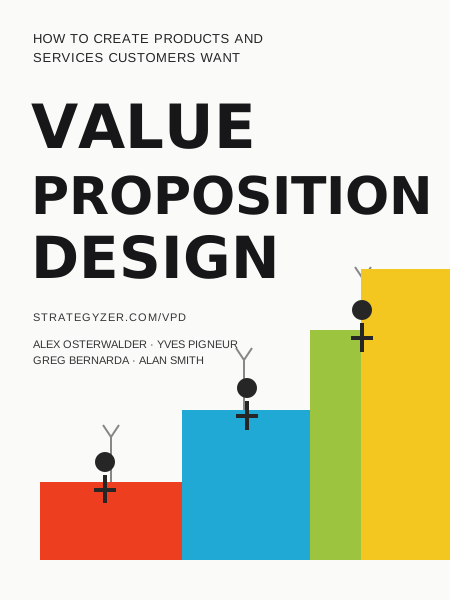
Value Proposition Design
Alexander Osterwalder, Yves Pigneur, Gregory Bernarda & Alan Smith · 2014
Editorial rating
- Evidence
- 6/10
- Actionability
- 9/10
- Originality
- 7/10
The thesis
Great products aren't designed by guessing what customers want - they're designed by systematically mapping customer jobs, pains, and gains, then creating products and services that address them. The Value Proposition Canvas provides a visual tool to achieve "fit" between what you offer and what customers actually need.
Who this is for
Product managers struggling to articulate why customers should care. Entrepreneurs validating business ideas before building. Innovation teams designing new offerings. Consultants who need a structured approach to guide clients through value creation. Anyone who's launched something customers didn't want.
My favorite quote
The customer is the judge, jury, and executioner of your value proposition.
Why it matters
This demolishes the common delusion that a great product will sell itself - customer perception is the only reality that matters.
Do this
Before your next product decision, interview three customers about their jobs, pains, and gains. Let their words guide you.
Start here
Map the Customer Profile before designing anything. Identify: (1) Customer Jobs - what are they trying to accomplish? (2) Pains - what frustrates them, what risks do they fear? (3) Gains - what outcomes do they desire, what would delight them? Only after deeply understanding these three elements should you design your Value Map (Pain Relievers, Gain Creators, Products & Services). Fit happens when your Value Map directly addresses the Customer Profile.
Critical summary
This is the sequel to Business Model Generation, zooming in on the most critical part of any business model: the connection between customer segments and value propositions. Osterwalder and team provide the Value Proposition Canvas (VPC) - a visual tool that splits into Customer Profile and Value Map.
The framework draws heavily from Clayton Christensen's Jobs-to-Be-Done theory, organizing customer understanding around functional jobs (tasks), social jobs (how they want to be perceived), and emotional jobs (how they want to feel). The Value Map then shows how your offering creates value through pain relievers and gain creators.
What it gets right
- Visual, hands-on approach makes abstract concepts concrete
- Customer Profile forces outside-in thinking before solution design
- Clear distinction between pains, gains, and jobs adds precision
- Testing guidance helps validate assumptions before expensive builds
- Integrates well with Lean Startup methodology
What it misses
- Book is beautifully designed but less substantive than Business Model Generation
- Reading it straight through is repetitive - works better as a reference
- Jobs-to-Be-Done concept is borrowed, not original
- Enterprise/B2B applications less developed than consumer examples
- Assumes you can access customers for research - sometimes you can't
- Online companion tools have changed, making some references dated
Evidence is primarily case studies and the authors' consulting experience. The underlying Jobs-to-Be-Done framework has stronger research backing from Christensen's work.
Key concepts
Customer Profile
Visual map of customer jobs, pains, and gains. Create one for each customer segment you serve.
Value Map
Your response - products/services, pain relievers, gain creators. Design this after the Customer Profile.
Jobs-to-Be-Done
Functional tasks, social impressions, and emotional states customers want to achieve. Look beyond product features.
Pain Relievers
How your offering eliminates or reduces things that annoy customers. List yours explicitly.
Gain Creators
How your offering creates positive outcomes customers desire. Be specific about which gains.
Fit
Achieved when Value Map addresses the most important jobs, pains, and gains. Validate fit through customer testing.
Core insights
-
Customers don't want your product - they want progress
People "hire" products to make progress in their lives. Understand the progress they seek.
-
Pains and gains are not opposites
Removing a pain is different from creating a gain. Address both deliberately.
-
Not all jobs, pains, and gains matter equally
Rank by importance and focus your value proposition on what matters most. Don't spread thin.
-
Fit is a hypothesis until tested
A beautiful canvas means nothing if customers disagree. Design experiments to validate assumptions.
-
Value propositions compete against non-consumption
Often your biggest competitor is "do nothing" or improvised workarounds.
Implementation steps
Today
- Select one customer segment to analyze
- List 10 jobs they're trying to accomplish (mix functional, social, emotional)
- Identify 10 pains related to those jobs
- Identify 10 gains they desire
This week
- Rank jobs, pains, and gains by importance to customer (not to you)
- Map your current offering against top jobs, pains, gains - where are the gaps?
- Interview 3 customers to validate your assumptions
This month
- Design or refine value proposition targeting top-ranked jobs, pains, gains
- Create testable hypotheses about fit
- Run experiments (landing pages, prototypes, concierge tests) to validate
Ongoing
- Update Customer Profiles quarterly - needs evolve
- Test new value proposition ideas before building
- Maintain library of Customer Profiles for each segment
Suggested 30-day practice plan
An editorial application plan created by Monolithic Vault - an interpretation of the book's ideas, not part of the original book.
- Day 1
Download Value Proposition Canvas template, read chapters 1-2
- Day 2
Create Customer Profile for your primary segment
- Day 3
Rank jobs, pains, and gains by customer importance
- Day 7
Interview 3 customers to validate and refine profile
- Day 14
Map current offering as Value Map, identify fit gaps
- Day 21
Design improved value proposition addressing top gaps
- Day 30
Create test plan to validate new value proposition with customers
Free PDF summary
Take this analysis with you: a designed two-page field-notes sheet with the thesis, my favorite quote, the key concepts and core insights, and the full 30-day checklist. Print it or keep it - free, no signup.
Go deeper
If this analysis earned your attention, the full book goes further than any summary can. The original is always the primary source.