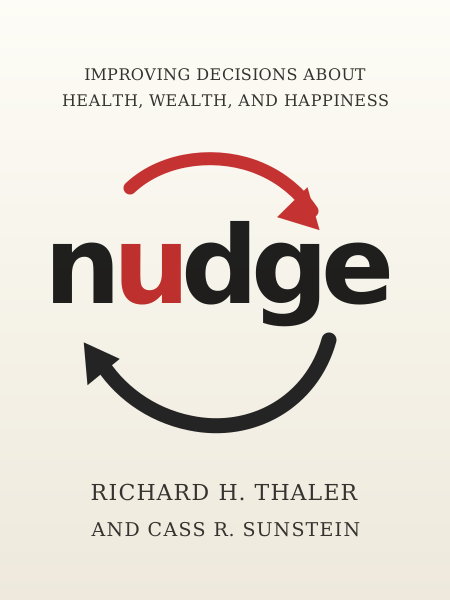
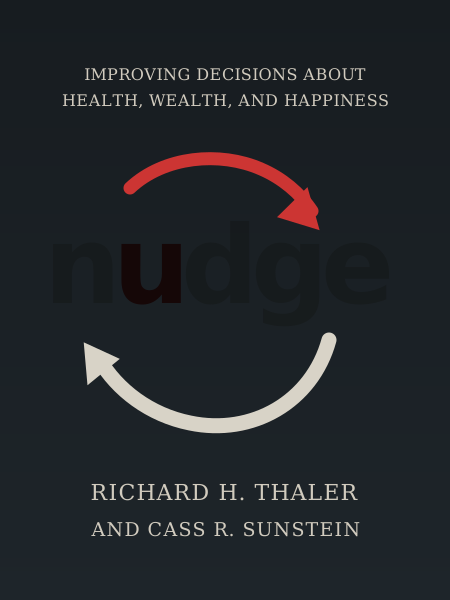
Nudge
Richard Thaler & Cass Sunstein · 2008
Editorial rating
- Evidence
- 9/10
- Actionability
- 8/10
- Originality
- 9/10
The thesis
People aren't the rational decision-makers economists assumed. We're predictably irrational - using mental shortcuts that lead to systematic errors. But these same biases can be leveraged: by carefully designing "choice architecture," we can nudge people toward better decisions without restricting their freedom.
Who this is for
Policy makers designing public programs, product managers structuring user choices, managers building team systems, and anyone who designs environments where others make decisions - from cafeteria layouts to signup flows to benefits enrollment.
My favorite quote
A nudge is any aspect of the choice architecture that alters people's behavior in a predictable way without forbidding any options or significantly changing their economic incentives.
Why it matters
This defines the key constraint: nudges preserve freedom. Putting fruit at eye level is a nudge; banning junk food is not.
Do this
Identify one choice you design for others. What's the current default? Does it serve their interests or just inertia?
Start here
Defaults are incredibly powerful. Whatever option is pre-selected becomes what most people choose - often permanently. Automatic enrollment in 401(k) plans increased participation from ~50% to 90%+ with no change in options. When you design any choice, ask: "What's the default, and whose interests does it serve?"
Critical summary
Thaler (Nobel Prize 2017) and Sunstein (Obama's regulatory czar) synthesize behavioral economics into a policy framework they call "libertarian paternalism" - guiding choices while preserving freedom. The book popularized concepts from Kahneman's work and applied them to practical domains: retirement savings, organ donation, healthcare, environmental policy.
The core insight: humans use two cognitive systems. The "Automatic System" (fast, intuitive, effortless) handles most decisions but makes predictable errors. The "Reflective System" (slow, deliberate, effortful) catches errors but is lazy. Choice architects can work with the Automatic System rather than fighting it.
What it gets right
- Default effects are real and massive - auto-enrollment transformed retirement savings
- Providing feedback (like energy bills comparing you to neighbors) changes behavior
- Making information salient and simple dramatically improves decision quality
- "Sludge" (friction that prevents good choices) is the opposite of good nudges
What it misses or overstates
- The term "libertarian paternalism" is philosophically contested - critics argue nudges can be manipulative
- Some nudges work in labs but fail at scale (replication crisis affects some cited studies)
- A 2022 meta-analysis found weak average effect sizes after adjusting for publication bias
- The book assumes benevolent choice architects; corporations use the same techniques exploitatively
- Limited discussion of when nudging becomes manipulation
- Some examples feel dated (mortgage crisis references, pre-smartphone contexts)
- UK House of Lords review found "precious little" evidence of real-world impact in some domains
The intellectual contribution is huge, but practitioners should be appropriately skeptical of claims about effect sizes.
Key concepts
Choice Architecture
The context in which people make decisions. You're always designing it - the question is whether you're designing it intentionally.
Defaults
The pre-selected option. Make the desired behavior the default; require active choice to opt out.
Libertarian Paternalism
Guiding choices toward welfare-improving options while maintaining freedom. The "nudge" philosophy.
NUDGES Framework
iNcentives, Understand mappings, Defaults, Give feedback, Expect error, Structure complex choices. Use as a design checklist.
Sludge
Friction that prevents people from doing what they want (cancellation hoops, confusing forms). The evil twin of nudges.
Availability Heuristic
We overweight recent, vivid, or easily recalled examples. Plane crashes feel more dangerous than car crashes.
Core insights
-
Status quo bias is universal
People stick with defaults even when switching is easy and beneficial. Design defaults for the majority's benefit.
-
Humans are bad at predicting their future selves
We underestimate how much we'll want retirement savings, health insurance, organ donation. Help people commit now.
-
Complexity is the enemy of good choices
When options overwhelm, people choose nothing or choose poorly. Simplify or structure choices.
-
Feedback loops are essential
People can't improve decisions without knowing results. Make outcomes visible, timely, and comparable.
-
Opt-out beats opt-in
For socially beneficial defaults (organ donation, retirement saving), automatic enrollment with easy opt-out dramatically increases participation.
Implementation steps
Today
- Audit one decision you design for others: what's the default? Does it serve their interests?
- Identify one sludge in your organization (a process that's unnecessarily difficult)
This week
- Redesign one form or process to have better defaults
- Add one feedback mechanism to help people see results of their choices
- Simplify one complex choice by grouping options or adding "recommended" labels
This month
- Map the "choice architecture" of a key process (onboarding, enrollment, purchasing)
- Identify where the current design exploits biases vs. serves users
- Pilot one nudge and measure the behavioral change
Ongoing
- Before launching any choice environment, apply NUDGES checklist
- Test defaults rigorously - they're the highest-leverage intervention
- Watch for sludge: friction that serves organizational convenience, not users
Suggested 30-day practice plan
An editorial application plan created by Monolithic Vault - an interpretation of the book's ideas, not part of the original book.
- Day 1
List 5 choices you design for others (signup flows, meeting invites, team processes)
- Day 2
For each, identify the current default and whether it serves users or inertia
- Day 3
Read Chapter 5 (Choice Architecture) and apply framework to one choice
- Day 7
Redesign one default; implement and track results
- Day 14
Audit for sludge - identify 3 processes with unnecessary friction
- Day 21
Add feedback to one choice (show people outcomes, comparisons, progress)
- Day 30
Review all changes; document what worked, what didn't, why
Free PDF summary
Take this analysis with you: a designed two-page field-notes sheet with the thesis, my favorite quote, the key concepts and core insights, and the full 30-day checklist. Print it or keep it - free, no signup.
Go deeper
If this analysis earned your attention, the full book goes further than any summary can. The original is always the primary source.